Saudi Press

Saudi Arabia and the world
Thursday, Jan 08, 2026

Europe agrees new law to curb Big Tech dominance

Europe agrees new law to curb Big Tech dominance

Under the rules major firms like Apple and Google would have to open up their systems to rivals.

Under the Digital Markets Act (DMA), giants such as Google and Apple will be forced to open up their services and platforms to other businesses.

Major technology firms have long faced criticism that they use their market dominance to squeeze out competition.

"What we want is simple: fair markets...in digital," said EU antitrust chief Margrethe Vestager.

"Large gatekeeper platforms have prevented businesses and consumers from the benefit of competitive digital markets," she said.

The announcement is the biggest regulatory move yet from the EU to act against what it defines as "anti-trust" or anti-competitive behaviour from mainly US technology businesses.

"The agreement ushers in a new era of tech regulation worldwide," said German MEP Andreas Schwab, who led the negotiations for the European Parliament.

Under the proposed Digital Markets Act, Apple would be forced to open up its App Store to third-party payment options instead of users being forced to use Apple's own payment system.

It is something Apple has been fighting in the US during a high-profile court battle with Epic Games, the maker of Fortnite.

Google will be asked to offer people who use smartphones which run on the company's Android operating system alternatives to its search engine, the Google Maps app or its Chrome browser.

Apple would also be forced to loosen its grip on the iPhone, with users allowed to uninstall its Safari web browser and other company-imposed apps that users cannot currently delete.

The targets of the law include WhatsApp, Facebook Messenger, iMessage, the App Store, Google Play and many other services belonging to large tech firms.

The EU wants to give users more choice over how people send messages. The new rules would require that technology make their messaging services interoperable with smaller competitors.

However, Apple said it was "concerned that some provisions of the DMA will create unnecessary privacy and security vulnerabilities for our users".

Meanwhile, Google said: "While we support many of the DMA's ambitions around consumer choice and interoperability, we're worried that some of these rules could reduce innovation and the choice available to Europeans."
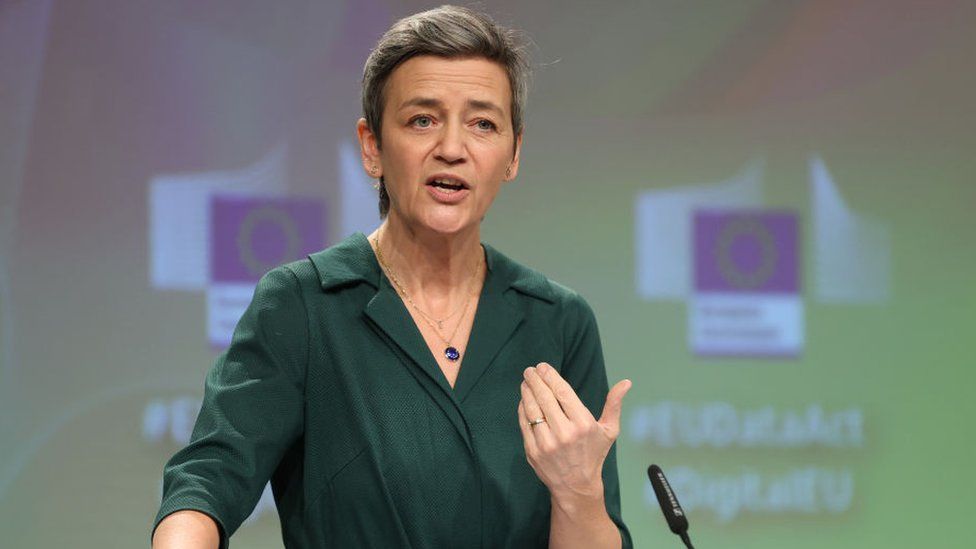
EU antitrust chief Margrethe Vestager said technology's "gatekeepers" must take responsibility


The law will only affect companies with a value of more than €75bn (£63bn), annual sales of €7.5bn and at least 45 million monthly users.

Legislation was originally proposed by Ms Vestager just over a year ago in reaction to what she felt was monopolistic behaviour from Big Tech. She was known to be frustrated by how mainly large, US tech companies had managed to delay and even thwart EU attempts to fine them.

"The gatekeepers - they now have to take responsibility," Ms Vestager said on Thursday.

Once implemented, the law will give Brussels unprecedented authority in regulating major tech companies.

Many major US tech companies have huge lobbying operations in Washington, and have been emphasising that such laws punish successful American companies.

However many US politicians are also keen to clip the wings of Big Tech, with bills currently going through Congress that would also rein in their power.

With the deal reached by negotiators, the DMA now faces final votes in the European Parliament as well as by ministers from the EU's 27 member states.

Newsletter

Related Articles

Saudi Press
0:00
0:00
Close
Mohammed bin Salman’s Global Standing: Strategic Partner in Transition Amid Debate Over His Role
Saudi Arabia Opens Property Market to Foreign Buyers in Landmark Reform
The U.S. State Department’s account in Persian: “President Trump is a man of action. If you didn’t know it until now, now you do—do not play games with President Trump.”
CNN’s Ranking of Israel’s Women’s Rights Sparks Debate After Misleading Global Index Comparison
Saudi Arabia’s Shifting Regional Alignment Raises Strategic Concerns in Jerusalem
OPEC+ Holds Oil Output Steady Amid Member Tensions and Market Oversupply
Iranian Protests Intensify as Another Revolutionary Guard Member Is Killed and Khamenei Blames the West
President Trump Says United States Will Administer Venezuela Until a Secure Leadership Transition
Delta Force Identified as Unit Behind U.S. Operation That Captured Venezuela’s President
Trump Announces U.S. Large-Scale Strike on Venezuela, Declares President Maduro and Wife Captured
Saudi-UAE Rift Adds Complexity to Middle East Diplomacy as Trump Signals Firm Leadership
OPEC+ to Keep Oil Output Policy Unchanged Despite Saudi-UAE Tensions Over Yemen
Saudi Arabia and UAE at Odds in Yemen Conflict as Southern Offensive Deepens Gulf Rift
Abu Dhabi ‘Capital of Capital’: How Abu Dhabi Rose as a Sovereign Wealth Power
Diamonds Are Powering a New Quantum Revolution
Trump Threatens Strikes Against Iran if Nuclear Programme Is Restarted
Why Saudi Arabia May Recalibrate Its US Spending Commitments Amid Rising China–America Rivalry
Riyadh Air’s First Boeing 787-9 Dreamliner Completes Initial Test Flight, Advancing Saudi Carrier’s Launch
Saudi Arabia’s 2025: A Pivotal Year of Global Engagement and Domestic Transformation
Saudi Arabia to Introduce Sugar-Content Based Tax on Sweetened Drinks from January 2026
Saudi Hotels Prepare for New Hospitality Roles as Alcohol Curbs Ease
Global Airports Forum Highlights Saudi Arabia’s Emergence as a Leading Aviation Powerhouse
Saudi Arabia Weighs Strategic Choice on Iran Amid Regional Turbulence
Not Only F-35s: Saudi Arabia to Gain Access to the World’s Most Sensitive Technology
Saudi Arabia Condemns Sydney Bondi Beach Shooting and Expresses Solidarity with Australia
Washington Watches Beijing–Riyadh Rapprochement as Strategic Balance Shifts
Saudi Arabia Urges Stronger Partnerships and Efficient Aid Delivery at OCHA Donor Support Meeting in Geneva
Saudi Arabia’s Vision 2030 Drives Measurable Lift in Global Reputation and Influence
Alcohol Policies Vary Widely Across Muslim-Majority Countries, With Many Permitting Consumption Under Specific Rules
Saudi Arabia Clarifies No Formal Ban on Photography at Holy Mosques for Hajj 2026
Libya and Saudi Arabia Sign Strategic MoU to Boost Telecommunications Cooperation
Elon Musk’s xAI Announces Landmark 500-Megawatt AI Data Center in Saudi Arabia
Israel Moves to Safeguard Regional Stability as F-35 Sales Debate Intensifies
Cardi B to Make Historic Saudi Arabia Debut at Soundstorm 2025 Festival
U.S. Democratic Lawmakers Raise National Security and Influence Concerns Over Paramount’s Hostile Bid for Warner Bros. Discovery
Hackers Are Hiding Malware in Open-Source Tools and IDE Extensions
Traveling to USA? Homeland Security moving toward requiring foreign travelers to share social media history
Wall Street Analysts Clash With Riyadh Over Saudi Arabia’s Deficit Outlook
Trump and Saudi Crown Prince Cement $1 Trillion-Plus Deals in High-Profile White House Summit
Saudi Arabia Opens Alcohol Sales to Wealthy Non-Muslim Residents Under New Access Rules
U.S.–Saudi Rethink Deepens — Washington Moves Ahead Without Linking Riyadh to Israel Normalisation
Saudi Arabia and Israel Deprioritise Diplomacy: Normalisation No Longer a Middle-East Priority
Saudi Arabia Positions Itself as the Backbone of the Global AI Era
As Trump Deepens Ties with Saudi Arabia, Push for Israel Normalization Takes a Back Seat
Thai Food Village Debuts at Saudi Feast Food Festival 2025 Under Thai Commerce Minister Suphajee’s Lead
Saudi Arabia Sharpens Its Strategic Vision as Economic Transformation Enters New Phase
Saudi Arabia Projects $44 Billion Budget Shortfall in 2026 as Economy Rebalances
OPEC+ Unveils New Capacity-Based System to Anchor Future Oil Output Levels
Will Saudi Arabia End Up Bankrolling Israel’s Post-Ceasefire Order in Lebanon?
Saudi Arabia’s SAMAI Initiative Surpasses One-Million-Citizen Milestone in National AI Upskilling Drive
×