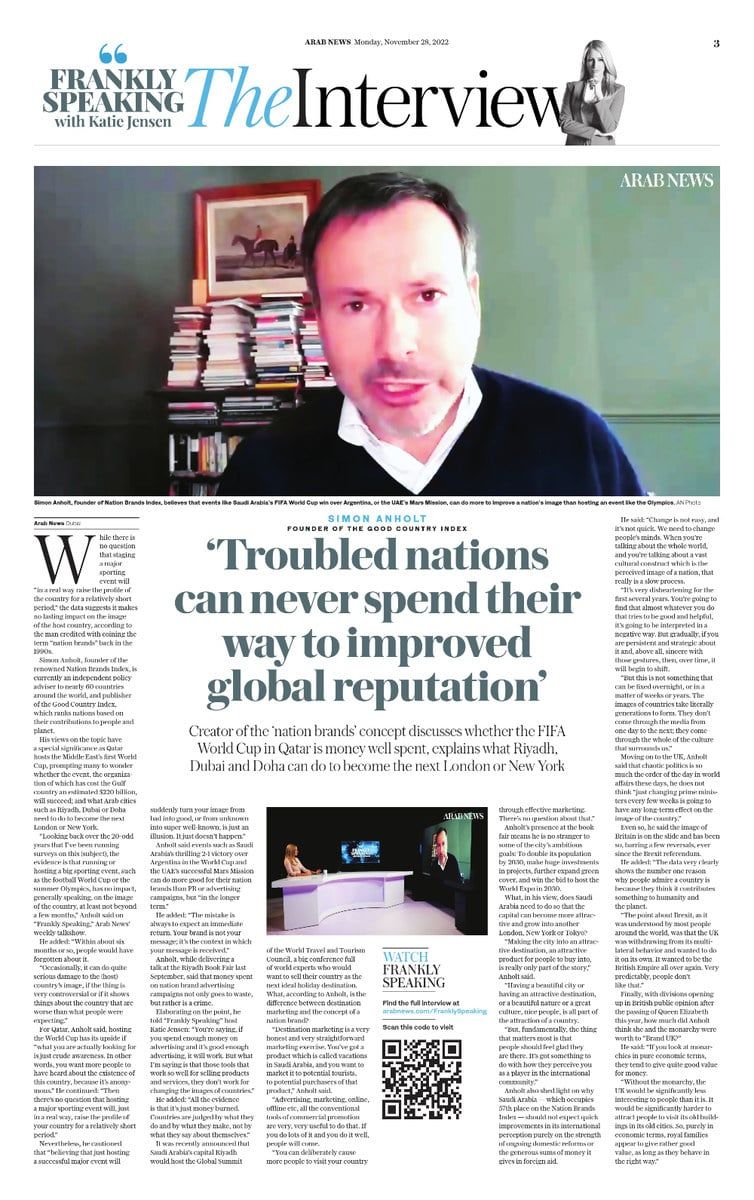
‘Troubled nations can never spend their way to improved global reputation,’ says Good Country Index creator Simon Anholt
Simon Anholt, founder of the renowned Nation Brands Index, is currently an independent policy adviser to nearly 60 countries around the world, and publisher of the Good Country Index, which ranks nations based on their contributions to people and planet.
His views on the topic have a special significance as Qatar hosts the Middle East’s first World Cup, prompting many to wonder whether the event, the organization of which has cost the Gulf country an estimated $220 billion, will succeed; and what Arab cities such as Riyadh, Dubai or Doha need to do to become the next London or New York.
“Looking back over the 20-odd years that I’ve been running surveys on this (subject), the evidence is that running or hosting a big sporting event, such as the football World Cup or the summer Olympics, has no impact, generally speaking, on the image of the country, at least not beyond a few months,” Anholt said on “Frankly Speaking,” Arab News’ weekly talkshow.
He added: “Within about six months or so, people would have forgotten about it.
“Occasionally, it can do quite serious damage to the (host) country’s image, if the thing is very controversial or if it shows things about the country that are worse than what people were expecting.”
For Qatar, Anholt said, hosting the World Cup has its upside if “what you are actually looking for is just crude awareness. In other words, you want more people to have heard about the existence of this country, because it’s anonymous.”
He continued: “Then there’s no question that hosting a major sporting event will, just in a real way, raise the profile of your country for a relatively short period.
“And, if you know exactly what you’re going to do to follow on from that immediately afterward, and keep the momentum going and keep the profile high, then that could work as part of a slightly more sophisticated strategy.”
Nevertheless, he cautioned that “believing that just hosting a successful major event will suddenly turn your image from bad into good, or from unknown into super well-known, is just an illusion. It just doesn’t happen.”
Anholt acknowledged that “there can be other valuable effects of hosting a major event” and that “these things are not necessarily a waste of time and money.”
He added: “Particularly the smaller ones can be very useful tactical instruments for countries to engage with the international community.”
In sum, he said: “It’s not a simple, straightforward relationship between hosting an event and the image of the country: It can do you harm. The most common effect is no effect at all.”
Anholt said events such as Saudi Arabia’s thrilling 2-1 victory over Argentina in the World Cup and the UAE’s successful Mars Mission can do more good for their nation brands than PR or advertising campaigns, but “in the longer term.”
He added: “The mistake is always to expect an immediate return. Your brand is not your message; it’s the context in which your message is received.”
 Saudi Arabia’s thrilling 2-1 victory over Argentina in the World Cup can
do more good for the Kingdom’s brand than PR or advertising campaigns,
said Simon Anholt.
Saudi Arabia’s thrilling 2-1 victory over Argentina in the World Cup can
do more good for the Kingdom’s brand than PR or advertising campaigns,
said Simon Anholt.Elaborating on the point, he told “Frankly Speaking” host Katie Jensen: “You’re saying, if you spend enough money on advertising and it’s good enough advertising, it will work. But what I’m saying is that those tools that work so well for selling products and services, they don’t work for changing the images of countries.”
He added: “All the evidence is that it’s just money burned. Countries are judged by what they do and by what they make, not by what they say about themselves.”
It was recently announced that Saudi Arabia’s capital Riyadh would host the Global Summit of the World Travel and Tourism Council, a big conference full of world experts who would want to sell their country as the next ideal holiday destination. What, according to Anholt, is the difference between destination marketing and the concept of a nation brand?
He said that the two concepts are separable. “Destination marketing is a very honest and very straightforward marketing exercise. You’ve got a product which is called vacations in Saudi Arabia, and you want to market it to potential tourists, to potential purchasers of that product,” Anholt said.
“Advertising, marketing, online, offline etc, all the conventional tools of commercial promotion are very, very useful to do that. If you do lots of it and you do it well, people will come.
“You can deliberately cause more people to visit your country through effective marketing. There’s no question about that.”
Anholt’s presence at the book fair means he is no stranger to some of Riyadh’s ambitious goals: To double its population by 2030, make huge investments in projects aimed at creating jobs for both locals and expatriates, further expand green cover, and win the bid to host the World Expo in 2030.
What, in his view, does Saudi Arabia need to do so that the capital can become more attractive and grow into another London, New York or Tokyo?
“Making the city into an attractive destination, an attractive product for people to buy into, is really only part of the story,” Anholt said.
“Having a beautiful city or having an attractive destination, or a beautiful nature or a great culture, nice people, is all part of the attraction of a country.
“But, fundamentally, the thing that matters most is that people should feel glad they are there. It’s got something to do with how they perceive you as a player in the international community.”

Anholt also shed light on why Saudi Arabia — which occupies 57th place on the Nation Brands Index — should not expect quick improvements in its international perception purely on the strength of ongoing domestic reforms or the generous sums of money it gives in foreign aid.
He said: “Change is not easy, and it’s not quick. We need to change people’s minds. When you’re talking about the whole world, and you’re talking about a vast cultural construct which is the perceived image of a nation, that really is a slow process.
“It’s very disheartening for the first several years. You’re going to find that almost whatever you do that tries to be good and helpful, it’s going to be interpreted in a negative way. But gradually, if you are persistent and strategic about it and, above all, sincere with those gestures, then, over time, it will begin to shift.
”But this is not something that can be fixed overnight, or in a matter of weeks or years. The images of countries take literally generations to form. They don’t come through the media from one day to the next; they come through the whole of the culture that surrounds us.”
Anholt joked that the Nation Brands Index is “one of the most boring social surveys ever conducted,” simply because the rankings change so little from year to year.
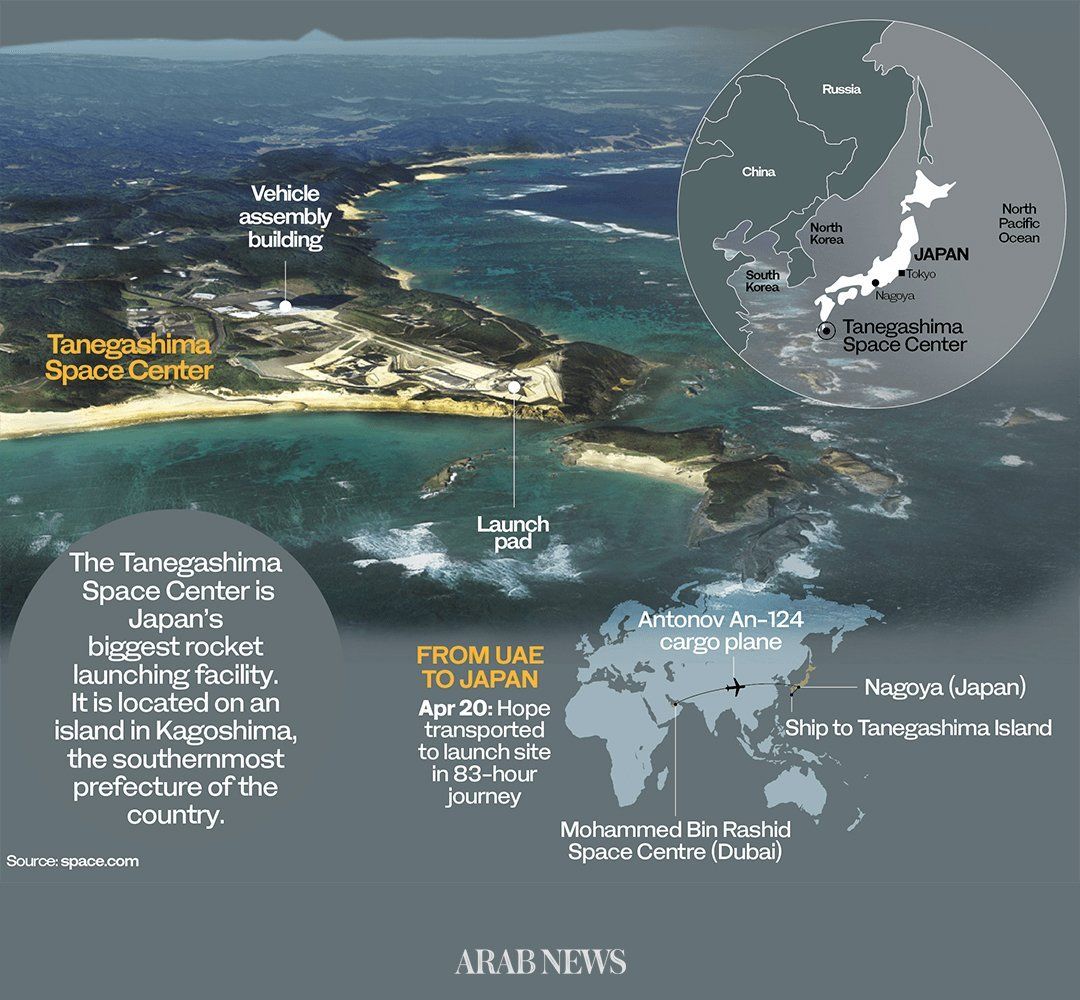 Anholt highlighted UAE’s Mars Mission as being better for the country’s brand than traditional advertising.
He added: “It’s because people really, really don’t change their minds about countries. These are the stable building blocks of their world view.”
As someone who has never seen a country rise by more than two places from one year to the next, he explained that “when a country does rise or fall by more than two or three places in the ranking, then that’s really important and it’s really worth analyzing.”
Case in point is Russia, which has plunged 31 places to the bottom of the index in one year.
Anholt used the example to say that, based on his experience running the Nation Brands Index survey since 2005, “international public opinion will not tolerate conflict. The one thing that people all over the world just cannot forgive a country for is being involved in a war.”
He added: “If you reach out and you harm or threaten or insult another group, whether that’s a religious group or another state, public opinion will punish you as a state for doing so.”
Does that mean Israel, which occupies illegal lands as per the UN but has not suffered a plunge in its Nation Brands ranking, is an exception to the rule?
Anholt said the explanation is more complicated in that “Israel doesn’t suffer quite the same because (the occupation) hasn’t just happened right now. It’s a situation which people have been used to for a number of years.”
He pointed out, however, that while Israel is nowhere near the bottom of the index, it is also nowhere near the top.
He said: “Considering the size of its economy, and considering its successes and the connections that it enjoys with other countries, its position in the international community, especially since the Abraham Accords and all the rest of it, you might expect Israel to rank significantly higher than it does.”
Moving on to the UK, Anholt said that chaotic politics is so much the order of the day in world affairs these days, he does not think “just changing prime ministers every few weeks is going to have any long-term effect on the image of the country.”
Even so, he said the image of Britain is on the slide and has been so, barring a few reversals, ever since the Brexit referendum.

He added: “The data very clearly shows the number one reason why people admire a country is because they think it contributes something to humanity and the planet.
“The point about Brexit, as it was understood by most people around the world, was that the UK was withdrawing from its multilateral behavior and wanted to do it on its own. It wanted to be the British Empire all over again. Very predictably, people don’t like that.”
As for the US, he said: “It had always been the number one country, right up until the second term of George W. Bush, when the Americans invaded Iraq for the second time. America was always the most admired country on Earth; now, it never is. It seems to have settled down at about seventh to 10th position.”
Anholt put the twin examples of the UK and US this way: “Aside from invading another country, the only way that you can gradually damage the image of a country is by behaving in a persistently chaotic, turbulent and unfriendly way in the international community, and both the US and the US are proving that from year to year.
“Year by year, their scores slip in the Nation Brands Index.”
Finally, with divisions opening up in British public opinion after the passing of Queen Elizabeth this year, how much did Anholt think she and the monarchy were worth to “Brand UK?”
He said: “If you look at monarchies in pure economic terms, they tend to give quite good value for money.
“They cost taxpayers several millions a year, sometimes many millions a year, to keep them there. But what they actually return to the country’s image in terms of pure brand value is in the order of billions. People love monarchies, especially people who don’t live in monarchies themselves.
“Without the monarchy, the UK would be significantly less interesting to people than it is. It would be significantly harder to attract people to visit its old buildings in its old cities. So, purely in economic terms, royal families appear to give rather good value, as long as they behave in the right way.”