

Iraqi protesters storm parliament for second time in a week
Protesters have once again breached Iraq’s parliament in a show of support for influential Shia leader Muqtada al-Sadr, leaving at least 125 people injured and escalating a political standoff.
Saturday’s demonstration comes days after protesters stormed the legislative body and suspended a session to nominate a new prime minister.
Thousands of supporters rallied by al-Sadr and his Sadrist Movement tore down concrete barriers on Saturday and entered the Green Zone, which houses government departments and foreign missions, before breaking into parliament.
The scenes followed similar protests on Wednesday, although this time at least 125 people – 100 civilians and 25 members of the security forces – were wounded, according to the Ministry of Health.
Al-Sadr’s supporters threw stones and police fired tear gas and stun grenades.
“We are calling for a government free from corruption … and those are the demands of the people,” one protester, Abu Foad, told the Reuters news agency among crowds of protesters carrying placards with al-Sadr’s photograph and national flags.
The media office of Prime Minister Mustafa al-Kadhimi had issued a statement calling on security officers to guarantee the safety of state institutions.
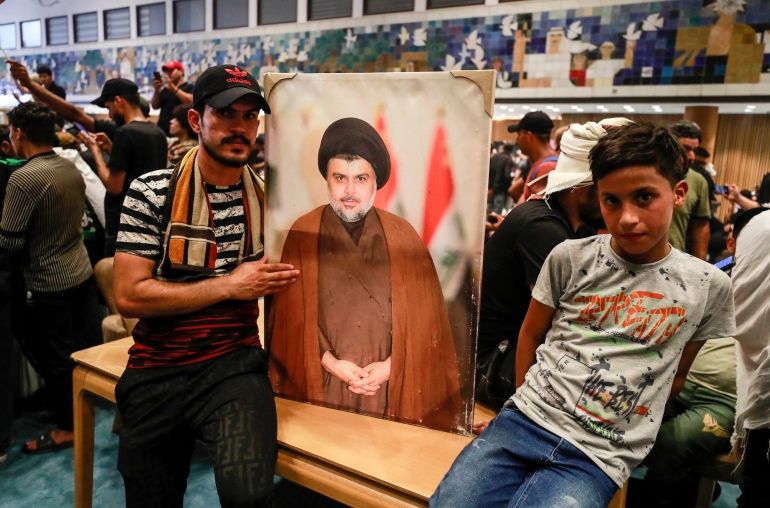 Supporters of al-Sadr hold a picture of their leader inside the country’s parliament
Al Jazeera’s Mahmoud Abdelwahed, reporting from Baghdad, said that supports of al-Sadr “are now in full control of the headquarters of the parliament.
“What’s new this time is that they’re not planning to leave until, as they say, their demands are met,” Abdelwahed said.
Demonstrators oppose the candidacy of Mohammed Shia al-Sudani, a former minister and ex-provincial governor, who is the pro-Iran Coordination Framework’s pick for the premier’s post.
A vote on appointing al-Sudani to the post of prime minister was scheduled to take place on Saturday, but the session was suspended after Wednesday’s events.
“They do not want parliament to accept al-Sudani … they believe [he] is a replica of Nouri al-Maliki, the former prime minister, whom they accuse of corruption,” Abdelwahed said. “Many of them accuse him of ruining the country for two terms when he was prime minister.
“[Protesters] wanted to storm the headquarters of the Supreme Judiciary Council, but they were instructed by one of the aides of al-Sadr at the last moment to back off, to keep it peaceful and keep it quiet.
“Despite all of these calls from politicians to keep it peaceful, to refrain from violence, it has been very chaotic and disorganised … the situation remains very tense,” Abdelwahed said.
Political deadlock
Al-Sadr’s bloc emerged from elections in October as the biggest parliamentary faction but still fell far short of a majority.
Ten months on, the deadlock persists over the establishment of a new government – the longest period since the 2003 invasion by the United States reset the political order in the oil-rich country.
Squabbling political parties failed to reach the two-thirds majority needed to pick a president – an important step before a prime minister can be selected. By convention, the post of prime minister goes to a leader from Iraq’s Shia majority.
After the negotiations stalled, al-Sadr withdrew his bloc from parliament and announced he was exiting talks on forming a government.
Al-Sadr’s withdrawal ceded dozens of seats to the Coalition Framework, an alliance of Shia parties backed by Iran.
Al-Sadr has since made good on threats to stir up popular unrest if parliament tries to approve a government he does not like, saying it must be free of foreign influence – by Iran and the United States – and the corruption that has plagued Iraq for decades.
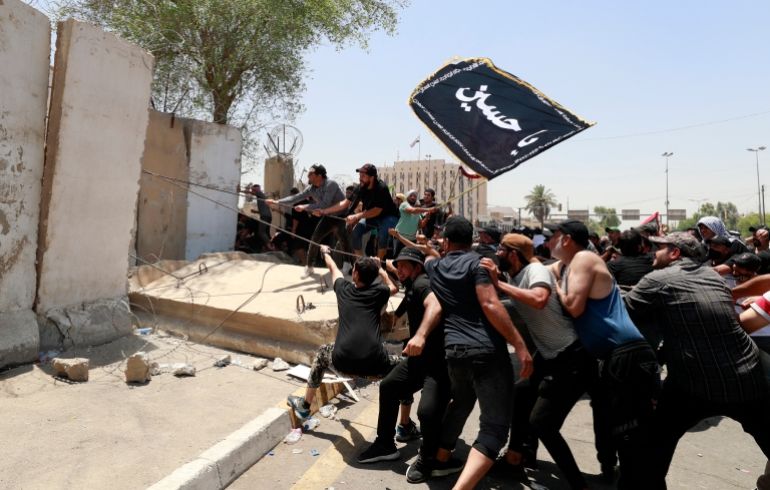 Supporters of al-Sadr bring down concrete barriers leading to the capital Baghdad’s high-security Green Zone
On Saturday, Al-Sadr’s supporters chanted against his rivals who are now trying to form a government. Many protested in front of the country’s Supreme Court, which al-Sadr has accused of meddling to prevent him from forming a government.
In response, the Coalition Framework called on Iraqis to protest peacefully “in defence of the state, its legitimacy and its institutions”, a statement read later on Saturday, raising fears of clashes.
The United Nations called for de-escalation. “Voices of reason and wisdom are critical to prevent further violence,” its mission in Iraq said.
Al-Sadr, whom opponents also have accused of corruption, maintains large state power himself because his movement remains involved in running the country. His loyalists sit in powerful positions throughout Iraqi ministries and state bodies.
Iraqis linked neither to al-Sadr nor to his opponents said they are caught in the middle of the political gridlock.
Mass mobilisation is a well-worn strategy of al-Sadr, a mercurial figure who has emerged as a powerful force with a nationalist, anti-Iran agenda.
Zeidon Alkinani, an analyst with the Arab Center in Washington, told Al Jazeera that “we shouldn’t be surprised that al-Sadr’s supporters are able to enter government premises, in contrast to the protests that began in 2019”.
Political movements such as the Sadrist movement “have infiltrated the ministry of interior affairs and of defence, meaning that it is very easy for them to bypass any security checkpoints,” the analyst said.
“Another layer to this crisis is the personal rivalry between al-Maliki – who is the most influential politician in the Coordination Framework – and al-Sadr,” Alkinani said.
“This rivalry has been going on since 2006. It’s an ideological and military rivalry that has been affecting the daily life of ordinary Iraqis.”