

How Moroccan Paralympian Kassioui beat cerebral palsy and society
Under the blazing summer sun, and not worried about the drops of sweat forming on her face contours that quiver involuntarily with Parkinson’s tremors, Paralympics medalist Fouzia El Kassioui devotedly went about her training in the Moroccan town of Benslimane.
She grabbed a silver at the Tokyo Paralympic Games but her journey to the medal in the F33 shot put event was “far from easy”, she says, before adding: “But I did it.”
Aside from Parkinson’s disease – which progressively damages the brain, affecting movement, speech and mental capacity – Kassioui, at the age of 10, was also diagnosed with cerebral palsy, a condition that causes body stiffness, affecting body motion and coordination, and leads to constant pain at the joints.
Her persistence at sports began as defiance to school bullying, as her body’s tremors limited her ability to do what other children her age could do.
Through an insatiable passion for sports, she overcame physical, social and financial hurdles to first achieve normalcy and then ultimately excel.
“Every day, I’d come back from school and repeat, in front of my mother, the aerobatic moves we were shown by our sports teacher,” she told Al Jazeera.
Unaware until she was 24 that certain sports were more suitable for those with physical disabilities, Kassioui spent her childhood trying to blend in.
“I remember clearly my daughter, as a teen, rolling on the floor again and again, repeating aerobics exercises until she nailed them,” Kassioui’s mother, Al-Zahra al-Arifi, told Al Jazeera, smiling fondly at the memory.
She also recalled, with pain, how she first noticed something different about her daughter – a slight tilt in the 10-year-old’s head – and her shock when told of her health conditions.
“It was very difficult to accept,” said the mother of four.
 A complete stranger on a wheelchair, to whom Kassioui expressed her love
for sports, directed her to Al-Ahd Al-Jadid Association, which provided
her with the guidance, support and mentorship she needed
A complete stranger on a wheelchair, to whom Kassioui expressed her love
for sports, directed her to Al-Ahd Al-Jadid Association, which provided
her with the guidance, support and mentorship she needed
Widowed only months before Kassioui’s diagnosis, Arifi worked in the fields as a helper to provide for her children.
Kassioui said her mother’s sacrifices were what drove her.
“It’s the least I can give to my mother and the smallest offering to dedicate to my late father,” she said.
Just as coincidental as the discovery of her illness, the launch of Kassioui’s professional sports career was also serendipitous.
By 2017, she had given up on making it as a professional due to what she thought was a complete absence of support for people with her condition.
This was until she randomly ran into another shot put athlete in a wheelchair while running errands.
Telling him of her love for sports, she said he gave her advice that “changed her life” and to which she “remains in debt”, guiding her to Benslimane’s Al-Ahd Al-Jadid Association.
Through the association, Kassioui got a dedicated coach to supervise her workouts and progress.
At the organisation, Kassioui was introduced to the javelin, shot put and discus, immediately directing her body’s muscles and skills towards mastering them.
Halima al-Dhubli, her first coach who introduced her to shot put and its basics, told Al Jazeera that Kassioui worked hard from day one.
“I didn’t doubt her achievement. She earned it,” said al-Dhubli.
Kassioui’s body, though, was now struggling to take on the new physical strain and she had not even dreamt of entering tournaments.
“It was not until after months of consistent training that I thought of tournaments. And when I did, sports opened horizons to me I never knew existed or I’m capable of,” she said.
In 2019, after two years of extensive training, Kassioui won three gold medals at the 2019 Tunis World Para Athletics Grand Prix, setting a new discus F32 world record along the way.
She then won bronze in the F33 shot put at the 2019 World Para Athletics Championships in Dubai, while finishing sixth in the javelin event.
Hamid El Aouni, chairman of the Royal Moroccan Federation of Sports for the Disabled, said Kassioui’s passion and drive led to the achievements.
“Gold medals in the future, including at the Paralympic Games, is something she can easily achieve,” he said.
Echoing similar confidence in Fouzia’s abilities, Abdelouahab Lakhdar, coach of the Moroccan national athletics team of players with special needs, described her as “a striking force”.
“Her enthusiasm and strength rank her among the elite of the world’s female players. She defied obstacles and turned them into a source of strength until she won a priceless Paralympic silver medal. How could she not be a world-class player?” Lakhdar said.
Hayat El Garaa, Kassioui’s friend, won bronze in the discus F41 category of short stature at Tokyo’s Paralympic Games. She describes Kassioui as having a “daring” personality, which makes her a “one-of-a-kind athlete”.
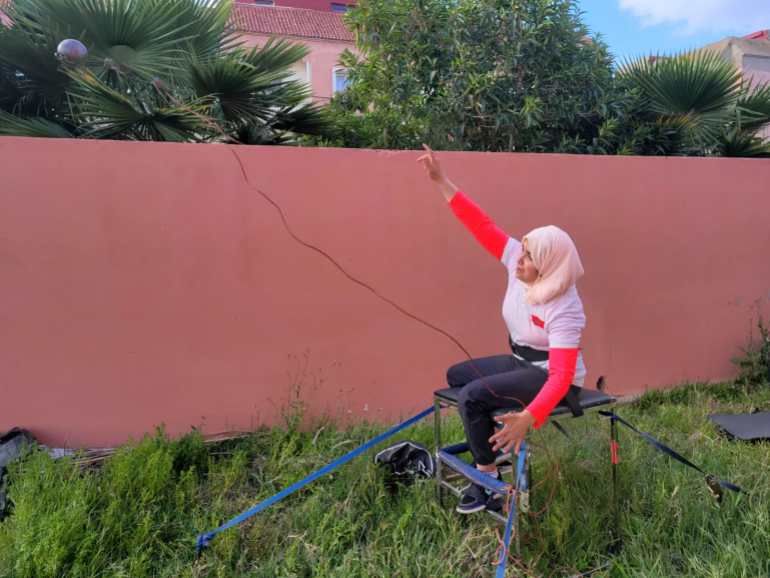 Fouzia El Kassioui spent her childhood doing sports to prove she was like other children
Having secured professional mentorship and training through the national association, Kassioui faced another key challenge: The absence of a venue nearby that was appropriate for exercising her shot put techniques.
In the lead-up to Tokyo’s 2020 games, and despite her family’s concern for her safety, she dragged her puts, exercising chair and ring to the city’s public park, around 15 minutes from home, every evening when the visitors had left and only the homeless and drifters remained.
“I won’t pretend that I wasn’t scared for my own safety every time I walked to the park, but my goals kept me going,” she said.
Kassioui recalled how she often faced hurtful comments from those passing by, for being a young girl, having physical limitations, and practicing an uncommon sport well into the night.
According to her mother, the belittling and insulting comments pointed to her daughter’s health conditions or what is expected of her by society as a woman.
“‘You are a girl. What are you doing out here at this hour?’ or ‘Someone like you shouldn’t be out here alone’ are some comments that were hurled at her, like she is unfit to do or be anything,” al-Zahra said of the comments.
But returning home from Tokyo with a silver medal changed everything, the athlete said, describing how children and adults would stop and ask for selfies.
“I love for them to share the happiness and pride I felt the day I got that medal – a day I’ll never forget. I remembered everything difficult I went through. It was all so hard,” she said.
“I couldn’t believe it then, and sometimes I still can’t believe it happened. It feels implausible. I finally achieved what I had always wanted but believed was impossible. It’s jumbled emotions of remembering the challenges that have been, and also being aware that more lie ahead, but with slightly more support,” she added.
An example of such support, she said, is the training spot allocated by the Ministry of Youth and Sports at Benslimane’s Club Socio-Sport after her Paralympic Games feat.
Since the venue is exclusively hers to use, she is spared from having to carry the heavy kit back and forth, and has the help of a dedicated guard to set up her equipment.
“I have my own place to practice. It isn’t that big, but it’s better than the public park,” she said.
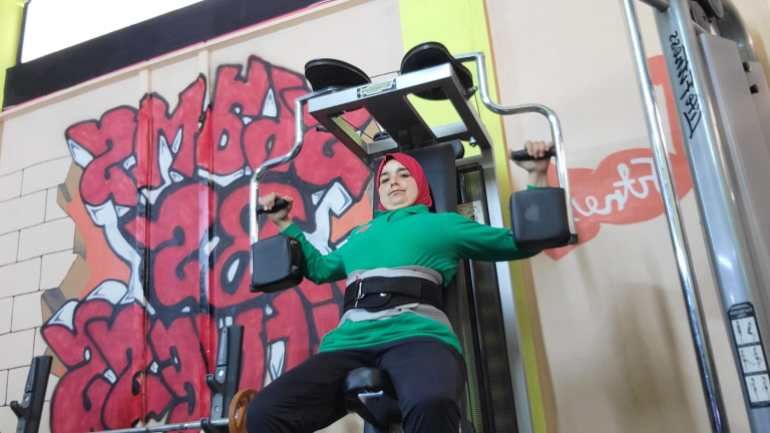
Mona Atef, Kassioui’s gym coach, said the medal “worked like magic” on how the community in Benslimane perceives Kassioui and her journey.
“Everyone knows her now. At the gym where she exercises, everyone witnessed the effort she had put into getting this far,” she said, also referring to a back injury that the athlete had sustained before Tokyo’s Paralympics, which did not deter her from showing up and training.
Apart from the physical and logistical hurdles, financial burdens have also weighed down on Kassioui and her family throughout her professional career.
The athlete, who was forced to abandon her education after secondary school because her jerky movements made it impossible to sit for written exams, said work opportunities were limited – especially given her health condition.
Kassioui’s struggles with education are commonplace among Moroccans with disabilities.
According to local media reports, nearly seven percent of Morocco’s 37 million population faces various physical and mental challenges, but just over 55 percent go to school, and a mere 1.8 percent manage to hold higher degrees.
Realising her pursuit of professional sports requires money, Kassioui did not want to throw this load on her mother, so she launched a business to sell makeup items online.
“It’s a job that suits my physical capabilities, and also covers my gym and kit expenses,” she explained.
With a renewed sense of hope and empowerment, Kassioui is now considering going back to school next year, especially after the Ministry of Education agreed to provide someone to help her write down answers during exams.
For the time being, Kassioui’s primary goal is to win gold medals. Since her return from Tokyo, she has been following a rigid training schedule although she does not have a clear plan, or dates, for upcoming regional and international championships.
“Whenever they will be or wherever they’ll be held,” she said, “I’ll be ready to win gold.”