Saudi Press

Saudi Arabia and the world
Friday, May 29, 2026

Former Senator Bill Nelson is officially NASA's new administrator. His goals: support climate research and put astronauts on the moon.

Former Senator Bill Nelson is officially NASA's new administrator. His goals: support climate research and put astronauts on the moon.

Presidential administration transitions can give NASA whiplash, but Bill Nelson wants the US space program to have "constancy of purpose."

NASA has a new leader, but he does not plan to shake things up.

Instead, Bill Nelson is keeping his eyes on the same prizes as his predecessor, Jim Bridenstine: sending astronauts to the moon and Mars.

Nelson, a three-term US Senator from Florida who flew into orbit aboard the Space Shuttle Columbia in 1986, was sworn in as the new NASA Administrator on Monday.

His plan is mainly to keep the ball rolling. During confirmation hearings, Nelson told Congress that he wants to see NASA achieve its most ambitious goal — sending astronauts to the lunar surface and, eventually, to Mars. He also advocated a renewed focus on climate-change research, which has historically been a big part of NASA's directive but was deprioritized under the Trump administration.
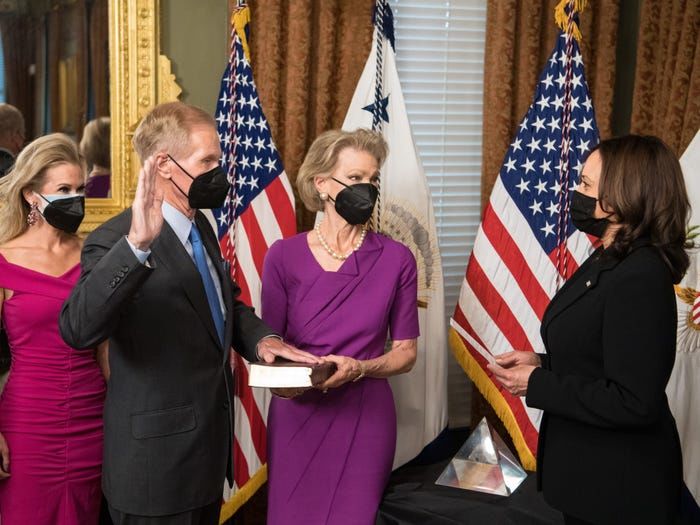
Former Senator Bill Nelson is sworn in as NASA Administrator, as his wife, Grace Nelson, holds their family Bible, and his daughter, Nan Ellen Nelson watches, May 3, 2021.


"The space program needs constancy of purpose," Nelson said in a written testimony to the Senate Committee on Commerce, Science, and Transportation. For continuity, he added, he plans to work with Bridenstine and "seek his advice."

That consistency may give NASA a break from the whiplash it often gets with new administrations. President George W. Bush first asked NASA to pursue a return to the moon in 2005. Five years later, President Barack Obama shifted the focus to Mars. The Trump administration shifted back to the moon, with a tight deadline: to return astronauts to the lunar surface by 2024. That's four years earlier than NASA was previously planning.

"If you ask me what is my vision for the future of NASA, it is to continue for us to explore the heavens with humans and with machines," Nelson told the Senate committee, of which he was previously a member, during a confirmation hearing on April 21. "There is a lot of excitement."

Sending astronauts back to the moon and on to Mars
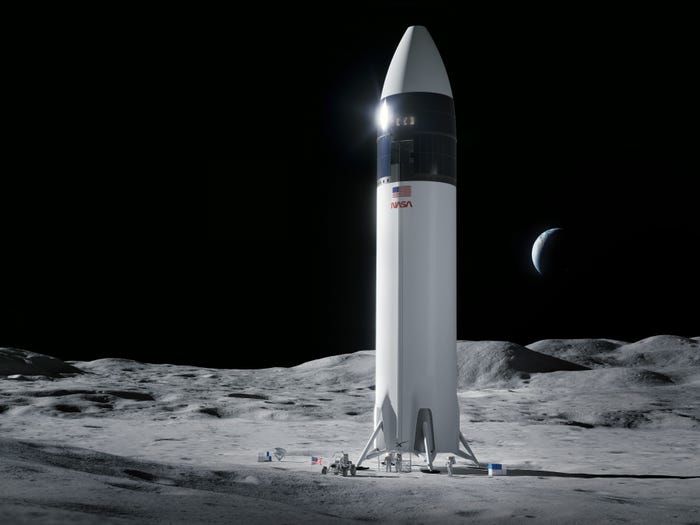
An illustration of SpaceX's Starship as a lander carrying NASA astronauts to the moon.


NASA still hopes to land astronauts on the moon by 2024 — a feat nobody has accomplished since 1972. Nelson is on board, even though the timeline may be too ambitious. NASA's Office of the Inspector General recently determined a 2024 landing is "highly unlikely."

"I think you may be pleased that we're gonna see that timetable try to be adhered to, but recognize that, with some sobering reality, that space is hard," Nelson told the Senate committee.

NASA's plan is to launch an astronaut crew inside an Orion spaceship, using the mega-rocket the agency is currently developing, called the Space Launch System. Once in lunar orbit, Orion would rendezvous with a lander. Two of the astronauts would move into that vehicle then land on the moon's surface.

NASA recently awarded the contract for that lander to SpaceX. Elon Musk's rocket company intends to convert its planned Starship mega-spaceship into a lunar lander. But NASA was expected to pick two contractors instead of one, so the decision prompted SpaceX's competitors — Dynetics and Blue Origin — to file complaints. While things are being sorted out, NASA asked SpaceX to pause work on the project.

NASA cited a lack of funding from Congress when it decided to award one single contract, and promised there would be a follow-on competition. Nelson stood by that statement, vowing that there will be competitions for contracts to send the first astronauts to Mars.

"Competition is always better than sole sourcing, because you can get the efficiencies and you get a lower price," he told the Senate committee.

NASA aims to launch its first Mars-bound astronaut mission in the 2030s.

'You can't mitigate climate change unless you can measure it'

Clouds over the Amazon rainforest, as seen from space, January 30, 2015.


During his hearing, Nelson defended a White House request to budget $2.3 billion for NASA's Earth-science programs. That would constitute a roughly 15% increase from the agency's 2020 Earth-science budget.

"It's a very important increase. You can't mitigate climate change unless you can measure it, and that's NASA's expertise," Nelson said. "Understanding our planet gives us the means to better protect it."

Nelson vocally opposed the Trump administration's decision to cancel NASA's Carbon Monitoring System — a $10-million-per-year program that gathers data on how carbon moves around the planet. Congress subsequently reinstated the program.

"When I flew on the space shuttle, any time that was not scheduled with experiments or flight activities – which was not often – I would make my way to the spacecraft window to look at our home, our planet," Nelson wrote in his testimony. "I was struck by how fragile it looked with its thin atmosphere. Combating climate change cannot succeed without robust observations, data, and research."

Newsletter

Related Articles

Saudi Press
0:00
0:00
Close
Japanese Technology Firm Fujitsu Launches Advanced Artificial Intelligence Tool for Corporate Disclosures
South Africa Officially Launches Nationwide Campaign for Highly Contested Local Government Elections
United Kingdom Commits Additional Funding for Unexploded Ordnance Clearance in Laos
Singapore Announces Stringent New Greenhouse Gas Regulations for Commercial Cooling Systems
Cambodia and Thailand Hold High-Level Border Security Talks at United Nations Headquarters
Myanmar Military Government and China Sign Major Agreement to Upgrade Media and Cultural Cooperation
Knife Attack at Swiss Train Station Leaves Three Injured in Suspected Act of Domestic Terrorism
Transnational Extortion Gang Threatens Canadian Police With Army of One Thousand Armed Operatives
Australia Imposes Forty-Two-Day Quarantine on Cruise Ship Passengers Following Deadly Hantavirus Outbreak
International Monetary Fund Unlocks Seven Hundred Million United States Dollars for Sri Lanka Following Economic Reforms
Australia Launches Record One Point Four Billion Dollar Lawsuit Against Chemical Giant 3M Over Contamination
China and Canada Foreign Ministers Meet in Ottawa in Effort to Stabilize Strained Diplomatic Ties
Indonesia Demands Urgent United Nations Security Council Reform Amid Escalating Global Conflicts
Extreme Weather Patterns Trigger Severe Drought in Madagascar and Destructive Flooding in East Africa
Indian State of Karnataka Faces Political Upheaval as Chief Minister Siddaramaiah Abruptly Resigns
Philippines and Japan Reaffirm Defense Ties as Crucial for Indo-Pacific Regional Stability
Norway Joins French Nuclear Deterrence Initiative in Major Shift for European Security Architecture
Global Critical Mineral Alliances Expand as Western Nations Move to Counter Chinese Supply Dominance
United States Imposes Fifty Percent Tariffs on Mexican Steel and Aluminum Ahead of Trade Pact Review
European Union and China Head Toward Major Trade Conflict Over Clean Technology Exports
United States Economic Growth Severely Downgraded to One Point Six Percent as Stagflation Fears Mount
World Health Organization Warns Central African Ebola Epidemic is Outpacing Containment Efforts
United States Treasury Department Conditions Sanctions Relief on Reopening of the Strait of Hormuz
Iranian Air Defenses Intercept and Destroy United States Military Drone Over Bushehr Province
Iranian Armed Forces Launch Ballistic Missiles Toward Unspecified Targets Prompting Regional Condemnation
United Nations Secretary-General Warns Global Order Facing Highest Level of Conflict Since 1945
Israel Issues Sweeping Evacuation Orders in Southern Lebanon Amid Intensified Hezbollah Conflict
Russia Announces Systemic Military Strikes Targeting Ukrainian Defense and Energy Infrastructure
United States and Iranian Negotiators Reach Draft Agreement to Extend Ceasefire and Resume Nuclear Talks
United Nations Security Council Deeply Divided Over United States Capture of Venezuelan President
US and Iran Exchange Direct Military Strikes Amid Fragile Gulf Ceasefire
World Health Organization Warns of Catastrophic Ebola Outbreak in DR Congo
Russia Threatens New Wave of Strikes on Ukrainian Infrastructure and Embassies
Scientists Warn Atlantic Ocean Currents Could Collapse Faster Than Projected
Anthropic Reaches $900 Billion Valuation in Historic AI Funding Round
Washington Imposes Crippling Sanctions on Iranian Maritime Authority
Japan and the Philippines Initiate Strategic Intelligence-Sharing Pact
Microsoft Deploys Autonomous Computer-Using AI Agents to Global Markets
Anthropic Secures $45 Billion Compute Infrastructure Agreement With SpaceX
U.S. Director of National Intelligence Resigns Amid Administration Shakeup
Micron Technology Crosses Trillion-Dollar Valuation Amid Unprecedented Hardware Demand
Canada and Germany Finalize Historic Long-Term LNG Export Agreement
China Expands International Travel Restrictions on Domestic AI Researchers
Japan Approves Sweeping Overhaul of National Intelligence Apparatus
Global Airlines Scramble Logistics as Middle East Airspace Remains Fractured
Japan's Naphtha Imports Plunge 47 Percent Amid Strait of Hormuz Closure
Global Crude Prices Retreat Below $96 as Gulf Tensions Momentarily Ease
Generative AI Outperforms Human Baselines in Landmark Global Creativity Study
NASA Partners With Private Aerospace to Unveil Permanent Lunar Base Architecture
South Korean Equity Markets Surge on Next-Generation Memory Chip Frenzy
×