

Exclusive: Prince Khaled bin Alwaleed on impact investing, Gulf talent and NEOM
Speaking exclusively to Al Arabiya English in a wide-ranging interview, Prince Khaled explored his food-first drive, the tenets of investing and funding local talent, and the philosophy behind mega-projects like NEOM in Saudi Arabia.
Future food
“Seventy percent of the world consumes other types of protein - we’re talking about sheep, we’re talking about lamb. [Black Sheep Foods] are really focused on that,” said Prince Khaled.
Black Sheep Foods, a company that specializes in developing plant-based lamb and other exotic meat, recently raised $12.3 million in series A funding led by plant-based venture veterans Unovis, Bessemer Ventures Partners, AgFunder, and KBW Ventures.
Prince Khaled said he met the foodtech team and arranged a tasting a few months ago before announcing the investment.
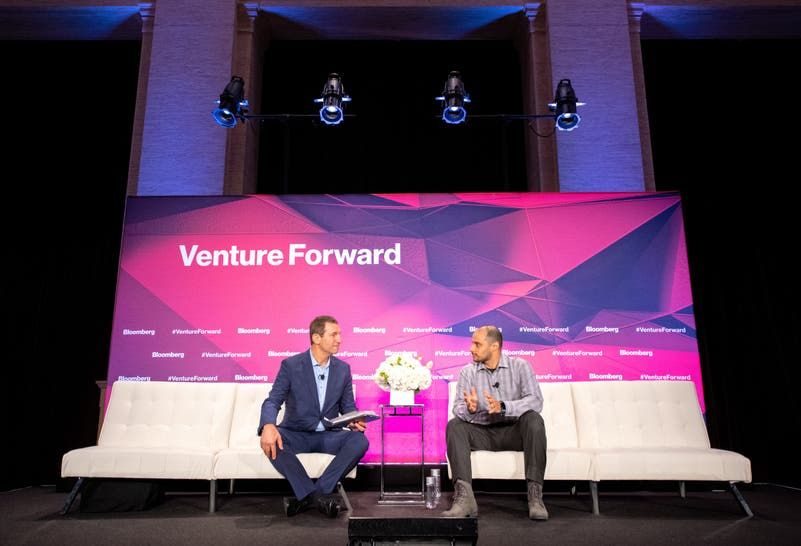 Prince Khaled bin Alwaleed interviews live on Bloomberg in San Francisco, California.
While many Silicon Valley companies are focused on plant-based chicken and beef, Black Sheep Foods sought after developing more exotic meat alternatives like lamb.
The new funding is expected to aid Black Sheep Foods in scaling up their production for national distribution according to information shared with Al Arabiya English.
“The beauty of it is that you can scale [the technology] to the extent where sheep and lamb [are] not necessarily needed to be transported from far areas of the world to the Middle East,” said Prince Khaled.
Australia and New Zealand take top spots for the export of lamb and sheep. These established practices are, however, changing.
New Zealand will ban live animal exports from April 2023, a move appreciated by Prince Khaled.
Speaking about the negative environmental impact of cattle farming, the KBW Ventures chief said: “From our standpoint, it’s a conscious investment into preserving our environment and finding alternatives for countries and consumers to enjoy the luxuries that they want without the downside of hurting the environment as well as hurting animals.”
Prince Khaled also briefly spoke about his venture’s investment in automated indoor farming platform OnePointOne. He said that the company is currently in talks with authorities in Abu Dhabi to establish a plant.
“We can grow 250 times more produce at about 99 percent less land and a lot less energy and a lot less water. There’s a huge incentive for this region to start participating in this field.”
A hearty lifestyle
Acknowledging that Saudi Arabia’s food culture is greatly meat based, Prince Khaled admits that “it would be really hard for people to wean away from it.”
Regardless of the steep task ahead of raising awareness on alternate food lifestyles, the vegan Prince Khaled is confident of his societal role and contributions he can make.
The 44-year-old is also the president of the Sports for All Federation, an organization under the Saudi Ministry of Sport that was tasked with, and achieved, getting 40 percent of the Kingdom’s population active by 2030.
“We advocate people to have a healthier lifestyle through physical activity and nutrition.”
“The impact has been tremendous. We’re advocating for people to consume less and less animal-based protein and more of a plant-based protein and just have a balanced lifestyle.”
He added that an active lifestyle involves at least 150 minutes a week of physical activity for grownups, and an hour and a half to two hours for young adults.
 Prince Khaled participating in the Spartan Race KSA staged by Saudi Sports for All Federation.
“We’ve exceeded that number last year. We’re about 48 percent.”
“The idea isn’t to pat ourselves on the back and say, okay, job well done… By us achieving that number, we’ve achieved the benchmark. Now, we can set new standards for how to increase that number to a higher amount,” he said.
The national sports strategy ties into the Kingdom’s Vision 2030 goals.
The ambitious roadmap for the Kingdom was drawn up by Crown Prince Mohammed bin Salman, aiming to transform the Gulf state into a sustainable economic and logistic powerhouse with mega-project NEOM at the center.
Not just a billion-dollar showpiece
“I wish people really just grasped the potential of NEOM and the long-term vision and the run off from NEOM innovation that can really feed into the world as we know,” said Prince Khaled.
“NEOM is not about building a smart city, it is about building the first cognitive city, where world-class technology is fueled with data and intelligence to interact seamlessly with its population,” NEOM Technology & Digital CEO Joseph Bradley has been quoted as saying on the project’s website.
The project, bankrolled by the Saudi Public Investment Fund, prides on looking into the future and becoming a hub for innovation, research and sustainability. It hopes to achieve these milestones by looking inward for solutions.
The first phase of the flagship NEOM development is said to cost $319 billion (SAR 1.2 trillion).
“This is the beauty of projects like NEOM,” Prince Khaled stated.
“People look at NEOM, and they think of The Line, they think of OXAGON. They really don’t think of the tie in with innovation that’s going to happen through the different workshops that they’ve had worldwide, and that’s going to start tackling huge issues.”
For example, events like the OXAGON Hackathon, which was held in October and wherein youth-led teams were tasked with developing next-gen tech, aim to foster collaboration between entities and enable a platform for start-ups.
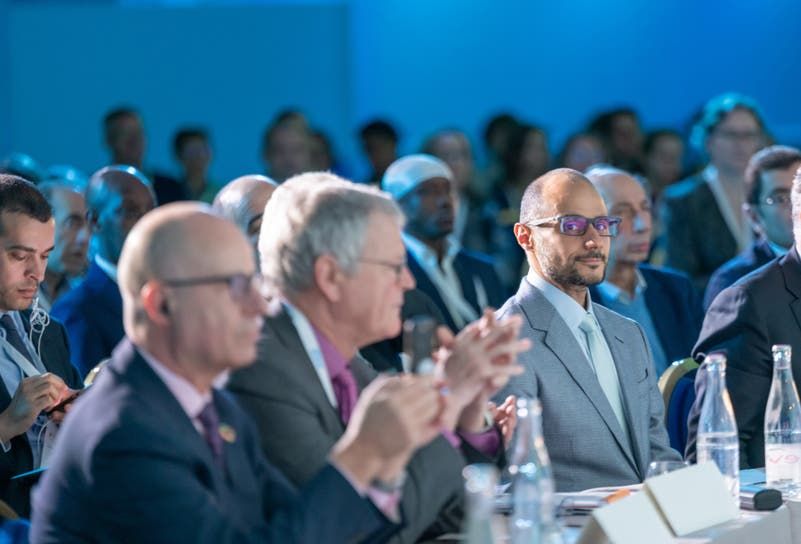 Prince Khaled bin Alwaleed leading the Saudi delegation in Monaco for International Peace and Sports conference.
The event’s theme covered technology in the service of people, innovation to address water scarcity challenges and renewable energy solutions including green hydrogen and e-fuels.
The three winning teams were reportedly fast-tracked to the OXAGON Accelerator program which will give them access to global experts, specialist resources, and a go-to-market toolkit to transform their ideas into investor-ready companies.
“To do The Line, you to have to develop new technologies that’s going to create different industries. To do the OXAGON, you’ll need new technologies. These partnerships really shed light on the importance of having a project like NEOM,” Prince Khaled continued.
“NEOM is a 100-year vision project. It’s not something that people are going to see… in the next 10, 20, 30 years. It’s much bigger than that,” he concluded.
The KBW Ventures chair is also doing his part to involve the local population in his projects.
“One of the mandates that we have at KBW Ventures is if I were to make an investment into a company, they must have a plan for some type of presence in the Middle East. And that’s a rule.”
With a local presence, Prince Khaled hopes for greater involvement and interest from the citizens of the country.
“Every one of our companies that we’ve invested in in the food tech arena has agreed to that. And we’re going to be seeing a lot more of that,” he added.
He is apparently working to bring manufacturing and R&D facilities to the Middle East. “What I would like to see is distribution from the Middle East.”
“We’re going to hear some really good news in the next few months of a huge company having a big presence here in Saudi Arabia and the wider Middle East,” he said only adding that it would be one of the largest manufacturing units in the Middle East in the food sector; and not disclosing further details.
Invest local
Given that two-thirds of Saudi Arabia’s population is below the age of 29, innovation and entrepreneurial ideas are inclined into industries of the future.
“We’re talking about a very young, agile population that really does not want to start working in their moms and dads hand me down boring companies. They want to start doing their own thing and they want to prove to the world they have their own fingerprint,” Prince Khaled said.
The veteran investor said that the Saudi government has recognized this potential and is continuing to invest in these projects through government entities like Monshaat, the Small and Medium Enterprises General Authority.
The government body was established in 2016 and aims to increase the productivity of SMEs and their contribution to GDP from 20 percent to 35 percent by 2030. It plans to do so through funding, support centers, accelerator programs and a variety of other initiatives.
“Take it from me as a venture capitalist who gets hundreds of decks a month,” said Prince Khaled, adding that he already sees an interest in entrepreneurship from Saudi Arabia and much more so from the UAE.
“There’s no shortage of ideas and no shortage of passion to start their own businesses,” he said.
The investor also sits on the Advisory Board of XPRIZE Feed the Next Billion, a multi-year, $15 million competition that hopes to incentivize teams to produce chicken breast or fish fillet alternatives.
Prince Khaled’s philosophy to investing relies on long-term impact that results in general social good – a means of impact investing – with greater focus on the Middle East.
His investment choices are partly driven by the UN SDG goals, including in his UAE-based property development company, Arada, chaired by Sharjah Deputy Ruler Sheikh Sultan bin Ahmed Al Qasimi.
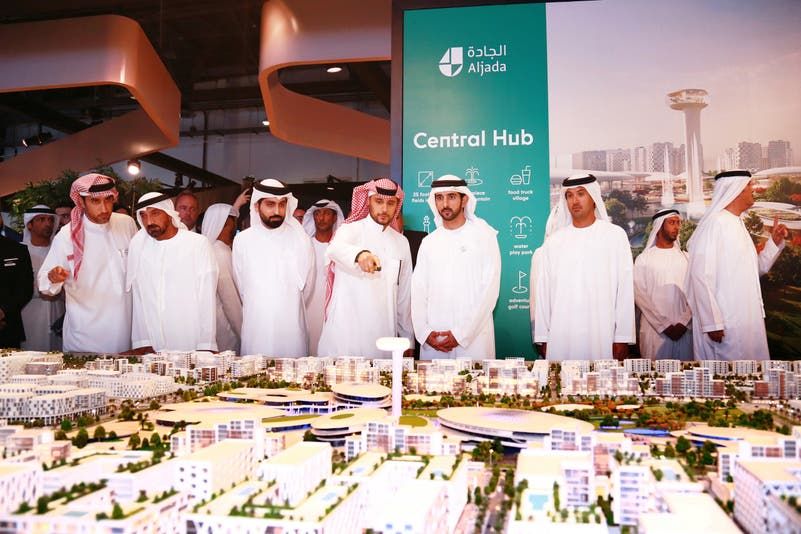 Sheikh Hamdan bin Mohammed bin Rashid Al Maktoum, Crown Prince of Dubai
at Arada's Cityscape 2018 exhibit by Arada Vice Chairman, Prince Khaled
bin Alwaleed bin Talal Al Saud.
Sheikh Hamdan bin Mohammed bin Rashid Al Maktoum, Crown Prince of Dubai
at Arada's Cityscape 2018 exhibit by Arada Vice Chairman, Prince Khaled
bin Alwaleed bin Talal Al Saud.
“As vice chairman of the company, I will always bring that DNA and philosophy into the organization. We’ve implemented it through different channels including manufacturing, or the sustainable types of material that we’re using…,” and through technology like smart home systems, Prince Khaled said.
“The way to become sustainable is to become cost effective,” he added.
“That’s why, for example, you haven’t seen cellular agriculture meat in the market, because it’s not cost effective yet. We’re about over one and a half times, at the price of regular meat, but we’re going to achieve them,” he said, drawing parallels to the sustainable means of development Arada follows.
He has but one advice for investors and venture capitalists – choose to invest in the Gulf, prepare for returns in the long term and wherever possible, ensure a net positive social impact.