Saudi Press

Saudi Arabia and the world
Tuesday, Jan 13, 2026

Winters past: Bitcoin plunge brings back memories of 2018

Winters past: Bitcoin plunge brings back memories of 2018

Memories of 2018 are sparking fears that a repeat is playing out now after the world’s largest cryptocurrency plummeted 50 percent from its most recent high of almost $69,000 in November.

There are few things scarier for investors than a bear market — unless you’re involved in crypto, in which case a winter is worse.

The chilling term refers to a sharp slump, followed by a drop-off in trading and months of market doldrums — a phenomenon that memorably befell the crypto market in 2018. Bitcoin’s price plunged by more than 80% to as low as $3,100 from the end of 2017 through December of the following year, a period characterized by the boom-and-bust of initial coin offerings and several big banks shelving their plans to start cryptocurrency trading desks. Bitcoin wouldn’t reach a new high until December 2020, according to data compiled by Bloomberg.

Memories of 2018 are sparking fears that a repeat is playing out now after the world’s largest cryptocurrency plummeted 50% from its most recent high of almost $69,000 in November. The crypto universe has shed more than $1 trillion in market value on growing conviction that the Federal Reserve is set to start ratcheting back the ultra-accommodative policy settings that fueled a boom in risk assets. The pullback has hit all corners of the crypto ecosystem, from Bitcoin to memecoins and publicly listed crypto exchanges. While the collapse has been rattling enough on its own, it has spawned an even bigger concern that the pain may persist for many months, according to UBS.

“There’s this question of how do we characterize that and the nearest analogy is probably 2018, which is this idea of a crypto winter,” James Malcolm, head of foreign exchange research at UBS, said by phone. “It looks likely to be a fairly difficult and potentially prolonged period and therefore, the crypto winter analogy is quite good. Remember, the crypto winter in 2018 wasn’t just over the Northern Hemisphere winter months. It basically extended for a whole year — so it was a crypto winter that lasted effectively a year.”
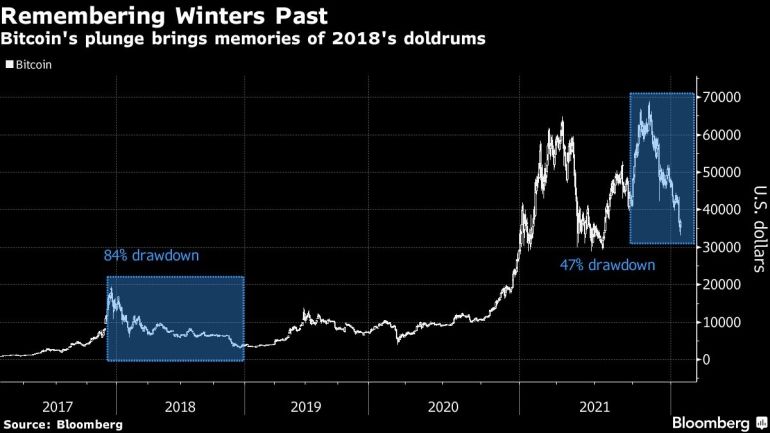

Bitcoin on Tuesday continued to decline, falling as much as 3% to trade at $35,721. The coin has spent more than 60% of the year so far trading lower, posting only nine sessions in the green.

Mentions of “crypto winter” and “crypto ice age” have flooded social media amid the latest drop. “Gm gm — make sure you stay warm, crypto winter is in full force,” Twitter user @brycent_ posted on Monday, using the crypto shorthand for “good morning” to start his tweet. “Enjoy this #bitcoin winter,” user @mir_btc tweeted over the weekend.

To Antoni Trenchev, co-founder and managing partner at Nexo, there’s a definite chill in the air. Bitcoin has already satisfied half of his two-part crypto-winter definition: a sharp decline in prices.

“I’m not looking for a re-run of the last ‘crypto winter,’” he said. “Undeniably, there are regulatory and macro storms ahead, and another leg down to $28,000-$30,000 can’t be ruled out in the current risk-off climate.”

Unlike the winter of three years ago, investment in the crypto-sphere remains robust — at least for now. In January alone, crypto-exchange FTX announced the launch of a $2 billion venture fund to target Web3 opportunities, while the Financial Times reported that Andreessen Horowitz is looking to raise $4.5 billion for crypto funds. Of course, a prolonged slump could douse enthusiasm for the sector.

Outside of venture capital, companies are also looking to expand into corners of the crypto ecosystem. Filings with the U.S. Patent and Trademark Office show that Walmart Inc. is preparing to create its own cryptocurrency and non-fungible tokens. Meanwhile, GameStop Corp. reportedly is also planning to launch an NFT marketplace for gamers by the end of the year.

To Tacen Inc.’s Budd White, that momentum is a sign that the crypto complex is in the midst of repricing, rather than a freeze.

“I don’t believe we are entering a crypto winter because there is still increasing momentum on the build-side — we are just seeing more realistic pricing of what is currently built,” said White, chief product officer and co-founder at the software development company that builds open-source, blockchain-based software.

The looming threat of intensified regulatory action adds to the risks embedded in the crypto complex. The Fed is considering the launch of its own digital currency, while crypto mining’s energy use has attracted scrutiny from the U.S. Congress and foreign governments.

“The White House may soon unveil some national security challenges posed by cryptocurrencies and the Fed’s paper on central bank digital currencies didn’t answer any questions on if we will see a digital dollar or how they could work with stablecoins,” said Edward Moya, a senior market analyst at Oanda Corp. “The regulatory environment got a lot cloudier now.”

Newsletter

Related Articles

Saudi Press
0:00
0:00
Close
Trump Designates Saudi Arabia a Major Non-NATO Ally, Elevating US–Riyadh Defense Partnership
Trump Organization Deepens Saudi Property Focus with $10 Billion Luxury Developments
There is no sovereign immunity for poisoning millions with drugs.
Mohammed bin Salman’s Global Standing: Strategic Partner in Transition Amid Debate Over His Role
Saudi Arabia Opens Property Market to Foreign Buyers in Landmark Reform
The U.S. State Department’s account in Persian: “President Trump is a man of action. If you didn’t know it until now, now you do—do not play games with President Trump.”
CNN’s Ranking of Israel’s Women’s Rights Sparks Debate After Misleading Global Index Comparison
Saudi Arabia’s Shifting Regional Alignment Raises Strategic Concerns in Jerusalem
OPEC+ Holds Oil Output Steady Amid Member Tensions and Market Oversupply
Iranian Protests Intensify as Another Revolutionary Guard Member Is Killed and Khamenei Blames the West
President Trump Says United States Will Administer Venezuela Until a Secure Leadership Transition
Delta Force Identified as Unit Behind U.S. Operation That Captured Venezuela’s President
Trump Announces U.S. Large-Scale Strike on Venezuela, Declares President Maduro and Wife Captured
Saudi-UAE Rift Adds Complexity to Middle East Diplomacy as Trump Signals Firm Leadership
OPEC+ to Keep Oil Output Policy Unchanged Despite Saudi-UAE Tensions Over Yemen
Saudi Arabia and UAE at Odds in Yemen Conflict as Southern Offensive Deepens Gulf Rift
Abu Dhabi ‘Capital of Capital’: How Abu Dhabi Rose as a Sovereign Wealth Power
Diamonds Are Powering a New Quantum Revolution
Trump Threatens Strikes Against Iran if Nuclear Programme Is Restarted
Why Saudi Arabia May Recalibrate Its US Spending Commitments Amid Rising China–America Rivalry
Riyadh Air’s First Boeing 787-9 Dreamliner Completes Initial Test Flight, Advancing Saudi Carrier’s Launch
Saudi Arabia’s 2025: A Pivotal Year of Global Engagement and Domestic Transformation
Saudi Arabia to Introduce Sugar-Content Based Tax on Sweetened Drinks from January 2026
Saudi Hotels Prepare for New Hospitality Roles as Alcohol Curbs Ease
Global Airports Forum Highlights Saudi Arabia’s Emergence as a Leading Aviation Powerhouse
Saudi Arabia Weighs Strategic Choice on Iran Amid Regional Turbulence
Not Only F-35s: Saudi Arabia to Gain Access to the World’s Most Sensitive Technology
Saudi Arabia Condemns Sydney Bondi Beach Shooting and Expresses Solidarity with Australia
Washington Watches Beijing–Riyadh Rapprochement as Strategic Balance Shifts
Saudi Arabia Urges Stronger Partnerships and Efficient Aid Delivery at OCHA Donor Support Meeting in Geneva
Saudi Arabia’s Vision 2030 Drives Measurable Lift in Global Reputation and Influence
Alcohol Policies Vary Widely Across Muslim-Majority Countries, With Many Permitting Consumption Under Specific Rules
Saudi Arabia Clarifies No Formal Ban on Photography at Holy Mosques for Hajj 2026
Libya and Saudi Arabia Sign Strategic MoU to Boost Telecommunications Cooperation
Elon Musk’s xAI Announces Landmark 500-Megawatt AI Data Center in Saudi Arabia
Israel Moves to Safeguard Regional Stability as F-35 Sales Debate Intensifies
Cardi B to Make Historic Saudi Arabia Debut at Soundstorm 2025 Festival
U.S. Democratic Lawmakers Raise National Security and Influence Concerns Over Paramount’s Hostile Bid for Warner Bros. Discovery
Hackers Are Hiding Malware in Open-Source Tools and IDE Extensions
Traveling to USA? Homeland Security moving toward requiring foreign travelers to share social media history
Wall Street Analysts Clash With Riyadh Over Saudi Arabia’s Deficit Outlook
Trump and Saudi Crown Prince Cement $1 Trillion-Plus Deals in High-Profile White House Summit
Saudi Arabia Opens Alcohol Sales to Wealthy Non-Muslim Residents Under New Access Rules
U.S.–Saudi Rethink Deepens — Washington Moves Ahead Without Linking Riyadh to Israel Normalisation
Saudi Arabia and Israel Deprioritise Diplomacy: Normalisation No Longer a Middle-East Priority
Saudi Arabia Positions Itself as the Backbone of the Global AI Era
As Trump Deepens Ties with Saudi Arabia, Push for Israel Normalization Takes a Back Seat
Thai Food Village Debuts at Saudi Feast Food Festival 2025 Under Thai Commerce Minister Suphajee’s Lead
Saudi Arabia Sharpens Its Strategic Vision as Economic Transformation Enters New Phase
Saudi Arabia Projects $44 Billion Budget Shortfall in 2026 as Economy Rebalances
×