Saudi Press

Saudi Arabia and the world
Monday, Jan 05, 2026

Will a Russian diamond ban be effective?

Will a Russian diamond ban be effective?

The UK has announced a ban on Russian diamonds as it tightens sanctions over Russia's war in Ukraine.

Countries in the G7 bloc also want to be able to trace the gemstones to block Russian exports as they try to limit cash flowing into Russia's war chest.

But how effective will these schemes be, and could there be unintended consequences?


How important are Russian diamond exports?


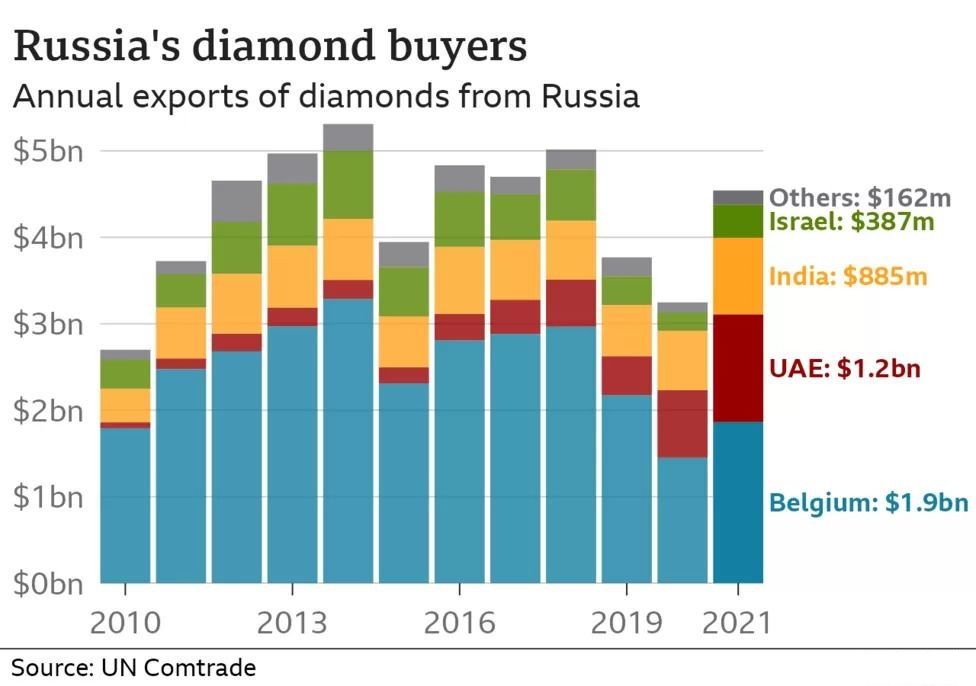
Russia's diamond trade, worth about $4bn (£3.2bn) per year, makes up a small proportion of its overall exports.

Before the invasion of Ukraine, Russia's total exports reached $489.8bn in 2021, according to the central bank, with oil and gas making up $240.7bn of that.

Nevertheless, Russia is the world's biggest diamond exporter by volume, followed by African countries.

A state-owned company called Alrosa dominates Russian diamond mining - and it mined almost a third of the world's diamonds in 2021.

Profits from Alrosa do flow into the Kremlin war chest, according to Hans Merket, a researcher with the International Peace Information Service - but it is nowhere near as important as oil and gas.


Why does the G7 want to track Russian diamonds?


Western countries want to cut off this revenue stream as part of efforts to hamper Russia's war.

However, the world's diamond trade is complex, and lacks transparency.

Diamonds can change hands 20 to 30 times between mine and market, Mr Merket said.

Typically the gemstones pass through the main global hubs of Antwerp, Dubai, Mumbai and Ramat Gan, which is near Tel Aviv.

Traders grade the stones for carat (weight), colour, clarity and cut - with different traders looking for different attributes.

They then take the remaining gemstones, mix them up, and sell them on - and the process is repeated.

Traders and firms jealously guard where they source their diamonds - it's their "secret sauce", according to Tobias Kormind, managing director of online jeweller 77 Diamonds.

But the major industry players could restrict the trade of Russian diamonds if they pulled together, he said.


How could the flow of Russian diamonds be restricted?


The US has already brought in sanctions to try to ban Russian diamond exports.

However, there is a "massive loophole" here, Mr Kormind said.

The restrictions apply to rough diamonds - but once they have been cut and polished, the country of origin no longer matters.

People in G7 countries buy about 70% of the world's diamonds - so a G7 ban could have an effect, if the diamonds can be traced, Mr Merket said.

However, a G7 ban would mean diamonds are likely to flow to other markets in China and India, Mr Kormind said.

Tracing the diamonds would make restricting that flow easier.


How could diamonds be traced?


There is already a scheme to try to restrict "blood diamonds" used to fuel conflict, called the Kimberley Process, where states certify that diamonds are "conflict free".

However, this does not allow the diamonds to be traced to the country of origin.

Mr Merket said the simplest way of tracing diamonds would be to extend this process to include documentation of where the stones come from.

There are also technologies that mark stones, and one is being developed that can scan them to check their geographical origin.


What effects would a ban have?


The majority of Russian diamonds end up in India, where there is a major cutting and polishing centre in Surat.

Smaller diamond businesses in the city have already suffered, in part due to the US ban.

In Africa, local mining operations benefitted after US sanctions hit Russian exports. However, many African mining producers are not ready to feed into a traceability scheme, Mr Merket said, and could be excluded if one is brought in.

In Angola, Russia's Alrosa has a significant stake in mining, and tightening sanctions could hit local firms.

For Europe, traceability needs to be "watertight, scientific, [and] international", said Tom Neys, head of media relations at the Antwerp World Diamond Centre.

If not, Europe risks losing $40bn in trade annually to places that don't have the frameworks to deal with money laundering and terrorism, he said.

He added that UK sanctions "will have no impact on the sale of Russian diamonds" because the UK represents less than 1% of the global diamond trade.

A UK government spokesperson said it would work with key partners to help restrict the Russian diamond trade, "including through tracing technologies".

Newsletter

Related Articles

Saudi Press
0:00
0:00
Close
The U.S. State Department’s account in Persian: “President Trump is a man of action. If you didn’t know it until now, now you do—do not play games with President Trump.”
CNN’s Ranking of Israel’s Women’s Rights Sparks Debate After Misleading Global Index Comparison
Saudi Arabia’s Shifting Regional Alignment Raises Strategic Concerns in Jerusalem
OPEC+ Holds Oil Output Steady Amid Member Tensions and Market Oversupply
Iranian Protests Intensify as Another Revolutionary Guard Member Is Killed and Khamenei Blames the West
President Trump Says United States Will Administer Venezuela Until a Secure Leadership Transition
Delta Force Identified as Unit Behind U.S. Operation That Captured Venezuela’s President
Trump Announces U.S. Large-Scale Strike on Venezuela, Declares President Maduro and Wife Captured
Saudi-UAE Rift Adds Complexity to Middle East Diplomacy as Trump Signals Firm Leadership
OPEC+ to Keep Oil Output Policy Unchanged Despite Saudi-UAE Tensions Over Yemen
Saudi Arabia and UAE at Odds in Yemen Conflict as Southern Offensive Deepens Gulf Rift
Abu Dhabi ‘Capital of Capital’: How Abu Dhabi Rose as a Sovereign Wealth Power
Diamonds Are Powering a New Quantum Revolution
Trump Threatens Strikes Against Iran if Nuclear Programme Is Restarted
Why Saudi Arabia May Recalibrate Its US Spending Commitments Amid Rising China–America Rivalry
Riyadh Air’s First Boeing 787-9 Dreamliner Completes Initial Test Flight, Advancing Saudi Carrier’s Launch
Saudi Arabia’s 2025: A Pivotal Year of Global Engagement and Domestic Transformation
Saudi Arabia to Introduce Sugar-Content Based Tax on Sweetened Drinks from January 2026
Saudi Hotels Prepare for New Hospitality Roles as Alcohol Curbs Ease
Global Airports Forum Highlights Saudi Arabia’s Emergence as a Leading Aviation Powerhouse
Saudi Arabia Weighs Strategic Choice on Iran Amid Regional Turbulence
Not Only F-35s: Saudi Arabia to Gain Access to the World’s Most Sensitive Technology
Saudi Arabia Condemns Sydney Bondi Beach Shooting and Expresses Solidarity with Australia
Washington Watches Beijing–Riyadh Rapprochement as Strategic Balance Shifts
Saudi Arabia Urges Stronger Partnerships and Efficient Aid Delivery at OCHA Donor Support Meeting in Geneva
Saudi Arabia’s Vision 2030 Drives Measurable Lift in Global Reputation and Influence
Alcohol Policies Vary Widely Across Muslim-Majority Countries, With Many Permitting Consumption Under Specific Rules
Saudi Arabia Clarifies No Formal Ban on Photography at Holy Mosques for Hajj 2026
Libya and Saudi Arabia Sign Strategic MoU to Boost Telecommunications Cooperation
Elon Musk’s xAI Announces Landmark 500-Megawatt AI Data Center in Saudi Arabia
Israel Moves to Safeguard Regional Stability as F-35 Sales Debate Intensifies
Cardi B to Make Historic Saudi Arabia Debut at Soundstorm 2025 Festival
U.S. Democratic Lawmakers Raise National Security and Influence Concerns Over Paramount’s Hostile Bid for Warner Bros. Discovery
Hackers Are Hiding Malware in Open-Source Tools and IDE Extensions
Traveling to USA? Homeland Security moving toward requiring foreign travelers to share social media history
Wall Street Analysts Clash With Riyadh Over Saudi Arabia’s Deficit Outlook
Trump and Saudi Crown Prince Cement $1 Trillion-Plus Deals in High-Profile White House Summit
Saudi Arabia Opens Alcohol Sales to Wealthy Non-Muslim Residents Under New Access Rules
U.S.–Saudi Rethink Deepens — Washington Moves Ahead Without Linking Riyadh to Israel Normalisation
Saudi Arabia and Israel Deprioritise Diplomacy: Normalisation No Longer a Middle-East Priority
Saudi Arabia Positions Itself as the Backbone of the Global AI Era
As Trump Deepens Ties with Saudi Arabia, Push for Israel Normalization Takes a Back Seat
Thai Food Village Debuts at Saudi Feast Food Festival 2025 Under Thai Commerce Minister Suphajee’s Lead
Saudi Arabia Sharpens Its Strategic Vision as Economic Transformation Enters New Phase
Saudi Arabia Projects $44 Billion Budget Shortfall in 2026 as Economy Rebalances
OPEC+ Unveils New Capacity-Based System to Anchor Future Oil Output Levels
Will Saudi Arabia End Up Bankrolling Israel’s Post-Ceasefire Order in Lebanon?
Saudi Arabia’s SAMAI Initiative Surpasses One-Million-Citizen Milestone in National AI Upskilling Drive
Saudi Arabia’s Specialty Coffee Market Set to Surge as Demand Soars and New Exhibition Drops in December
Saudi Arabia Moves to Open Two New Alcohol Stores for Foreigners Under Vision 2030 Reform
×