Saudi Press

Saudi Arabia and the world
Monday, Jan 26, 2026

Visualising the Quran

Visualising the Quran

The Quran is the central religious text in Islam and is believed by Muslims to be the word of God as guidance for humanity.

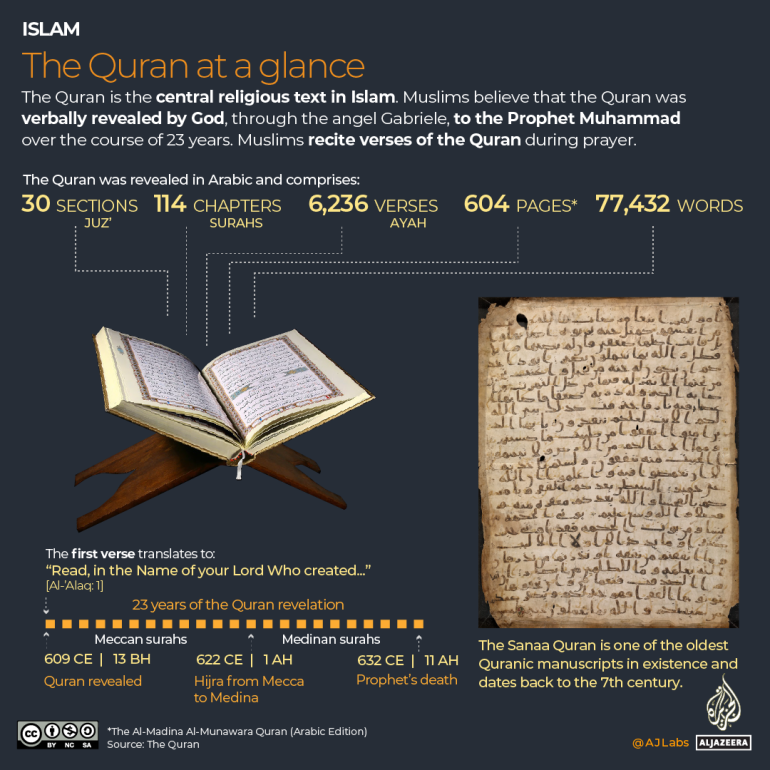
The Quran is the central religious text in Islam. Muslims believe the Quran was verbally revealed by God, through the angel Gabriel, to the Prophet Muhammad over the course of 23 years.

The Quran was revealed in Arabic and it comprises: 30 sections, 114 chapters, 6,236 verses and 77,432 words.

The first verse of the Quran translates to: “Read, in the Name of your Lord Who created ...” [Al-’Alaq: 1]

Muslims are encouraged to continually read and memorise the Quran which has been preserved – to the letter – in its original form since it was revealed more than 1,400 years ago.

Among the oldest Quranic manuscripts in existence are the Sanaa Quran and Birmingham University Quran, both of which date back to the 7th century.

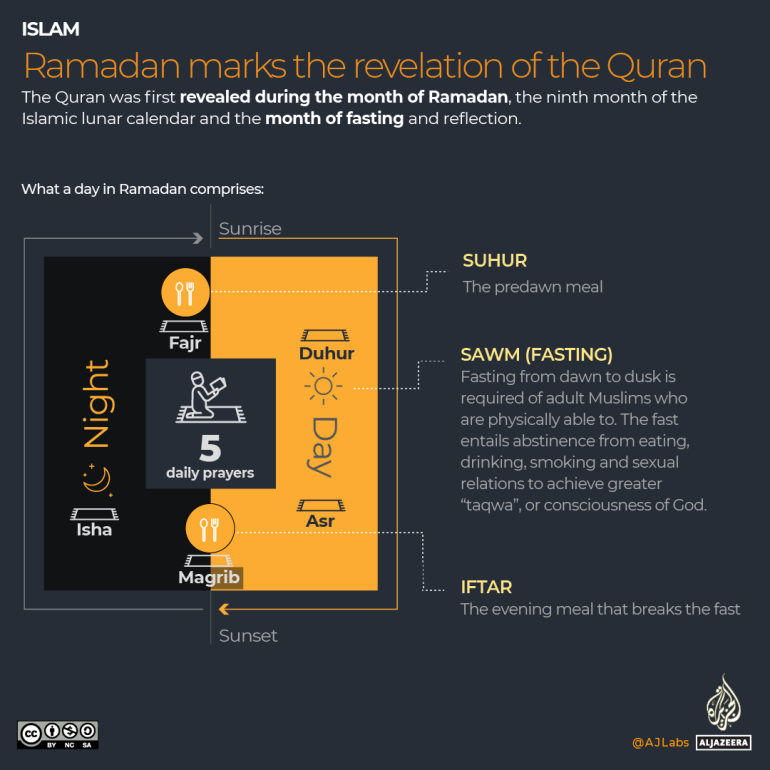
The Quran was first revealed during the month of Ramadan, the ninth month of the Islamic lunar calendar and the month of fasting and reflection.

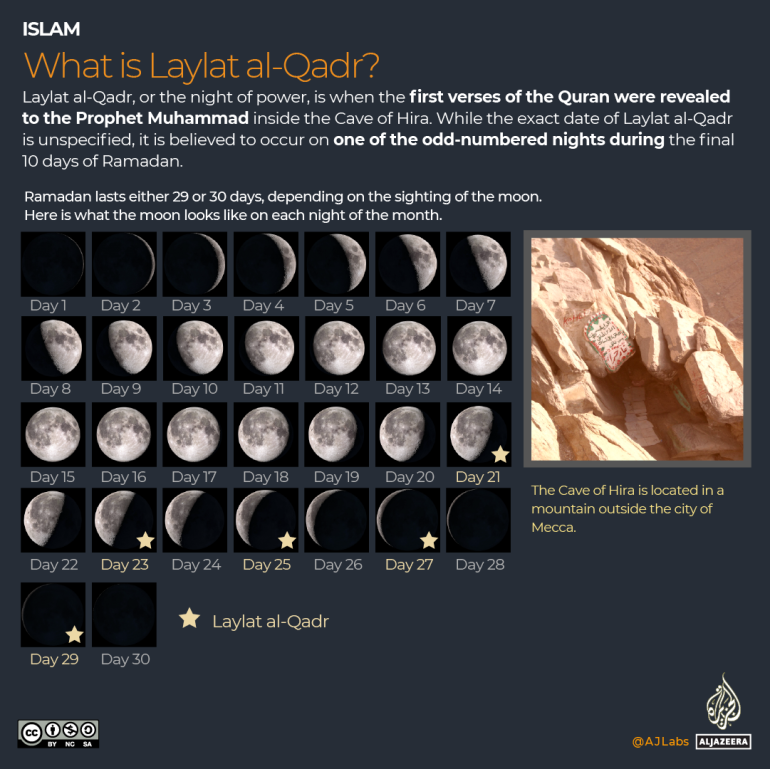
Ramadan lasts either 29 or 30 days, depending on the sighting of the moon.

Laylat al-Qadr, or the night of power, is considered by Muslims to be the holiest night of the year. It is the night when the first verses of the Quran were revealed to the Prophet Muhammad inside the Cave of Hira - located in a mountain outside the city of Mecca.

While the exact date of Laylat al-Qadr is unspecified, it is believed to occur on one of the odd-numbered nights during the final 10 days of Ramadan.

Praying on that night is believed to be better than a thousand months of worship and devotion. For this reason, millions of Muslims head towards mosques to attend congregational prayers during this time.

Fasting during the month of Ramadan, from dawn to dusk, is required of adult Muslims who are physically able to. The fast entails abstinence from eating, drinking, smoking and sexual relations to achieve greater “taqwa”, or consciousness of God.

At the end of Ramadan, Muslims celebrate Eid al-Fitr. In Arabic, it means “festival of breaking the fast”.

The Quran is meant as guidance for humanity and covers various topics from the oneness of God (Allah), moral behaviour, social conduct and stories of the prophets.

In many Muslim-majority countries, Quranic recitations, which Muslims recite during prayer, echo on the streets outside for everyone to hear.

The repetition of words and symmetry appears frequently in the Quran. For example, life and death are both mentioned 145 times throughout the Quran. Angels and devils are mentioned 88 times each, while man and woman are each mentioned 24 times.

The word “day” is repeated 365 times in the Quran - which some scholars have connected to the number of days in a year. The word “month” is repeated 12 times in the Quran - like the number of months in a year. “Days”, in the plural form, is repeated 30 times - like the number of days in a month.
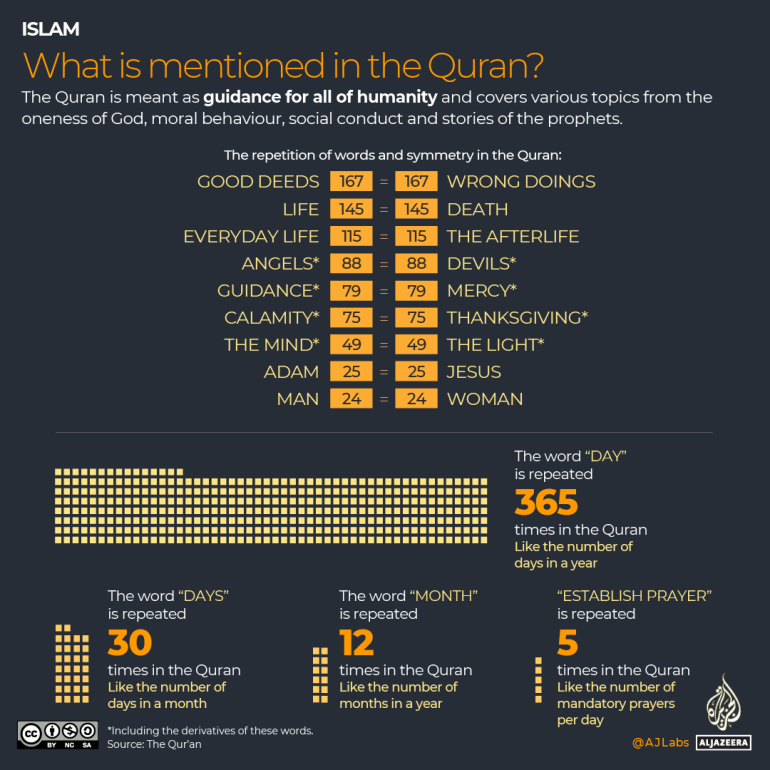
“Establish prayer” is repeated five times in the Quran, the same number of times of mandatory prayers per day.


The names of Allah mentioned in the Quran


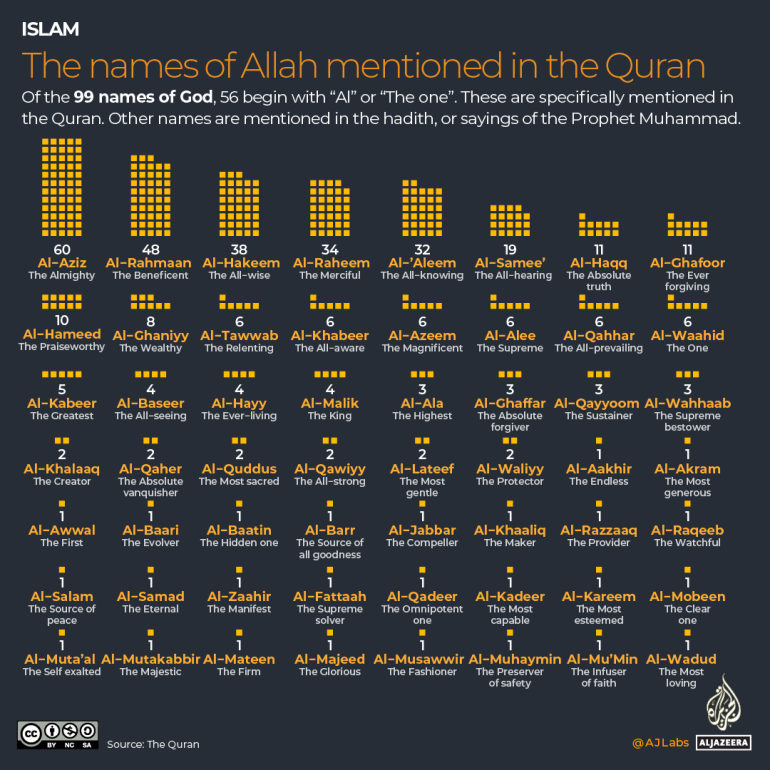
Of the 99 names of God (Allah), 56 begin with "Al" or "The one". These are specifically mentioned in the Quran. Other names are mentioned in the hadith, or sayings of the Prophet Muhammad.

The most frequently mentioned name of God is Al-Aziz (The Almighty) with 60 mentions, followed by Ar-Rahmaan (The Beneficent) 48 times and Al-Hakeem (The All Wise) with 38 mentions.

Many Muslim names and surnames are prefixed by “Abd al” or Abdul, meaning the “servant of”, followed by any one of the 99 names such as Abdulrahmaan or Abd Al-Aziz.

The 25 prophets mentioned in the Quran


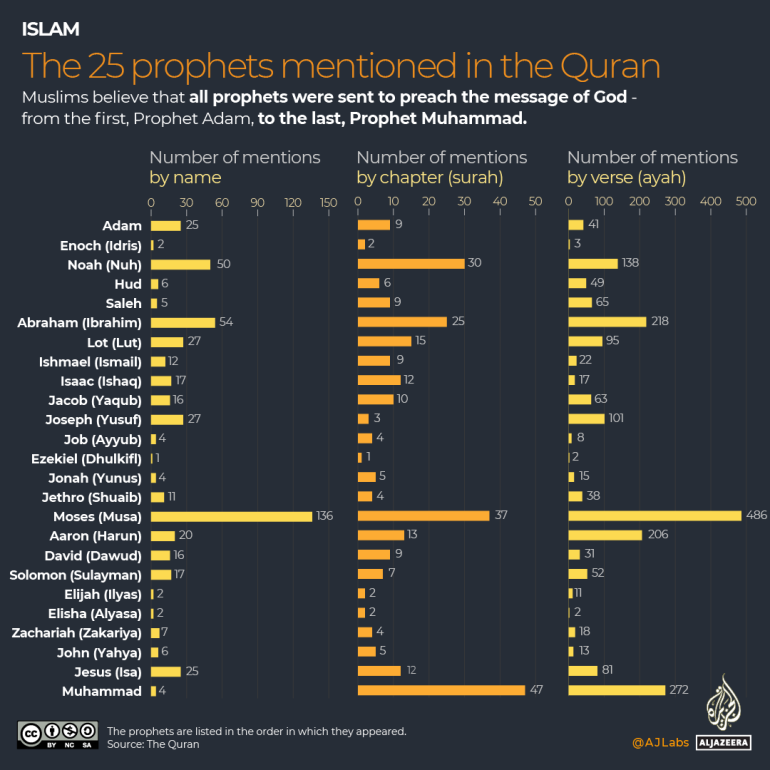
Muslims believe that all prophets were sent to preach the message of God - from the first, Prophet Adam, to the last, Prophet Muhammad. More than a quarter (26 percent) of the words of the Quran are stories of the prophets which are meant to serve as historical lessons for people.

The prophets most mentioned by name in the Quran are Prophet Moses (136 times), followed by Prophet Abraham (54 times) and Prophet Noah (50 times). Prophet Adam and Prophet Jesus are mentioned 25 times each.

The Prophet Muhammad is mentioned in the most number of chapters in the Quran, appearing 47 times.

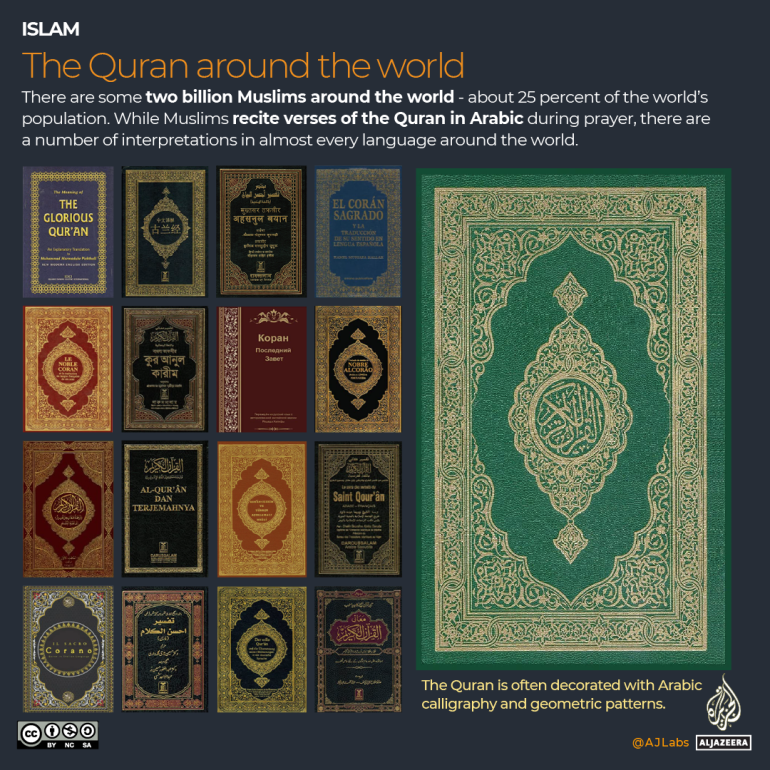
There are some two billion Muslims around the world - about 25 percent of the world’s population. While Muslims recite verses of the Quran in Arabic during prayer, there are a number of interpretations in almost every language around the world.

Muslims are taught to handle the Quran with utmost respect and care. To express their admiration, Quran covers are often decorated with Arabic calligraphy and geometric patterns.

The graphic below shows the covers of translations of the Quran in some of the world’s most spoken languages.

Newsletter

Related Articles

Saudi Press
0:00
0:00
Close
Trump Defends Saudi Crown Prince in Heated Exchange After Reporter Questions Khashoggi Murder and 9/11 Links
Saudi Stocks Rally as Kingdom Prepares to Fully Open Capital Market to Global Investors
Air France and KLM Suspend Multiple Middle East Routes as Regional Tensions Disrupt Aviation
Saudi Arabia scales back Neom as The Line is redesigned and Trojena downsized
Saudi Industrial Group Completes One Point Three Billion Dollar Acquisition of South Africa’s Barloworld
Saudi-Backed LIV Golf Confirms Return to Trump National Bedminster for 2026 Season
Gold Jumps More Than 8% in a Week as the Dollar Slides Amid Greenland Tariff Dispute
Boston Dynamics Atlas humanoid robot and LG CLOiD home robot: the platform lock-in fight to control Physical AI
United States under President Donald Trump completes withdrawal from the World Health Organization: health sovereignty versus global outbreak early-warning access
Trump Administration’s Iran Military Buildup and Sanctions Campaign Puts Deterrence Credibility on the Line
Tech Brief: AI Compute, Chips, and Platform Power Moves Driving Today’s Market Narrative
NATO’s Stress Test Under Trump: Alliance Credibility, Burden-Sharing, and the Fight Over Strategic Territory
Saudi Arabia’s Careful Balancing Act in Relations with Israel Amid Regional and Domestic Pressures
Greenland, Gaza, and Global Leverage: Today’s 10 Power Stories Shaping Markets and Security
America’s Venezuela Oil Grip Meets China’s Demand: Market Power, Legal Shockwaves, and the New Rules of Energy Leverage
Trump’s Board of Peace: Breakthrough Diplomacy or a Hostile Takeover of Global Order?
Prince William to Make Official Visit to Saudi Arabia in February
Saudi Arabia Advances Ambitious Artificial River Mega-Project to Transform Water Security
Saudi Crown Prince and Syrian President Discuss Stabilisation, Reconstruction and Regional Ties in Riyadh Talks
Mohammed bin Salman Confronts the ‘Iranian Moment’ as Saudi Leadership Faces Regional Test
Cybercrime, Inc.: When Crime Becomes an Economy. How the World Accidentally Built a Twenty-Trillion-Dollar Criminal Economy
Strategic Restraint, Credible Force, and the Discipline of Power
Donald Trump Organization Unveils Championship Golf Course and Luxury Resort Project in Saudi Arabia
Inside Diriyah: Saudi Arabia’s $63.2 Billion Vision to Transform Its Historic Heart into a Global Tourism Powerhouse
Trump Designates Saudi Arabia a Major Non-NATO Ally, Elevating US–Riyadh Defense Partnership
Trump Organization Deepens Saudi Property Focus with $10 Billion Luxury Developments
There is no sovereign immunity for poisoning millions with drugs.
Mohammed bin Salman’s Global Standing: Strategic Partner in Transition Amid Debate Over His Role
Saudi Arabia Opens Property Market to Foreign Buyers in Landmark Reform
The U.S. State Department’s account in Persian: “President Trump is a man of action. If you didn’t know it until now, now you do—do not play games with President Trump.”
CNN’s Ranking of Israel’s Women’s Rights Sparks Debate After Misleading Global Index Comparison
Saudi Arabia’s Shifting Regional Alignment Raises Strategic Concerns in Jerusalem
OPEC+ Holds Oil Output Steady Amid Member Tensions and Market Oversupply
Iranian Protests Intensify as Another Revolutionary Guard Member Is Killed and Khamenei Blames the West
President Trump Says United States Will Administer Venezuela Until a Secure Leadership Transition
Delta Force Identified as Unit Behind U.S. Operation That Captured Venezuela’s President
Trump Announces U.S. Large-Scale Strike on Venezuela, Declares President Maduro and Wife Captured
Saudi-UAE Rift Adds Complexity to Middle East Diplomacy as Trump Signals Firm Leadership
OPEC+ to Keep Oil Output Policy Unchanged Despite Saudi-UAE Tensions Over Yemen
Saudi Arabia and UAE at Odds in Yemen Conflict as Southern Offensive Deepens Gulf Rift
Abu Dhabi ‘Capital of Capital’: How Abu Dhabi Rose as a Sovereign Wealth Power
Diamonds Are Powering a New Quantum Revolution
Trump Threatens Strikes Against Iran if Nuclear Programme Is Restarted
Why Saudi Arabia May Recalibrate Its US Spending Commitments Amid Rising China–America Rivalry
Riyadh Air’s First Boeing 787-9 Dreamliner Completes Initial Test Flight, Advancing Saudi Carrier’s Launch
Saudi Arabia’s 2025: A Pivotal Year of Global Engagement and Domestic Transformation
Saudi Arabia to Introduce Sugar-Content Based Tax on Sweetened Drinks from January 2026
Saudi Hotels Prepare for New Hospitality Roles as Alcohol Curbs Ease
Global Airports Forum Highlights Saudi Arabia’s Emergence as a Leading Aviation Powerhouse
Saudi Arabia Weighs Strategic Choice on Iran Amid Regional Turbulence
×