Saudi Press

Saudi Arabia and the world
Friday, Jan 23, 2026

Swiss start-up rivals Google with '100%' secure smartphone keyboard

Swiss start-up rivals Google with '100%' secure smartphone keyboard

Swiss start-up Typewise has developed an AI keyboard for your phone that is better at correcting typos and more secure. Can it rival the US giants?

The application we use most on our phones is the keyboard, spending on average up to an hour a day typing on our phones to decode our thoughts and interact with our contacts.

But the keyboards we typically use are not designed for today’s mobile world and are based on typewriters used in the 19th century. The most commonly used keyboards from Google and Microsoft are also arguably not that secure.

The Swiss start-up Typewise is trying to rival the tech giants in offering a keyboard app that claims to be 100 per cent secure and allows you to type with four times fewer typos.

“Our algorithms work on your phone device, so none of your data, none of what you type gets transmitted to the cloud or internet and that's very different from pretty much any standard keyboard that you find in the market,” Typewise chief executive officer and co-founder David Eberle told Euronews Next.

“People are scared of WhatsApp and say ‘I need to switch to some secure messenger’ but then the keyboard they use on that secure messenger may still siphon off all the data and send it somewhere else.”

How does it work?


With its larger hexagon keyboard and layout, it also claims to be easier to use and has 33 per cent faster typing speeds.

But switching from the keyboards we are so accustomed to using daily and getting used to new features does admittedly take time.

The keyboard works by using an AI technology that corrects your mistakes and can predict your next words while also learning the user’s own slang or colloquial vocabulary.

“The algorithms are better than even a Google keyboard that's out there,” Eberle said.

Another key feature the keyboard offers is that it recognises over 40 different Latin-based languages, so you could type in English and in French in the same sentence without it autocorrecting or having to manually switch languages.

As the company is based in Switzerland, a country that speaks four languages, it is in a prime position to understand the need for multiple language technology, unlike its United States-based rivals.

Typewise is also collaborating on its AI system with the Swiss Federal Institute of Technology and is developing its predictive text ability.

“Traditional machine learning models are more probability-based and you see it also on your phone. The typical words that get suggested are ‘the or an or he or I’, because those are very probable words,” said Eberle.
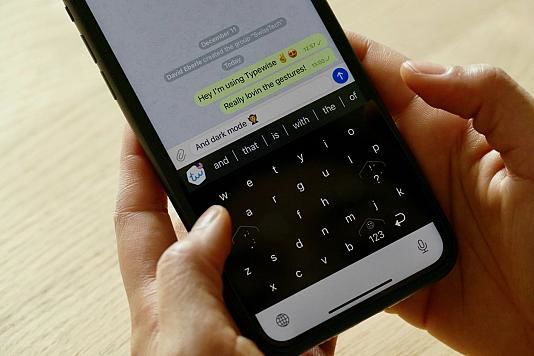
Example of the hexagon keyboard


“But you don't type those words all the time. So I think the challenge really in this technology is to make it more personal to you, how you type, but also understanding the context.”

He said the technology could become really powerful when it does not just predict the next word, but could even one day predict the next sentence and even an entire paragraph.

But the company wants to expand past smartphone keyboards.

Its goal is to licence its AI technology as an Application Programming Interface (API) and Software Development Kit (SDK) so that it can then power its technology across mobile, desktop and even brain-computer interfaces.

How to take on the tech giants


Google and Microsoft are also developing their own predictive text technology but the Swiss start-up says it is also a contender for a place in the market.

“We believe there is a space for an independent provider that also has a different approach with privacy built in,” said Eberle.

“I think it's a big opportunity because not all the big enterprises want to work with Microsoft or Google, which is their proprietary technology. And we believe with a more open approach that we have a right to win in the market.”

Eberle started the company with his school friend Janis Berneker, officially launching Typewise in 2019. Since then it has grown to have over one million users.

It hopes to grow ten-fold in two years. The app is free to download but has a pro setting that allows use of additional features for just over €2 a month.

The company started with a Kickstarter campaign and had a successful seed round in 2020 where it raised $1 million (€1.2 million). It has had 400 per cent revenue growth year-on-year.

On August 23, the company is also launching an equity crowdfunding campaign, which Eberle said has already garnered a lot of attention.

In its mammoth challenge to contend with Google and Microsoft, Eberle believes being based in a small European country has its advantages.

Switzerland is more risk-averse than the US, he acknowledged, but says in being a small country, you are forced to expand to other markets quickly, which requires new approaches.

“We know that the domestic market is never going to be big enough. And maybe that's a driver of being more open-minded,” Eberle said.

“I think with any Start-up you have, you have to kind of run-up hills and you just have to run fast enough to kind of make it.”

Newsletter

Related Articles

Saudi Press
0:00
0:00
Close
Saudi Arabia’s Careful Balancing Act in Relations with Israel Amid Regional and Domestic Pressures
Greenland, Gaza, and Global Leverage: Today’s 10 Power Stories Shaping Markets and Security
America’s Venezuela Oil Grip Meets China’s Demand: Market Power, Legal Shockwaves, and the New Rules of Energy Leverage
Trump’s Board of Peace: Breakthrough Diplomacy or a Hostile Takeover of Global Order?
Prince William to Make Official Visit to Saudi Arabia in February
Saudi Arabia Advances Ambitious Artificial River Mega-Project to Transform Water Security
Saudi Crown Prince and Syrian President Discuss Stabilisation, Reconstruction and Regional Ties in Riyadh Talks
Mohammed bin Salman Confronts the ‘Iranian Moment’ as Saudi Leadership Faces Regional Test
Cybercrime, Inc.: When Crime Becomes an Economy. How the World Accidentally Built a Twenty-Trillion-Dollar Criminal Economy
Strategic Restraint, Credible Force, and the Discipline of Power
Donald Trump Organization Unveils Championship Golf Course and Luxury Resort Project in Saudi Arabia
Inside Diriyah: Saudi Arabia’s $63.2 Billion Vision to Transform Its Historic Heart into a Global Tourism Powerhouse
Trump Designates Saudi Arabia a Major Non-NATO Ally, Elevating US–Riyadh Defense Partnership
Trump Organization Deepens Saudi Property Focus with $10 Billion Luxury Developments
There is no sovereign immunity for poisoning millions with drugs.
Mohammed bin Salman’s Global Standing: Strategic Partner in Transition Amid Debate Over His Role
Saudi Arabia Opens Property Market to Foreign Buyers in Landmark Reform
The U.S. State Department’s account in Persian: “President Trump is a man of action. If you didn’t know it until now, now you do—do not play games with President Trump.”
CNN’s Ranking of Israel’s Women’s Rights Sparks Debate After Misleading Global Index Comparison
Saudi Arabia’s Shifting Regional Alignment Raises Strategic Concerns in Jerusalem
OPEC+ Holds Oil Output Steady Amid Member Tensions and Market Oversupply
Iranian Protests Intensify as Another Revolutionary Guard Member Is Killed and Khamenei Blames the West
President Trump Says United States Will Administer Venezuela Until a Secure Leadership Transition
Delta Force Identified as Unit Behind U.S. Operation That Captured Venezuela’s President
Trump Announces U.S. Large-Scale Strike on Venezuela, Declares President Maduro and Wife Captured
Saudi-UAE Rift Adds Complexity to Middle East Diplomacy as Trump Signals Firm Leadership
OPEC+ to Keep Oil Output Policy Unchanged Despite Saudi-UAE Tensions Over Yemen
Saudi Arabia and UAE at Odds in Yemen Conflict as Southern Offensive Deepens Gulf Rift
Abu Dhabi ‘Capital of Capital’: How Abu Dhabi Rose as a Sovereign Wealth Power
Diamonds Are Powering a New Quantum Revolution
Trump Threatens Strikes Against Iran if Nuclear Programme Is Restarted
Why Saudi Arabia May Recalibrate Its US Spending Commitments Amid Rising China–America Rivalry
Riyadh Air’s First Boeing 787-9 Dreamliner Completes Initial Test Flight, Advancing Saudi Carrier’s Launch
Saudi Arabia’s 2025: A Pivotal Year of Global Engagement and Domestic Transformation
Saudi Arabia to Introduce Sugar-Content Based Tax on Sweetened Drinks from January 2026
Saudi Hotels Prepare for New Hospitality Roles as Alcohol Curbs Ease
Global Airports Forum Highlights Saudi Arabia’s Emergence as a Leading Aviation Powerhouse
Saudi Arabia Weighs Strategic Choice on Iran Amid Regional Turbulence
Not Only F-35s: Saudi Arabia to Gain Access to the World’s Most Sensitive Technology
Saudi Arabia Condemns Sydney Bondi Beach Shooting and Expresses Solidarity with Australia
Washington Watches Beijing–Riyadh Rapprochement as Strategic Balance Shifts
Saudi Arabia Urges Stronger Partnerships and Efficient Aid Delivery at OCHA Donor Support Meeting in Geneva
Saudi Arabia’s Vision 2030 Drives Measurable Lift in Global Reputation and Influence
Alcohol Policies Vary Widely Across Muslim-Majority Countries, With Many Permitting Consumption Under Specific Rules
Saudi Arabia Clarifies No Formal Ban on Photography at Holy Mosques for Hajj 2026
Libya and Saudi Arabia Sign Strategic MoU to Boost Telecommunications Cooperation
Elon Musk’s xAI Announces Landmark 500-Megawatt AI Data Center in Saudi Arabia
Israel Moves to Safeguard Regional Stability as F-35 Sales Debate Intensifies
Cardi B to Make Historic Saudi Arabia Debut at Soundstorm 2025 Festival
U.S. Democratic Lawmakers Raise National Security and Influence Concerns Over Paramount’s Hostile Bid for Warner Bros. Discovery
×