Saudi Press

Saudi Arabia and the world
Saturday, Mar 14, 2026

Shinzo Abe death: Shock killing that could change Japan forever

Shinzo Abe death: Shock killing that could change Japan forever

Since news broke this morning of Shinzo Abe's shooting, messages have been pouring in from friends and contacts, all asking the same question: how could this have happened in Japan?

I felt much the same myself. Living here you get used to not thinking about violent crime.

The identity of the victim only makes the news more shocking.

Shinzo Abe may no longer be Japan's prime minister, but he's still a huge figure in Japanese public life, and probably the most recognisable Japanese politician of the last three decades.

Who would want to kill Abe? And why?

I'm trying to think of an equivalent - of another act of political violence that would be similarly shocking to the local population. The one that comes to mind is the shooting of Swedish Prime Minister Olof Palme in 1986.

When I say people don't think about violent crime here, I'm not exaggerating.

Yes, there are the Yakuza, Japan's famously violent organised crime gangs. But most people never come in to contact with them. Even the Yakuza shy away from guns because the penalties for illegal possession are just not worth it.

Owning a gun in Japan is extremely difficult. It requires no criminal record, mandatory training, psychological evaluation, and extensive background checks including police interviewing neighbours.

Consequently, gun crime virtually doesn't exist here. On average, there are fewer than 10 gun-related deaths in Japan each year. In 2017, there were just three.

Little wonder then that much of the attention has been focused on the gunman and the weapon he used.

Who is he? Where did he get the gun from? Japanese media is reporting that the 41-year-old is a former member of the country's self-defence forces, the equivalent of an army.

But closer inspection shows he only spent three years in the navy. The gun he used is more curious. Pictures of it lying on the ground after the shooting show what looks like a home-made weapon. Two bits of steel pipe stuck together with black gaffer tape, with some sort of handmade trigger. It looks like something fashioned from plans downloaded off the internet.

So, was this a deliberate political attack, or the act of a fantasist, someone who wanted to become famous, by shooting someone famous? So far, we don't know.
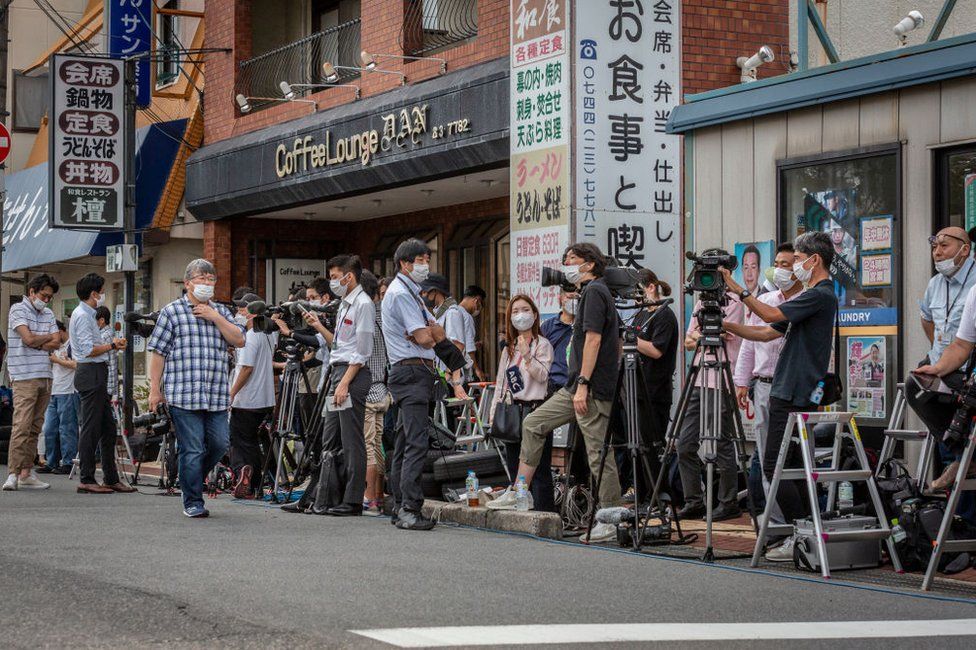
The news has shocked a country that prides itself on public safety


Japan has certainly had its share of political assassinations. The most famous was in 1960 when the leader of Japan's socialist party, Inejiro Asanuma, was stabbed in the abdomen by a right-wing fanatic wielding a samurai sword. Although right-wing extremists still exist in Japan, Abe, a right-wing nationalist, would be an unlikely target.

In recent years, we have seen another type of crime becoming more common here. The quiet, lonely male with a grudge against someone or something.

In 2019, a man set fire to a building housing a popular animation studio in Kyoto, killing 36 people.

The man told police he had a grudge against the studio because it had "stolen his work".

In another case in 2008, a disgruntled young man drove a truck into a crowd of shoppers in Tokyo's Akihabara district, then got out and started stabbing onlookers. Seven people were killed.

Before carrying out the attack he had posted a message online saying, "I will kill people in Akihabara" and "I don't have a single friend, I am ignored because I'm ugly. I am lower than trash".

It's not clear yet whether Abe's shooting fits in to the first or the second category. But it seems certain that the assassination will change Japan.

Given how safe Japan is, security here is very relaxed. During election campaigns, like the ongoing one, politicians literally stand on street corners giving speeches and shaking hands with shoppers and passers-by.

It's almost certainly why Abe's attacker was able to get so close and discharge the weapon he had cobbled together.

That surely has to change after today.

Newsletter

Related Articles

Saudi Press
0:00
0:00
Close
Strait of Hormuz Crisis Forces Saudi Arabia Into Major Oil Production Shut-In
Saudi Arabia Slashes Oil Output as Strait of Hormuz Crisis Cuts Deep Into Gulf Revenues
Saudi Arabia’s Cultural Scene Presses Ahead as Nation Navigates Regional War
Saudi-Pakistan Defence Pact Faces Real-World Constraints as Iran War Escalates
Saudi Arabia Offers Two Million Barrels of Crude From Red Sea as War Disrupts Gulf Exports
Formula One Faces Tens of Millions in Lost Revenue if Bahrain and Saudi Arabia Races Are Cancelled
Formula One Set to Cancel Bahrain and Saudi Arabian Grands Prix Amid Escalating Middle East War
Saudi Arabia Downs Dozens of Iranian Drones in Major Defensive Operation
Saudi Arabia Cuts Oil Output by About Twenty Percent as Iran War Disrupts Gulf Energy Flows
Formula One Set to Cancel Bahrain and Saudi Arabian Grands Prix Amid Escalating Iran War
Asian Energy Security Tested as Strait of Hormuz Disruption Threatens Oil Supplies
Iran Sets Three Conditions for Ending Regional War as Diplomatic Efforts Intensify
Saudi Arabia Launches Royal Institute of Anthropology to Examine Social Transformation
Pakistan’s Prime Minister Shehbaz Sharif Arrives in Saudi Arabia for High-Level Talks
Saudi Aramco Turns to Ukrainian Drone Interceptors to Shield Oil Infrastructure from Iranian Threats
UK Foreign Secretary Travels to Saudi Arabia to Reinforce Support for Regional Allies
Rising Iran Conflict Casts Shadow Over Saudi Arabia’s $38 Billion Gaming Industry Ambitions
Iran Launches Missile and Drone Strikes Across Gulf as Oil Prices Surge Past $100
Saudi Air Defences Destroy Three Drones Targeting Strategic Shaybah Oil Field
Debate Grows Over Saudi Arabia’s Role in Sudan War Amid US Alliance Questions
Pakistan’s Prime Minister Travels to Saudi Arabia After Discussions With Iranian Leadership
Two Strategic Pipelines Allow Saudi Arabia and the UAE to Bypass the Strait of Hormuz
US Deploys Bunker-Buster Bombs to UK Airbase as Iran Conflict Intensifies
Iran warns of $200 oil as forces target merchant ships in Gulf
Japan to Release 45 Days of Oil Reserves Amid Iran Conflict
Saudi Red Sea Oil Exports Set for Record in March as Kingdom Reroutes Crude Amid Hormuz Crisis
Saudi Arabia Seeks Belgian Military Support After Iranian Missile Attacks
Saudi Arabia Welcomes US Decision to Designate Sudan’s Muslim Brotherhood as Terrorist Organisation
Saudi Aramco Plans Dual Gulf and Red Sea Export Routes as Iran Crisis Disrupts Oil Shipments
Saudi Cabinet Condemns Iranian Attacks and Reaffirms Kingdom’s Right to Defend Its Sovereignty
Ukraine Deploys Counter-Drone Teams to Gulf States as Iranian Drone Threat Expands
Bahrain Grand Prix Faces Uncertainty as Saudi Arabia Works to Keep Formula One Race on Track
Saudi Arabia Faces New Strategic Dilemma in Yemen as Regional War Reshapes Calculations
OPEC Confirms Saudi-Led Oil Output Increase as Iran War Disrupts Global Energy Markets
Pakistan Pledges Rapid Support for Saudi Arabia Amid Escalating Middle East Tensions
Global Energy Agency Announces Record Release of 400 Million Barrels to Stabilize Oil Markets Amid Hormuz Disruption
Aramco Warns Global Oil Market Faces ‘Catastrophic’ Shock if Strait of Hormuz Remains Closed
Iran Launches Drone and Missile Attacks Across Gulf Targets Including Saudi Arabia, Kuwait and Bahrain
Saudi Arabia Elevates Fahad Al-Saif as Vision 2030 Enters Crucial Implementation Phase
Saudi Aramco Expands Routes to Move Oil Without Reliance on the Strait of Hormuz
Saudi Arabia and Pakistan Reaffirm Mutual Defense Cooperation Following Iran Strike
Saudi Arabia Plans Major Ukrainian Arms Deal to Counter Iranian Drone Threat
Pentagon Signals Intensification of U.S. Air Campaign as Iran Conflict Escalates
U.S. Senator Lindsey Graham Raises Prospect of Mutual Defense Pact With Saudi Arabia Amid Iran Conflict
Why Saudi Arabia Is Unlikely to Have Wanted U.S. Airstrikes on Iran
Saudi Arabia’s Red Sea Oil Exports Set to Reach Record High as Gulf Routes Face Disruption
Saudi Arabia Pushes East–West Oil Pipeline Toward Full Capacity as Hormuz Crisis Disrupts Global Energy Flows
Oil Prices Retreat From Peak as G7 Weighs Release of Strategic Reserves
Pentagon Identifies U.S. Soldier Who Died After Iranian Strike on Saudi Air Base
×