
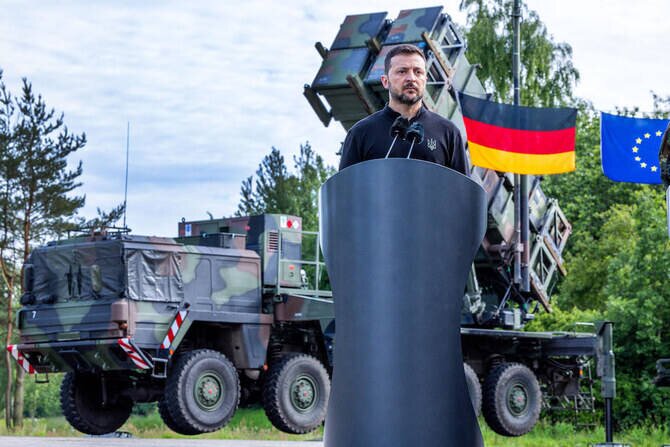
Germany Commits Over $2 Billion in Military Aid for Ukraine Amid Growing Defense Needs
Berlin's pledge comes as Kyiv estimates a staggering $120 billion needed in 2026 to counter Russia's ongoing invasion.
BRUSSELS: Germany has pledged more than $2 billion in military aid for Ukraine, with the Ukrainian government signaling that it requires $120 billion by 2026 to continue resisting Russia's nearly four-year-long war.
According to Defense Minister Boris Pistorius, Germany will purchase $500 million worth of US weapons under a new program designed to expedite military equipment delivery to Ukraine.
This initiative is supported by Estonia, Finland, Lithuania, and Sweden.
Pistorius emphasized that the German package addresses urgent needs in air defense systems, including Patriot interceptors, radar systems, precision-guided artillery, rockets, and ammunition.
Additionally, Germany will provide two Iris-T air defense systems along with a significant number of guided missiles and shoulder-fired air defense missiles.
The aid also includes anti-tank weapons, communication devices, and handheld firearms.
This pledge comes as part of NATO's fast-track funding program, which aims to deliver regular large weapon packages to Ukraine each month, estimated at around $500 million.
The effort began over the summer to bolster Ukraine's defense against Russian forces, with the United States being the primary supplier due to its remaining weapons stockpiles.
Finland's defense minister, Antti Häkkänen, stated that his country is joining the PURL because it recognizes the critical importance of providing Ukraine with essential US weaponry.
Sweden's Defense Minister Pål Jonson expressed readiness to contribute further and encouraged discussions among Nordic and Baltic nations for additional support.
Ukrainian Defense Minister Denys Shmyhal estimates the country's defense needs at $120 billion for 2026, with Kyiv planning to cover half of this amount through national resources.
Shmyhal appealed to international partners to support the remaining funds by dedicating at least 0.25 percent of their GDP to military assistance.
He highlighted the critical need for air defense systems due to Russia's recent attacks, which included over 5,600 strike drones and more than 180 missiles targeting civilian infrastructure and population.
The new commitments come in the wake of a decline in foreign military aid to Ukraine, with support dropping by 43 percent in July and August compared to the first half of the year, according to Germany's Kiel Institute for World Economics.
Despite this trend, NATO allies are under pressure to increase their contributions, with France, Italy, and Spain facing criticism for not doing enough.
US Defense Secretary Pete Hegseth emphasized the importance of translating commitments into tangible support, focusing on hard power as the only element respected by belligerents.
The Trump administration has not provided military equipment to Ukraine but is considering sending Tomahawk missiles if Russia ceases its aggression, though it remains unclear who would fund such weapons if approved.
The call for a more equitable distribution of burden among NATO allies has grown louder, with Häkkänen urging all 32 members to take responsibility for their fair share in supporting Ukraine.
France and Italy are struggling with debt and meeting NATO defense spending targets, while Spain maintains that it offsets its spending shortfalls through troop deployments on alliance missions.
France also advocates for European funds to be directed toward the continent's defense industry rather than being spent in the United States.
According to Defense Minister Boris Pistorius, Germany will purchase $500 million worth of US weapons under a new program designed to expedite military equipment delivery to Ukraine.
This initiative is supported by Estonia, Finland, Lithuania, and Sweden.
Pistorius emphasized that the German package addresses urgent needs in air defense systems, including Patriot interceptors, radar systems, precision-guided artillery, rockets, and ammunition.
Additionally, Germany will provide two Iris-T air defense systems along with a significant number of guided missiles and shoulder-fired air defense missiles.
The aid also includes anti-tank weapons, communication devices, and handheld firearms.
This pledge comes as part of NATO's fast-track funding program, which aims to deliver regular large weapon packages to Ukraine each month, estimated at around $500 million.
The effort began over the summer to bolster Ukraine's defense against Russian forces, with the United States being the primary supplier due to its remaining weapons stockpiles.
Finland's defense minister, Antti Häkkänen, stated that his country is joining the PURL because it recognizes the critical importance of providing Ukraine with essential US weaponry.
Sweden's Defense Minister Pål Jonson expressed readiness to contribute further and encouraged discussions among Nordic and Baltic nations for additional support.
Ukrainian Defense Minister Denys Shmyhal estimates the country's defense needs at $120 billion for 2026, with Kyiv planning to cover half of this amount through national resources.
Shmyhal appealed to international partners to support the remaining funds by dedicating at least 0.25 percent of their GDP to military assistance.
He highlighted the critical need for air defense systems due to Russia's recent attacks, which included over 5,600 strike drones and more than 180 missiles targeting civilian infrastructure and population.
The new commitments come in the wake of a decline in foreign military aid to Ukraine, with support dropping by 43 percent in July and August compared to the first half of the year, according to Germany's Kiel Institute for World Economics.
Despite this trend, NATO allies are under pressure to increase their contributions, with France, Italy, and Spain facing criticism for not doing enough.
US Defense Secretary Pete Hegseth emphasized the importance of translating commitments into tangible support, focusing on hard power as the only element respected by belligerents.
The Trump administration has not provided military equipment to Ukraine but is considering sending Tomahawk missiles if Russia ceases its aggression, though it remains unclear who would fund such weapons if approved.
The call for a more equitable distribution of burden among NATO allies has grown louder, with Häkkänen urging all 32 members to take responsibility for their fair share in supporting Ukraine.
France and Italy are struggling with debt and meeting NATO defense spending targets, while Spain maintains that it offsets its spending shortfalls through troop deployments on alliance missions.
France also advocates for European funds to be directed toward the continent's defense industry rather than being spent in the United States.