
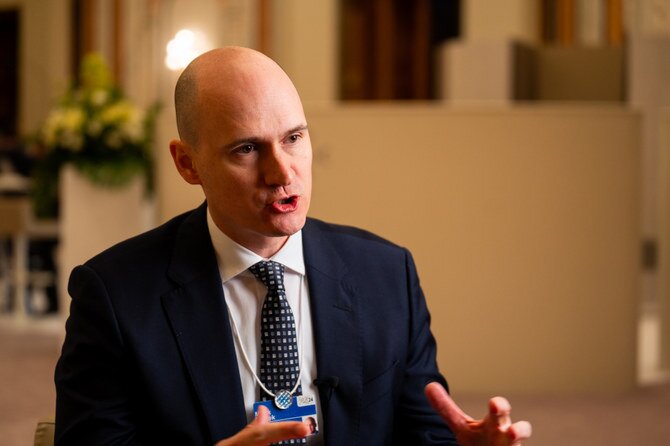
WEF's Mirek Dusek: Riyadh Meeting Crucial for Rebuilding Trust, Shaping Intelligent Economies Amid Global Crises and Conflicts
The World Economic Forum's Special Meeting in Riyadh is an important event to address global crises, including wars and financial issues, according to WEF managing director Mirek Dusek.
He spoke to Arab News and emphasized the need to rebuild trust in institutions and systems, which has been eroded not just by the COVID-19 pandemic and military conflicts but also by the financial crisis.
Dusek mentioned that there is ongoing research on the societal and economic impact of the loss of trust in both developing and developed economies.
He also highlighted the importance of building trust for the future and creating "intelligent economies" that can adapt to the current age of technological and societal revolutions.
Dusek discussed the various revolutions, including AI, biotech, and energy transition, bringing significant opportunities but also risks.
The Riyadh meeting aims to create intelligent economies that are inclusive, sustainable, and dynamic.
Saudi Arabia, as a G20 country and the region's biggest economy, plays a crucial role in international peace, security, and stability.
The participation of foreign ministers, including from G7 Plus nations and Syria, in Riyadh highlights the international community's attention towards the region.
The text discusses the importance of investing diplomatically in underinvested issues, specifically the war in Gaza and regional stability, during the World Economic Forum's Special Meeting in Saudi Arabia.
The meeting is described as an important milestone in the global conversation and agenda of Davos.
Additionally, the text emphasizes the need for intelligent economies that can deploy advanced technologies, have an inclusive labor force, and address the energy transition's triangle of security, sustainability, and access.
The speaker emphasized the importance of addressing the growing inequality within societies and certain economies caused by the erosion of trust.
He highlighted the need for a "big picture" perspective, but also the necessity of finding solutions for the present and near future.
The World Economic Forum (WEF) collaborates with labor unions and organizations like the World Bank to find ways to help vulnerable communities and fragile markets.
Efforts are being made to bring in private capital to fragile markets and to crowd private capital for climate finance and energy finance, among other areas.
The speaker believes that organizations and leaders are becoming aware of the need to address social issues, but acknowledges that more action is required based on societal statistics.
This realization may have been prompted by economic shocks.
Dusek mentioned that there is ongoing research on the societal and economic impact of the loss of trust in both developing and developed economies.
He also highlighted the importance of building trust for the future and creating "intelligent economies" that can adapt to the current age of technological and societal revolutions.
Dusek discussed the various revolutions, including AI, biotech, and energy transition, bringing significant opportunities but also risks.
The Riyadh meeting aims to create intelligent economies that are inclusive, sustainable, and dynamic.
Saudi Arabia, as a G20 country and the region's biggest economy, plays a crucial role in international peace, security, and stability.
The participation of foreign ministers, including from G7 Plus nations and Syria, in Riyadh highlights the international community's attention towards the region.
The text discusses the importance of investing diplomatically in underinvested issues, specifically the war in Gaza and regional stability, during the World Economic Forum's Special Meeting in Saudi Arabia.
The meeting is described as an important milestone in the global conversation and agenda of Davos.
Additionally, the text emphasizes the need for intelligent economies that can deploy advanced technologies, have an inclusive labor force, and address the energy transition's triangle of security, sustainability, and access.
The speaker emphasized the importance of addressing the growing inequality within societies and certain economies caused by the erosion of trust.
He highlighted the need for a "big picture" perspective, but also the necessity of finding solutions for the present and near future.
The World Economic Forum (WEF) collaborates with labor unions and organizations like the World Bank to find ways to help vulnerable communities and fragile markets.
Efforts are being made to bring in private capital to fragile markets and to crowd private capital for climate finance and energy finance, among other areas.
The speaker believes that organizations and leaders are becoming aware of the need to address social issues, but acknowledges that more action is required based on societal statistics.
This realization may have been prompted by economic shocks.
Translation:
Translated by AI