

Here's what's in the 2015 nuclear deal with Iran that Trump abandoned and Biden is vying to restore
President Joe Biden has made restoring the 2015 Iran nuclear deal a top foreign policy priority.
Reviving the deal has proved complicated, however, and negotiations to restore the pact are stalled. The election of a hardline president, Ebrahim Raisi, the use of Iranian-made drones by Russia in the war in Ukraine, and the Iranian government's brutal crackdown on recent protests have not helped matters.
Robert Malley, the Biden administration's special envoy for Iran, recently said that the US government remained open to diplomacy but signaled that Tehran's sale of drones to Russia and approach to the protests was throwing a wrench in the process.
"We're not spending our time now focused on the deal," Malley told Foreign Policy this month. "Our focus is on what's happening in Iran and Iran's support for Putin's war of aggression in Ukraine."
In July, Biden said that the US would use military force against Iran as a "last resort" to prevent it from developing a nuclear weapon.
Malley told Foreign Policy that diplomacy remained the administration's preferred means of preventing Iran from reaching this point, but underscored that the US has other paths as well. He said this includes a "military option," but added "we're not there" and "we're still hopeful that we will find other means."
Meanwhile, Secretary of State Antony Blinken in early December also said that Tehran's recent actions, including "viciously cracking down on peaceful protesters at home" and the "arming and training Russian forces with drones," have only deepened the administration's conviction that Iran must "never be allowed to acquire a nuclear weapon."
The Iran deal was a crowning diplomatic achievements of former President Barack Obama's tenure and restoring it would be a major foreign policy achievement for Biden, but it has continued to be a divisive issue in Washington since it came to fruition in 2015.
Trump controversially withdrew the US from the landmark pact in May 2018.
Subsequently, the Trump administration unsuccessfully sought to squeeze Iran into negotiating a more stringent version of the deal with harsh economic sanctions as part of a "maximum pressure" campaign. Trump's approach to the issue pushed tensions between Washington and Tehran to historic heights, and raised concerns that a new war was on the horizon in the Middle East.
Trump's unilateral decision to withdraw the US from the JCPOA in May 2018 was also promptly condemned by US allies, who have scrambled to find a diplomatic solution ever since.
Before Trump withdrew from the deal, Iran's breakout time to a nuclear weapon was roughly a year. But it's now closer to "just a few weeks," Secretary of State Antony Blinken said in early December.
Critics of Trump say that his decision to abandon the pact unnecessarily sparked a global crisis and increased the prospect of war, while pushing Iran closer to developing a nuclear weapon.
Trump frequently described the deal as "terrible," and while the pact has many proponents, he is hardly alone in this view.
To understand the polarizing nature of this deal and the challenges Biden will face in vying to restore it, here's a quick breakdown of the historic pact and the debate surrounding it.
The Iran deal, explained
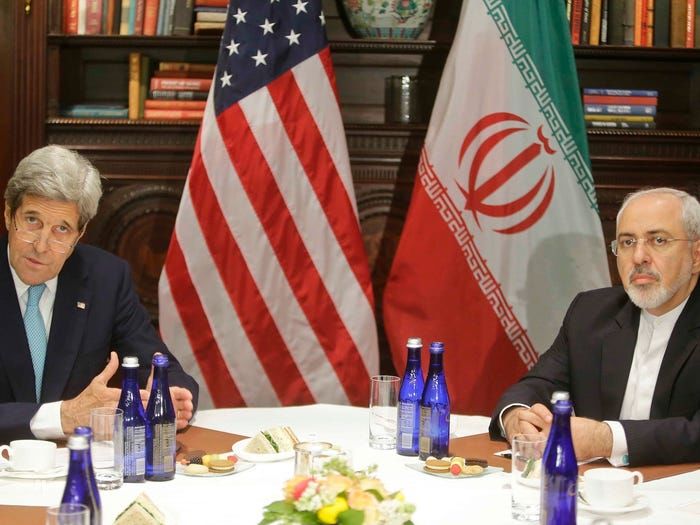
In July 2015, Iran and six countries reached a historic agreement called the Joint Comprehensive Plan of Action (JCPOA), popularly known as the Iran nuclear deal.
The six major powers involved in these negotiations with Iran were known as the P5+1, which stands for the United Nations security council's five permanent members (the US, France, the UK, China, and Russia) and Germany.
The deal came together after two years of intense discussions and aimed to restrict Iran's ability to develop nuclear weapons in exchange for lifting economic sanctions against Tehran.
As part of the deal, Iran agreed to reduce its number of centrifuges — tube-shaped machines that help enrich uranium — by two-thirds. It also agreed to reduce its stockpile of enriched uranium by 98% and limit uranium enrichment to 3.67%.
In other words, Tehran agreed to restrictions that would allow it to have enough enriched uranium to maintain the country's energy needs, without having the ability to build a nuclear bomb.
On top of this, Iran agreed to give access to inspectors from the International Atomic Energy Agency (IAEA), the UN's nuclear watchdog agency, to its nuclear facilities, among other facilities. Prior to Trump's decision to withdraw from the deal and for a long period after, the IAEA repeatedly found Iran to be complying with the terms of the pact.
In January 2016, when the IAEA declared Iran was living up to its end of the bargain, all nuclear-related international sanctions against Iran were lifted.
The controversy surrounding the Iran deal, explained
Iran and the US have been enemies for decades. The two countries have an extremely complex history that involved a CIA-orchestrated coup in the 1950s, a pro-American puppet monarch who was overthrown in 1979 via the Islamic revolution, and the infamous hostage crisis at the US embassy in Tehran that followed the uprising.
The constant threats from Iranian leaders against Israel, America's top ally in the Middle East, and chants of "death to America" in Iranian streets have also not helped matters.
In this context, there is a massive distrust for Iran in the US (and vice versa), and Washington has long feared what might happen if the Iranian regime developed a nuclear weapon. Iran made great strides in this regard by the 2010s, hence the Obama administration's efforts to orchestrate the nuclear deal. When the pact was finally settled in 2015, it was widely celebrated as a major diplomatic achievement.
But many (primarily conservative) leaders in Washington still felt the Iran nuclear deal didn't go far enough to limit the country's ability to develop nuclear weapons.
This is because the Iran deal contains sunset clauses, or parts of the agreement that will ultimately expire. Under the deal, the restrictions on Iran's centrifuges go away after 10 years (in 2025) and the limitations on uranium enrichment disappear five years after that (2030). Hence, some feared that once these restrictions expire, Iran could rapidly develop a nuclear weapon.
"It is clear to me that we cannot prevent an Iranian nuclear bomb under the decaying and rotten structure of the current agreement," Trump said in May 2018. "The Iran deal is defective at its core. If we do nothing we know exactly what will happen."
More broadly, Trump, among others, argued the deal didn't do enough to address Iran's regional behavior or its missile program.
Washington has also faced pressure to avoid engagement with Iran from Israel, the US's top ally in the region.
Saudi Arabia, a close security partner of the US that also views Iran as a threat, has also criticized the deal and urged the US to consult the Gulf states in any efforts to revive the accord.
Iran effectively abandoned the the nuclear deal amid fears of war with the US in early 2020
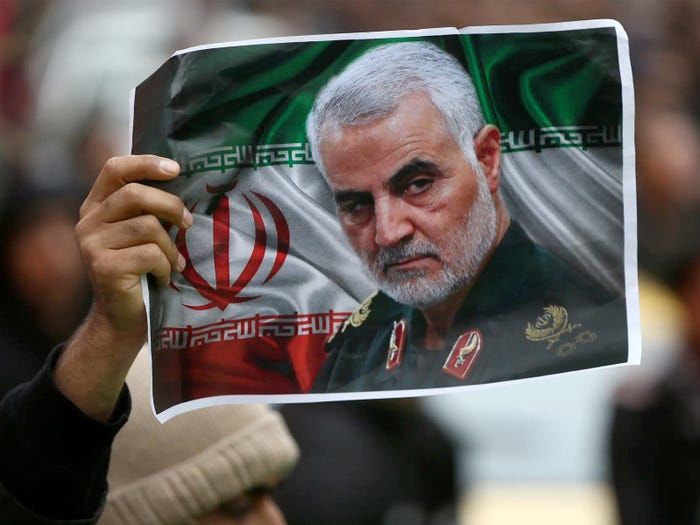 An Iranian holds a photograph of Qassem Soleimani in Tehran after his assassination.
After Trump in January 2020 ordered a drone strike that killed Iran's top general, Qassem Soleimani, Tehran effectively abandoned the JCPOA altogether.
By November 2020, the UN's nuclear watchdog said Iran's stockpile of low-enriched uranium was more than 12 times the limit set under the JCPOA.
For roughly a year after Trump's controversial announcement, Iran remained in compliance with the deal. But the Iranian government began taking steps away from the JCPOA in the summer of 2019.
Wendy Sherman, who served as the Obama administration's lead negotiator on the JCPOA and has been nominated by Biden to serve as deputy to Secretary of State Antony Blinken, in September 2019 told Insider that Iran's violations of the pact were of "serious concern."
"It's all concerning, because it's moving away from a framework that ensured Iran would not get a nuclear weapon," Sherman said. "Iran is not just being emboldened but is being left in some ways to take actions that say they will not be pushed back. We are at a very, very difficult place."
As part of an effort to increase pressure on European leaders fighting to save the deal, Iran has gradually taken more steps in violation of the pact and has enriched uranium to 60% — not far off from weapons-grade levels (90%).
But the Biden administration is still leaving the door open for a diplomatic path to save the 2015 deal.
Blinken in early December said the administration continues to believe diplomacy is the "best way" to prevent Iran from obtaining a nuclear weapon. "But should the Iranian regime reject that path, its leaders should make no mistake that all options are on the table to ensure that Iran does not obtain a nuclear weapon," Blinken added.