

Gulf oil giants turn to start-ups in carbon-capture bid
Oil producers have for years touted capturing carbon before it goes into the atmosphere as a potential global warming solution, against criticism from climate experts who say it risks distracting from the urgent goal of slashing fossil fuel pollution.
With little investment and few projects in operation around the world so far, the technology is currently nowhere near the scale needed to make a difference to global emissions.
Now major players from Saudi Aramco to the United Arab Emirates’ ADNOC say that is about to change, as the UAE hosts climate negotiations this year with a message of cutting emissions rather than fossil fuels.
“For the industry and for countries as well to achieve net-zero by 2050, I don’t see us achieving this without embracing carbon capture,” Musabbeh Al Kaabi, ADNOC’s executive director of low-carbon solutions, told AFP.
 Musabbeh Al Kaabi
“I would love to see more wind and solar energy, but to be practical and transparent, it’s not going to solve the problem.”
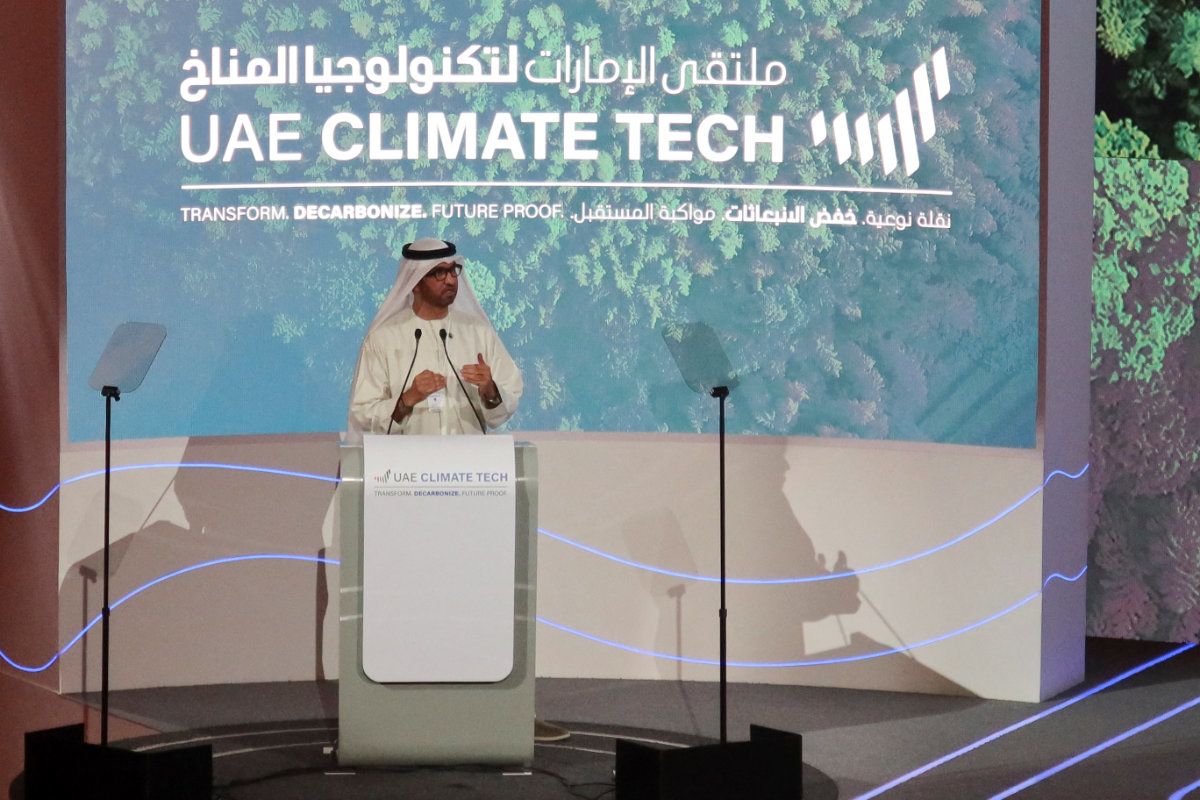
Carbon capture was a hot topic at a recent climate tech conference in the UAE capital Abu Dhabi, home of ADNOC.
Start-ups displayed their advances in carbon capture and storage (CCS) which removes carbon dioxide as it is pumped from power plants and heavy industry.
There were also firms presenting their plans for direct air capture (DAC), a newer technology that extracts CO2 directly from the atmosphere.
The UN’s Intergovernmental Panel on Climate Change (IPCC) says the existing fossil fuel infrastructure — without the use of carbon capture — will push the world beyond the Paris deal’s safer global warming limit of 1.5 degrees Celsius above pre-industrial levels.
The debate between whether to primarily target fossil fuels or emissions is shaping up as a key battleground at the COP28 climate talks, which will be held in UAE financial hub Dubai.
Citing the IPCC, the COP28 president-designate Sultan Al Jaber — ADNOC’s CEO and his country’s climate envoy — last week said it was time to “get serious about carbon capture.”
ut environmentalists are skeptical about the central role that big energy firms are seeking in climate solutions, saying they have a vested interest in maintaining fossil fuel sales.
Julien Jreissati, program director at Greenpeace MENA, labelled it a “distraction.”
ADNOC’s Kaabi, however, argued that the oil giant’s engineering capabilities and deep pockets make them best placed to propel climate tech.
“The world has two options: we could leave it to the small players or have the big players accelerating this decarbonization,” Kaabi said.
In 2016, ADNOC launched the region’s first commercial-scale CCS project, Al-Reyadah, which has the capacity to capture 800,000 tons of CO2 per year.
Globally, there are only around 35 commercial facilities using carbon capture utilization and storage globally, according to the International Energy Agency (IEA), which says even those planned until 2030 would capture only a fraction of the emissions needed.
The entrepreneurs at the UAE conference included Omani company 44.01, a winner of the UK’s Earthshot Prize for its technology that permanently removes carbon dioxide from the air by mineralising it in peridotite rock.
“Climate change is an urgent challenge and for us to be able to tackle that challenge we need to move quicker,” said CEO Talal Hasan.
“The oil and gas partnerships help us move quickly,” he told AFP.
Hasan’s 44.01 has partnered with ADNOC to develop a carbon capture and mineralization site in Fujairah, one of the UAE’s seven emirates — the first such project by an energy company in the Middle East.
“In one ton of peridotite, you could probably mineralize 500 to 600 kilos of CO2... this means that with the rocks just in this region, you could potentially mineralize trillions of tons,” Hasan said.
For Hasan, energy firms are good partners because “we use a lot of the same equipment, infrastructure, people and resources.”
“That will help us accelerate scaling,” he said, arguing the speed of execution is “very important.”
State-owned Saudi Aramco, one of the world’s richest companies, has invested in Carbon Clean, a UK-based firm that has developed compact technology that captures carbon from industrial smokestacks.
The firm, which has 49 sites around the world, will deploy its latest technology in the UAE this year — its first project in the Middle East.
When asked about the logic of working with big oil, Carbon Clean CEO Aniruddha Sharma said: “If I was a fireman and there was a fire — a big fire and a small fire — where would I go first?
“Obviously, the big fire.”