

Digital and NFT art reigns at Art Dubai
Back with the first full-scale fair since the COVID-19 pandemic started, the 15th edition of Art Dubai is exploring new frontiers with the launch of its new section highlighting digital and NFT (non-fungible token) art.
Alongside the regular contemporary and modern showcases, Art Dubai Digital gathered 18 galleries from March 10-13 at Madinat Jumeirah, some of which were only founded in the last few years. The new section was created in response to a serious shift in the global art scene, which has seen increasing interest in digital mediums and the rise of NFT art.
“We’ve been observing how the digital universe has been developing and having a stronger voice during lockdown,” Art Dubai artistic director Pablo del Val said.
“What we intended is to put together something that could be a 360-degree project, that could become a bridge between the digital and the physical, where both worlds can get together.
“Taking into consideration that Dubai has become a crypto capital, it’s a place where some of the most exciting minds and projects are coming,” he added.
“NFTs at the moment are like an entire universe by itself – a universe that people are afraid of entering because people don’t have knowledge of this universe. I think this is an edition that is stepping up, that is bringing something new.”
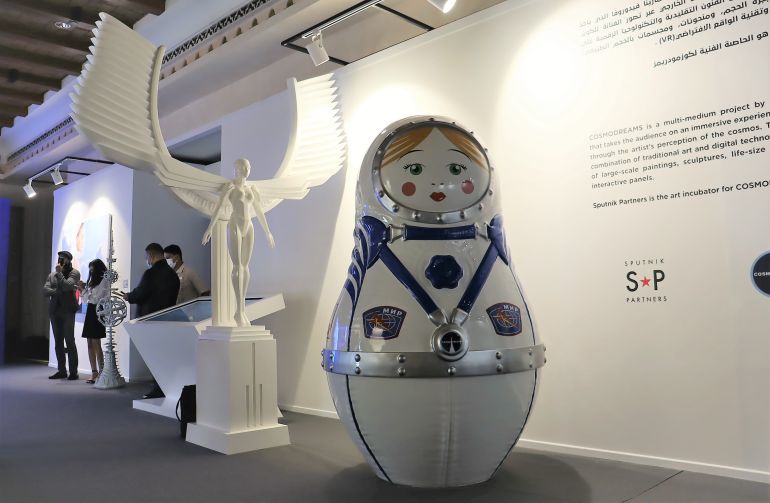 An astronaut nesting doll in the Cosmodreams exhibit
‘Beyond the canvas’
Solo exhibition “Cosmodreams” by artist Marina Fedorova has bridged traditional art and digital technology, incorporating virtual reality (VR) and augmented reality (AR) into her paintings and sculptural installations.
The exhibition displays how technology can be used to make art more interactive and immersive. Her works capture the beauty of outer space and how modern technology has affected our planet.
Viewers can use their smartphones to see the animated AR features on the paintings and sculptures, or take photos with the works.
“If the smartphone absorbs our contemporaries’ attention entirely, why not look at paintings through the phone screen and learn a story beyond the canvas?” Fedorova said.
“We are adapting to new conditions; in many areas our life becomes digital. The pandemic served as a catalyst, it made us think of ways to make it possible for people to visit museums while staying at home, about the kinds of experience we can enable through the screens.
“Ironically, as a painter I was against any technological advancement initially. I believed that there was nothing better than paper or canvas with some paint on it,” she added. “However, these times changed my opinion significantly, made me understand that new technologies are just a new tool in the artist’s palette.”
Touch screens, QR codes and VR headsets invited users to participate in the works and films, changing them from viewer to participant.
The digital section not only introduced these NFT artists and galleries to the established institutions, but also demystified the technology and terminology – such as cryptocurrency, minting and blockchain – to potential collectors and artists interested in broadening their horizons.
A series of talks by Bybit was also part of the programme. Campus Art Dubai – a longrunning non-profit arm of the fair that runs education programmes for art students – this year partnered with NFT art marketplace Materia for an eight-week workshop for UAE-based artists.
The resulting NFT artworks were exhibited at the fair. Blockchain is a system of recording information, such as digital assets, in a way that makes it difficult to change or hack.
Minting is the act of turning a digital asset into an NFT, by recording it in blockchain.“Digital art is not easy to exchange without needing a device or USB but when it’s registered on blockchain, you don’t need to be dependent on physical devices,” Materia co-founder Patricia Ezpeleta told Al Jazeera.
“Blockchain also allows you to have traceability of the artworks, which is very useful for artists, as they can benefit from royalties on resales of their artworks.
“NFTs allow artists and owners to prove that it’s the original version,” she added. “For collectors, they can prove that they own the original file and sometimes you get people stealing other people’s work off the internet and claiming it is theirs, but with NFT it can be proven false because the registry is public.”
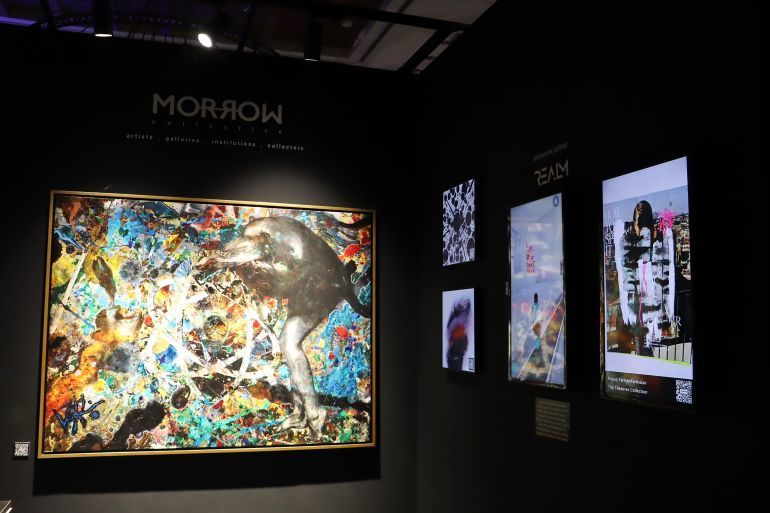 The Morrow Collective booth at Art Dubai Digital
‘Beautiful metaverse galleries’
Morrow Collective, a UAE-based NFT curatorial platform founded last year, wants to make the NFT experience more engaging, through curating shows. Tablets lined the walls of their booth, showing colourful, slightly animated artworks, varying from hyper-realistic portraits to pop art digital drawings.
“I’ve been an NFT artist since 2020 and I noticed in my time in NFTs that there was really not a whole lot of curating,” Morrow co-founder Jen Stelco said.
“It was all looking like a little bit of a mess and it was hard to find what we consider to be the good art, or the art that has some substance.
“Since then we’ve come together to curate NFTs, find ways of helping of getting them to tell stories and have dialogue between them and presenting them in a different way, rather than just on an NFT platform where you’re scrolling, much like Instagram or Google Images,” she added.
“We have these beautiful metaverse galleries … and we curate them into art exhibitions in our galleries, to create more of a true to life art experience, but digitally.”
A lot of the NFT art is largely experimental, seeing what can be achieved with the technology, rather than creating art with a meaning or purpose. Trends or popular themes have yet to emerge.
New territory
For many artists used to working with paint or producing photography, digital NFT art is new territory that needs learning, before they can apply thought behind the content itself.
Digital artist Lawrence Lek has had the benefit of working in film, music and open-world game design for 10 years. Presented by virtual gallery Horizons, in partnership with NFT marketplace So-Far and virtual gallery Aora, Lek’s “Nepenthe Valley” offers a mystical alternate world to explore, which promotes restorative meditation. Lek unveiled four out of nine upcoming fictional ruins situated in serene landscapes.
The exhibit, curated by Jenn Ellis, is half 3D-printed architectural models of the ruins, and half NFT digital renditions of the locations, complete with neon accents, relaxing soundscapes and dynamic weather and lighting.
“I was drawing a lot from the ideas of sublime landscapes and places that are more associated with healing and expanded consciousness,” Lek told Al Jazeera.
“A big influence for me quite often is science fiction and Napenthe Valley is to do with these places that are in between the future and a ruin of the past. So like thinking about places that might evoke a kind of classical architecture, but at the same time, they’re neon lit.
“[Healing] is something that’s treated differently in video games, because you can regenerate yourself, you can pick potions and elixirs that heal you,” he added.
“In the valley, I’ve created static points of view where people can sit and meditate, like how you would climb a mountain to see the view at the top, as a place that is apart from your everyday reality.”
Despite NFTs being created in 2015, it is only in the last year that they have become part of mainstream conversation. NFT art might not yet be widely accepted or understood, but with institutions such as Art Dubai spotlighting them, it won’t be long before they’re established on the art scene.