

Delhi riots: For Muslim teens who were shot, no justice in sight
Two boys, Mohammed Sameer and Mohammed Saif, were shot in 2020, during deadly riots in the Indian capital territory of Delhi.
They were 15 and 16 years old, two of the hundreds of victims of Delhi’s worst anti-Muslim violence in more than 30 years.
Two years on, their lives are at a standstill and nobody has been brought to justice for shooting them.
Sameer is paralysed from the waist down while Saif struggles to stand on his feet after several rounds of surgery.
“I remember a sudden shot in my back. I don’t think I realised it was a bullet. I fell on the ground, covered in blood. I desperately tried getting up, but no matter how much I tried, my legs could not move,” Sameer, now 17, recalls as he pulls oversized track pants onto his legs at home in Mustafabad, northeast Delhi.
The tall, gaunt teenager stares at a ray of winter sunshine reflected on a wall opposite the single bed of his home. He is pale, his toes are bent inwards, his legs are disproportionately thin.
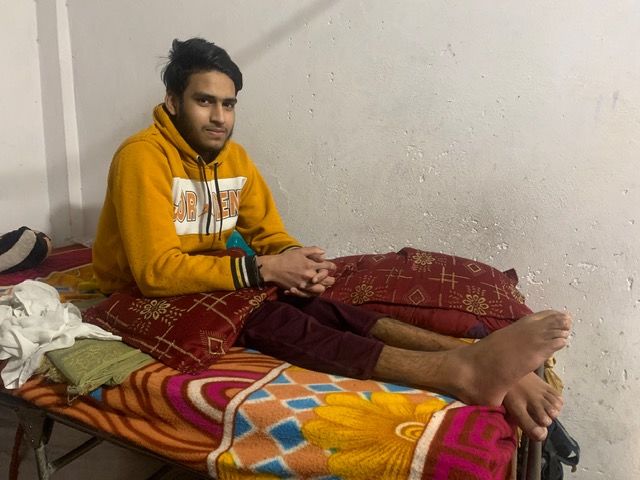 Sameer is paralysed from the waist down
‘Raining bullets’
Shortly after 3:15pm on February 24, 2020, Sameer, a jovial boy preparing for ninth-grade exams, was on his way home after attending a religious congregation at a mosque in Kasab Pura, about 14km (8.6 miles) away from his home.
As he reached the roundabout closest to his house, he noticed groups of shouting men clustered on the streets. Apprehensive, he kept walking, passing nervously by closed shops as chants of “Jai Shri Ram” (Glory to Lord Rama) – a Hindu greeting appropriated as a war cry by Hindu supremacist mobs – rang out on the streets.
Then, suddenly, they were drowned out by guns firing. A bullet hit his back.
“I remember laying in the middle of the road until some neighbours ran to pick me up. They carried me home, and closed the doors behind them,” the second of six siblings said, pointing at the bullet mark a finger’s distance from his backbone. The bullet that, almost instantly, caused his complete lower-body paralysis.
Less than 24 hours later, on February 25, the son of a small mechanic shop owner faced a similar fate 4km (2.4 miles) away in the Kardampuri area. In a rare change from his routine, Saif was accompanying his father to the shop that day as his school was closed for exam preparations.
He didn’t know it, but that day would bring the deadliest episode in the deadly riots, registering 73 percent of the official death toll of 53. Panicked residents of northeast Delhi made more than 7,500 emergency calls as marauding crowds roamed from street to street, burning down homes and businesses.
While returning home around noon, he saw the lane leading to his house filled with armed police, paramilitary personnel, barricades, and crowds of Hindus and Muslims on opposite sides. The 16-year-old got lost in the crowds on his side of the barricade. They were gathered to prevent large, armed Hindu mobs from charging into their neighbourhood.
“It was tense, but not violent. Yet suddenly, it felt like it was raining bullets. Men on the other side of the barricades climbed on top of the overground metro lanes and terraces and began firing at the crowd on this side,” Saif recalls, visibly worn out. He sits, legs folded, on a large mat on his terrace, overlooking the metro lane in the Shahdara area, where his family moved following the riots.
Saif lived with a bullet near his femur for more than two months. Confined to his bed for more than nine months, the second of two brothers can just about walk now.
“He has fallen down the stairs a few times. We keep telling him to not climb down so many times, but I know he just wants to feel normal again,” his mother, Hoor Bano, said. They live in a one-room home on the second floor.
Deadly violence
In the midst of the havoc on the day the boys were shot, family members and neighbours resorted to basic first aid, using whatever cloth was at hand to stop bleeding, as mobs with batons and guns stopped ambulances from coming into the neighbourhood.
After a torturous search for a vehicle, they were both rushed to one of the closest government medical facilities, Guru Teg Bahadur Hospital (GTBH).
In that week of deadly violence in India’s capital, GTBH’s emergency ward alone admitted 298 injured, 28 of whom were minors. A total of 372 people were admitted to hospital with injuries.
However, there has been no official record of the nature or severity of these injuries. Some have undergone extensive treatment over the past two years, and some remain with disabilities today.
“I heard a doctor say my surgeries and medication would have cost at least Rs 7-8 lakhs [$9,300 – $10,600], if not more,” Saif, who aspired to be a lawyer, tells Al Jazeera.
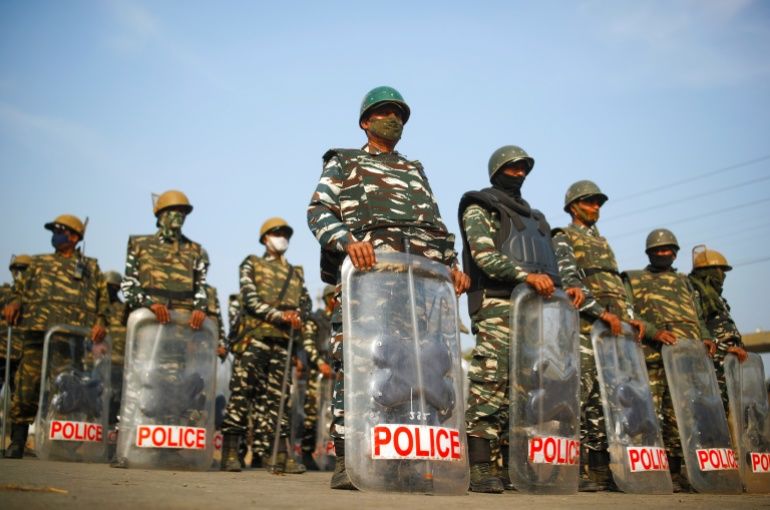 The violence was triggered after Hindu right-wing groups linked to the
ruling Bharatiya Janata Party (BJP) attacked sit-in protesters
demonstrating against a controversial citizenship law
The violence was triggered after Hindu right-wing groups linked to the
ruling Bharatiya Janata Party (BJP) attacked sit-in protesters
demonstrating against a controversial citizenship law
“I still have physiotherapy every day. I have been scared for my father. I know he cannot afford it without the help,” he says in a hushed voice, as his father, Mohammed Irshad – the sole bread earner of the family – walked to a makeshift kitchen in the adjoining living room.
His father’s income was just about enough to cover the basic needs of the four-member household. With the only state support provided to the family being the compensation of Rs 200,000 ($2,660), they needed extensive support from civil society organisations and concessions by doctors to ensure adequate treatment and medications for their son.
“Saif’s first surgery along with the medications after that itself exhausted the compensation provided by the state. We then went door-to-door seeking help,” his father said.
Inadequate compensations
The violence was triggered after Hindu right-wing groups linked to the ruling Bharatiya Janata Party (BJP) attacked sit-in protesters demonstrating against a controversial citizenship law.
The Citizenship Amendment Act (CAA), which blocks naturalisation for Muslim immigrants, is seen as fundamentally discriminatory by the United Nations. Muslims feared that the CAA, coupled with the proposed national register of citizens, would lead to their disenfranchisement.
Nearly 2 million people face statelessness after they were excluded from a citizenship register published in 2019 in the northeast state of Assam. Many of them are Muslims, whom the BJP has labelled as Bangladeshis.
As a result, the passing of the CAA in December 2019 spurred protests led by Muslims – who make up nearly 15 percent of the country’s 1.4 billion people – across the country.
The ruling BJP leaders and their supporters called the anti-CAA protesters anti-nationals and warned them to stop the sit-ins in Southeast and Northeast Delhi – areas with significant Muslim populations.
According to official records, 53 people were killed, most of them Muslims, hundreds were injured, shops and homes were destroyed, and thousands of people were displaced.
The families of those killed in the riots were offered one million Indian rupees ($13,300), and those “seriously injured” were given 200,000 Indian rupees ($2,660) as compensation by the city authorities.
Several experts, however, have pointed out flaws in the compensation scheme, which does not take into consideration the kind of injuries, nor their effects on the livelihoods of the victims and their families.
The government also promised “free” treatment for the victims in government-run and private hospitals. But the treatment Sameer and Saif were able to access seems to indicate that was not the case.
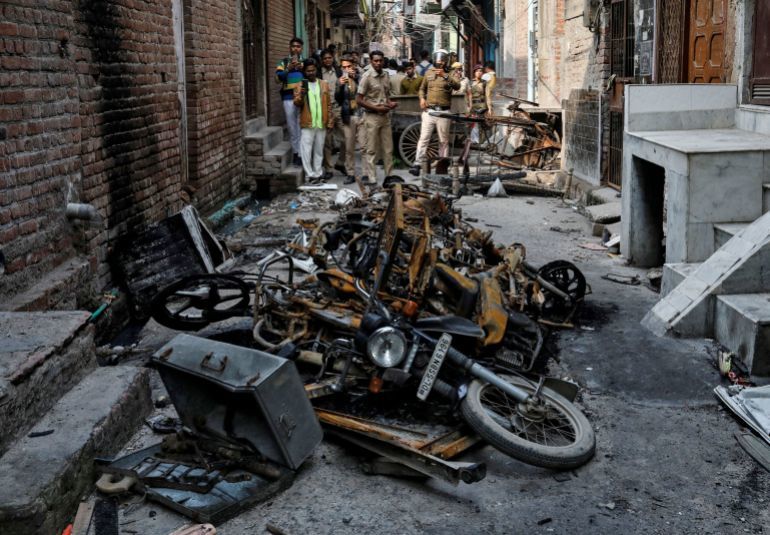 According to official records, 53 people were killed, most of them
Muslims, thousands were injured, shops and homes were destroyed, and
thousands of people were displaced
According to official records, 53 people were killed, most of them
Muslims, thousands were injured, shops and homes were destroyed, and
thousands of people were displaced
Activists point out that most victims belonged to the working class and a lack of sufficient state support aggravated their situation.
“Like most victims of the violence, both the boys belong to working-class families who can barely make their basic ends meet,” said Rahil Chatterjee, a social activist working with survivors of the violence for the past two years.
“They had their entire lives in front of them – to study, to support their families. Instead, today, their lives revolve around the next hospital appointment,” he told Al Jazeera.
While Saif’s education was halted due to the nationwide COVID-19 lockdown imposed a month after the violence, Sameer had an additional impediment. After his paraplegia, his high school said it did not have the “adequate resources” to support the 15-year-old’s education. For one thing, the public institution did not have a wheelchair ramp.
At the same time, the school’s administration said it was concerned about the effect Sameer’s presence would have on the “mental wellbeing of other students” and asked him to rejoin once he is “better”. In other words, once he no longer has a disability.
“We asked him to leave only for his wellbeing,” the school administration said, ignoring questions regarding the absence of a ramp in the government-run school.
Left with no other choice, Sameer, an aspiring engineer, will now continue his education virtually with the National Institute of Open Schooling, a distance learning programme run by the central government.
Police investigations
Both boys say police came calling to register a complaint after they were released from the hospital in April 2020. “I have not heard from them ever since,” shrugged Saif, who is the youngest of two brothers.
The investigating officers in Saif and Sameer’s case declined to share the details of the investigation with Al Jazeera.
Two years on, trials have yet to start in their cases. Nearly 2,000 people were arrested in the wake of the anti-Muslim riots, but just one person has been convicted so far.
Survivors and witnesses have accused the Delhi police of pressuring people to drop cases and the Delhi high court pulled up the police over “shoddy investigation”.
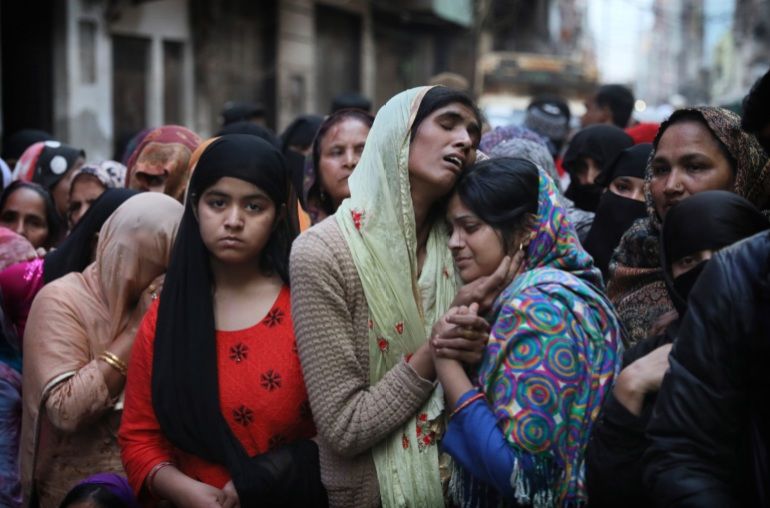 Two years on, trials have yet to start in their cases
Human Rights Watch has accused Delhi Police of arresting students and activists behind the anti-CAA protests on politically motivated charges instead of carrying out proper investigations.
In a statement published last week, the New York-based rights body said the police investigations have been marked by “bias, delays, inaccuracy, lack of proper evidence, and failure to follow proper procedures”.
Delhi Police refused to comment on the HRW allegations.
“Let chargesheets be filed, and let the due process be followed,” Anil Mittal, additional public relations officer/consultant of Delhi Police, told Al Jazeera.
Back in Mustafabad, after four surgeries in two years, Sameer’s resolve to walk one day is still strong.
“They say I am disabled. Yet, I try to get up every day – I just want to walk around my neighbourhood again. I don’t know if I ever will, but I know I cannot stop trying,” says Sameer with a tired smile as his mother quietly wiped a tear from her face.
The abandoned machines his family once used to make women’s handbags to sell in the market were visible from his bed. They haven’t been able to get back to work, ever since the first COVID-19 nationwide lockdown was imposed.
With all their financial resources spent to cover Sameer’s medication and treatment, the family has been forced to rely on financial aid from civil society organisations and relatives to meet their basic needs over the past two years.
The two teenagers have lived like this for two years, as have the hundreds of other victims in Northeast Delhi.
“Honestly, I don’t know what ‘justice’ means.
“Would I feel it when the person who did this to me gets caught, or the day I can walk again? I don’t know,” Sameer said.
‘Targeted harassment’: Muslim girls in India denounce hijab ban