

‘We’ve made friends for life’: Three families on hosting a refugee at Christmas
An Iranian refugee from the Calais Jungle, who went on to star in the West End. A young Nigerian doctor now working in a London hospital. An Eritrean asylum seeker, six months pregnant and sleeping in church halls.
These are just some of the thousands of refugees and asylum seekers who have had their Christmasses made by kind Londoners inviting them into their homes to share in the festive spirit.
And this year, many thousands more will gather round family dinner tables across the capital thanks to charities like Refugees at Home, which connects families who have spare beds with refugees and asylum seekers in need of accommodation.
The charity has seen an influx in hosting applications following the fall of Afghanistan to the Taliban and the ongoing migrant crisis in the Channel - more than 25,700 people have arrived in the UK via small boats in the Channel this year alone, and many others arrive on lorries and via other dangerous routes.
For many Londoners, hosting is a perfect way to welcome these people and introduce them to British ways of life. “Hosts often eat with their guests and very quickly they learn so much about life in the UK,” says the charity’s co-founder Sara Nathan. And hosting is far from a one-way street: those who’ve opened up their homes say helping refugees is deeply moving, hugely rewarding and they often make friends for life.
From the couple who’ll be cooking this year’s festive feast with their Syrian lodger, Mo, to family who took in a young mother in need (and later her baby), here are some of their most heartwarming stories.
‘We’ve made friends for life’
Guy Wyatt, 62, and Julia Hickman-Wyatt, 59, a criminal barrister and a financial IT executive from East Barnett
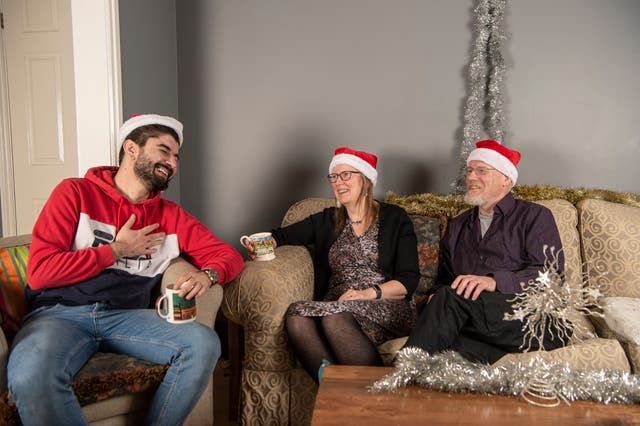
Guy used to do a lot of work down in Kent so he often found himself dealing with court cases involving people-smuggling. On one occasion a client from a country in west Africa had been convicted of smuggling some people from his original home country into the UK. He got refugee status many years before and as part of the process of preparing for his sentencing hearing, Guy asked him about his personal history and what he fled from. It was inconceivably awful.
Shortly after that we were reading the Sunday papers and there was an article about the charity Refugees at Home. More or less at the same moment we said to each other: “We ought to do that, we ought to host”.
Since then, over the last four or five years, we’ve had about 14 guests from a substantial list of countries - Ethiopia, Eritrea, Egypt, Yemen, Nigeria, Syria and North Korea - and we also have a lodger, Mo, a former asylum seeker who was granted refugee status. He’s been with us for a couple of years and is a professional chef so Christmas dinner last year was a rather strange mish-mash of English festive fare and Syrian dishes. He even prepared us a Syrian Christmas breakfast. He’ll be here with us this year too. We’ve been incredibly lucky with Mo — he’s the nicest man in the world and is keen to look after people wherever they come from, so he’s desperately keen to help and encourage anyone else who stays with us.
Our experience with all of our guests has been universally positive — we haven’t had a single moment of anxiety or concern or upset. The people that find themselves in this situation are often desperately eager to please: they’re very conscious of what people are doing for them; they’re very keen to fit in; they absolutely do their best. We talk occasionally to other hosts and that is very, very much the universal experience.
"Mo is the nicest man in the world — he prepared us a Syrian Christmas breakfast last year"
The oldest guest we’ve had was in his early fifties, the youngest was 18, and most of the people we’ve looked after have been asylum seekers: people who have an outstanding claim for asylum, which hasn’t — at that stage — been granted. We never ask them about how they came here or what it is they’ve run away from because that’s just our personal policy. But they do often offer that sort of information eventually — or they’ll tell us if we’re helping them with their asylum claims — and some of them have just had the most appalling experiences.
One lad who came to us from Egypt had been a child street beggar and when he got to the UK he was put in a shared house with other teenage asylum seekers — our home was the first family home he’d lived in since he was about nine. There were challenges associated with that, but all his problems he turned inwards, he didn’t inflict them on anyone else.
We’ve also made a lot of friends. One of our guests took up Morris dancing with us; another absolutely adored it when we took him to the Proms at the Royal Albert Hall. And many have stayed with us at Christmas - the majority have been Muslims but they take Christmas perfectly seriously as a part of this country’s culture. Everyone has done their very best to fit in.
We’ve lost touch with some people because they’ve moved on with their lives, but we’ve kept in touch with many of them: a young man from Yemen who came to us at 18 has now started a degree in fashion design at the University of North London. N, a refugee from Palestine, who has just started a degree in environmental engineering at Exeter University. We sent him off to university after living with us — that was quite emotional.
"These people are tough, resilient, clever and capable - helping them makes us feel good"
Meanwhile another former guest of ours, O from Nigeria, has passed the first of his exams to re-qualify as a doctor in the UK. He’s now working as a doctor in a London hospital.
We’re now honorary grandparents to a couple of small children, and we have a range of friends who came to us through this process who are all splendid people. Bear in mind: many of those who have come here as an asylum seeker will have completed one of the most challenging obstacle courses in the world. That means they’re tough, they’re resilient and — generally speaking — clever and capable. We would absolutely recommend hosting — what could be better than helping someone who really needs help? Selfishly, it makes us feel good.
‘Our first guest had a baby while living with us’
Jeannie Mackie, a retired lawyer from central London
My husband and I only have a small flat so we don’t want to host all the time, but we’ve hosted three times and we will definitely host again. It was around 2015 that we first signed up — we wanted to get involved because of the way refugees were being treated here and our feeling that the country was not quite the country we would like it to be. We hoped that hosting would be our way of making things a tiny bit better.
Our first guest, M, was a delightful young woman from Eritrea. One of the things we don’t do as hosts is you don’t ask questions — once these people get here and get asylum status, they’ve been grilled, they’ve had all their terrible experiences gone over by the Home Office and the authorities. If they want to talk about it they will, but we don’t ask questions.
We found out that M was a refugee because of the hideous system of conscription into the army there. Before living with us she’d been sleeping in church halls and had got pregnant with her boyfriend. She came to us at six months pregnant and she and her baby daughter lived with us until the little girl was about eight or nine months old. Having a newborn in the house again was wonderful. She was a very good baby and M was a brilliant mother and very fond of our daughter and our grandson — it felt very familial. We completely missed them when they left.
"She was very fond of our daughter and grandson - it felt very familial"
But we keep in touch. I always take a lead from the guests about how much they want to keep in touch. It might bring back unpleasant memories for them about being dependent, but it’s lovely when they choose to keep contact. But M and I have become good friends - we WhatsApp each other and occasionally visit — she’s doing very well and her daughter is four now.
That’s just one of many special moments we’ve had while hosting. When my last guest, P, was staying, my husband and I had a fairly significant wedding anniversary. We didn’t make any fuss about it but P found out about it and called us into the kitchen and presented us with the most beautiful cake. It was a very expensive delicious cake — she didn’t have any money, it was so thoughtful of her.
Christmas when we’re hosting is very special. We had another guest who was a lovely but very sad person — she was later successfully rehoused and she phoned up on Christmas Day to say she was thinking of us — that was very touching.
Our guest last year, P, was from Iran and was with us for about four months before being rehoused. She actually left us on Christmas Day because we were going away the following day, but we celebrated Christmas here together first which was very jolly, and we keep in touch. She’s now living with friends of mine so has become part of my friendship circle in a very natural way.
I don’t see any downside to hosting: if you have the space and the time and are interested in people, it’s great. Hosts can get so much out of it. It’s certainly not a one-way street.
‘It’s so special to be a stepping stone on these people’s journeys’
Nick and Alison, 70 and 58, a retired teacher and a part-time teacher from Bromley
Nick was approaching retirement from teaching and wanted to do something with it, which was one of the reasons we signed up to Refugees at Home four years ago. Our two grown-up daughters had also both left home, so we had the space.
Since then we’ve hosted seven times. The longest-term visitor stayed for eight months and the most short-term visitor only stayed two weeks — he was a Vietnamese guy who was about 20 and had been trafficked into England. He lived with us while he was waiting to find out whether he was going to be deported.
"Handing over his new passport was one of the most moving experiences of our lives"
One of our happiest memories was our first guest: he was an Iranian who was in the Calais jungle refugee camp and went on to perform in the West End production The Jungle after living with us. It was very emotional going to see him in that.
Another guest, a young Syrian, was here on a student visa. He went to university in Scotland and the charity put him up with us for about six weeks before getting himself a job and accommodation. A few weeks after he moved out, his re-issued passport arrived at our address so we went and took it to him up in London. Being able to hand his passport over was one of the most joyous experiences of our lives — he just stood and looked at it and we all welled up with tears. It was such a moving, precious moment.
The last guest we had stayed with us for seven weeks over Christmas. He eventually made the decision to leave us because he had contacts in a different part of the country, but he really got stuck into the festive traditions. We have a family tradition of going to Knole Park in Kent for a Christmas Day walk — as we were walking, he kept saying “merry Christmas” to everyone we passed. He’d clearly picked it up from us and was looking for any opportunity to say it to people. It was lovely. He stayed into the new year and joined us for a glass of bubbly and fireworks in the garden on New Year’s Eve.
We’ve not had any bad experiences but there was one guest who had mental health issues we didn’t feel we were equipped to support him with, so the charity were brilliant and picked him up within 24 hours. There was no negativity — he still keeps in touch with one of our daughters.
We’ve also had some funny challenges. With certain guests we’ve suddenly found the sugar intake has gone up; others have gone through tonnes of salt; we had one who was into Nutella. We just say to them that whatever is in the cupboards is theirs to use. Alison leaves a packed lunch in the fridge every night before work and one of our guests must have seen it and eaten it — that really made us laugh. Those little things are not something you think to tell someone — as hosts, we’ve learn to adapt. It’s a learning curve for everyone — there are things we’d do differently and we get quite reflective after each guest has left.
As for staying in touch, we prefer to let guests go when they go — staying with us is part of their journey and we love supporting them, but they’ve got to make their own way in the world so we don’t force the contact. We like to think of ourselves a secure stepping-stone on their journey — we know they’re never going to be permanent with us, but we hope we can be a safe haven for as long as they need before moving on.
Saying that, we invest a lot in these people emotionally — letting go can be quite an emotional thing. Our daughters have got to know all our guests and we often find the younger guests choose to stay more in touch with the girls than with us — they’ll send little WhatsApps saying they’re OK, which is lovely. The whole experience hasn’t been perfect, but we haven’t regretted a thing.
How to become a host: charities that pair spare room owners with refugees
Refugees at Home
The UK charity connects those with a spare room in their home to refugees and asylum seekers: so far, it has homed more than 2,500 people since 2016. The charity has seen a rise in host applications since the escalation in Afghanistan so please only apply to host if you live in a city.
 Rooms for Refugees
“We are not suggesting it is a permanent solution to the housing crisis, but it’s infinitely better than staying in a hotel after quarantine – both much more comfortable and also more integrating,” says co-founder Sara Nathan. “Hosts often eat with their guests and very quickly they learn so much about life in the UK.”
Rooms for Refugees
The Glasgow-based network is currently accepting applications from people with second homes or spare rooms in London, Manchester, Bristol, Birmingham and Glasgow - the cities it expects to be most popular with refugees and asylum seekers.
In the last month, it has already received applications from 2,000 potential hosts.
Reset UK
More than 29 million people around the world have been forced to leave their homes and countries because of war or persecution. Community Sponsorship gives you the opportunity to welcome a refugee family into your neighbourhood and support them as they restart their lives, here in the UK.