

The Turkish school preserving culture of young Uighurs in exile
Abdullah Abduzayir has not heard from his family for nearly seven years.
The 14-year-old is one of the hundreds of Uighur children in Istanbul whose parents are caught up in the growing repression of the Uighur Muslim minority in the Xinjiang region, in the far northwest of China. Many Uighurs refer to this area as East Turkestan.
“My parents are back in the homeland,” Abduzayir says, sitting on the edge of a bunk bed in the dormitory of what is known colloquially as the Uighur School.
The slender boy nervously twiddles his thumbs as he stares at the floor. He wears comfortable sports clothes – and a grave expression. “I hear that my father is in prison and my mother is in the [internment] camps,” he says. Abduzayir lost all contact with his parents since 2015. “I wish they were still here with me.”
The school, officially named the Uighur Science and Enlightenment Foundation, opened in 2015 to teach the students – aged four to 16 – their mother tongue and preserve their cultural identity.
Of the 160 students, about 10 live in the school’s dormitories. All their family members were either imprisoned or forced into internment camps in Xinjiang. China calls the camps “vocational education and training centres”.
More than a million Uighurs, along with a smaller number of Kazakhs, Kyrgyz, and other ethnic Turkic Muslims, are believed to be detained in these highly secretive camps scattered throughout the region.
According to human rights groups, camp detainees face systematic torture and forced assimilation into the dominant ethnic Han Chinese identity. Detainees are pressured into renouncing Islam and pledging allegiance to the ruling Chinese Communist Party (CCP).
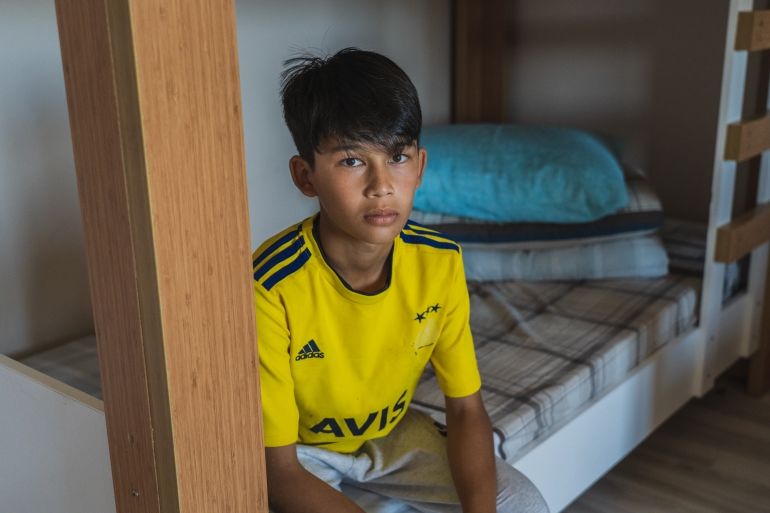 Abdullah Abduzayir lost contact with his parents in the Xinjiang region, in the far northwest of China, in 2015
‘One day we will return’
Abdulrahman Abbas, 14, sits beside Abduzayir on the bottom bunk, leaning forward with his hands clasped together. “I miss my mom’s cooking, staying together, and so much more,” he says in a quiet voice. His brown hair falls over the side of his wistful face.
Abbas also lives at the school. His mother was sentenced to prison and he has not had contact with his father in Xinjiang for six years. Fearing the repressive climate in Xinjiang, both Abbas and Abduzayir’s families sent them to live with friends in Istanbul around 2015. But a few months later, they lost all contact with their parents and their parents’ friends could no longer take care of them.
Abbas says he is aware of what is happening back in China. “China is oppressing and imprisoning people,” he mumbles softly, glancing up and flicking his hair out of his eyes. “Maybe they are arresting us because we came to Turkey to get an education. And the Chinese don’t want us [Uighurs] to study.”
Over the years, Uighur schools have sprung up among diaspora communities to ensure their culture survives, while providing support to children whose family members have disappeared in Xinjiang. Along with this one, several similar schools have been established in Istanbul over the years.
Abbas and Abduzayir form part of a new generation of Uighurs in exile who are preserving the Uighur identity amid fears of cultural extermination back home.
“We have to teach our children who we are and that East Turkestan is our homeland so that they never forget where they belong,” says 49-year-old Habibullah Kuseni, the founder of the school, which is in the seaside city of Selimpasa in Istanbul province. “In China, we can no longer speak Uighur without being arrested.”
Kuseni fled Xinjiang in 2012 after Chinese authorities arrested him nine times. As more Uighur families arrived in Turkey, he started a tutoring programme in Uighur language and history out of his apartment. Through donations collected from the Uighur diaspora in the Middle East and Europe, he opened the Uighur School in 2015.
“But now we are in another country and it gives us an opportunity to preserve and build upon our language, history, and culture,” explains Kuseni, who says more than 40 of his family members in Xinjiang have been sent to camps or prisons.
“One day we will return home and we need to prepare the future generations for that day. We have to survive this genocide.”
‘Re-education’ in Xinjiang
Roughly 11 million Uighurs are still in China, and 1.5 million more live elsewhere in the world. About 35,000 of those have sought refuge in Turkey, mostly around Istanbul.
Many arrived following the 2009 riots in Xinjiang’s capital Urumqi. Peaceful protests erupted into deadly clashes between Uighurs and Han Chinese and authorities rolled out ever-increasing daily restrictions on Uighur life. Suppression of religion includes bans on praying and on fasting during the Muslim holy month of Ramadan.
According to scholars, the Communist Party has also encouraged Han Chinese to migrate to Xinjiang with promises of jobs and housing, in order to undermine what was a Uighur-majority demographic. Uighur and Han populations are now almost equal. The Uighurs view these policies as clear attempts to erase them.
Since 2016, the situation in Xinjiang has worsened dramatically. Hundreds of police checkpoints have been erected throughout the region and millions of cameras and state-of-the-art facial recognition technology track residents.
There have been near-daily police and security raids on Uighur homes, with scores arrested for making trips abroad, communicating to a relative overseas, using unauthorised apps like WhatsApp, wearing a hijab, having a long beard, or possessing religious or Uighur language books.
Many have buried Qurans, along with books by Uighur poets, historians, and scholars, in their yards, farms, and cemeteries to evade the Chinese authorities. According to Omer Kanat, executive director of the Uighur Human Rights Project (UHRP), CCP leaders at times burn the books in massive bonfires in the city or village squares following the raids.
In 2017, a vast network of mysterious facilities was built in the region’s desert, appearing to be massive internment camps. Hundreds of thousands of Uighurs began to disappear.
According to the activist group Chinese Human Rights Defenders, 21 percent of all arrests recorded in China in 2017 were in Xinjiang. In 2018, the United Nations said it had “numerous and credible reports” that two million Uighurs and other Muslim minorities were forced into political camps for indoctrination.
Beijing has denied accusations of genocide and, while it first denied the existence of the camps, it has since credited its “vocational education and training centres” with reducing religious “extremism” and poverty.
Human rights groups, however, have painted a disturbing image, where detainees suffer widespread abuses and are forced to undergo psychological indoctrination programmes. These include praising Chinese President Xi Jinping. Various forms of torture have also been reported, including electrocution, waterboarding and sexual abuse. The camps are considered the largest mass internment of an ethnic-religious minority group since World War II.
Detainees are reportedly subjected to forced labour in factories. The Communist Party has also led a mass sterilisation campaign targeting Uighur women while encouraging the country’s Han majority to have more children.
A report by the Australian Strategic Policy Institute found that the birthrate across Xinjiang fell by 48.74 percent between 2017 and 2019. In counties where the population was at least 90 percent non-Han Chinese, the birthrate dropped by an average 56.5 percent between 2017 and 2018.
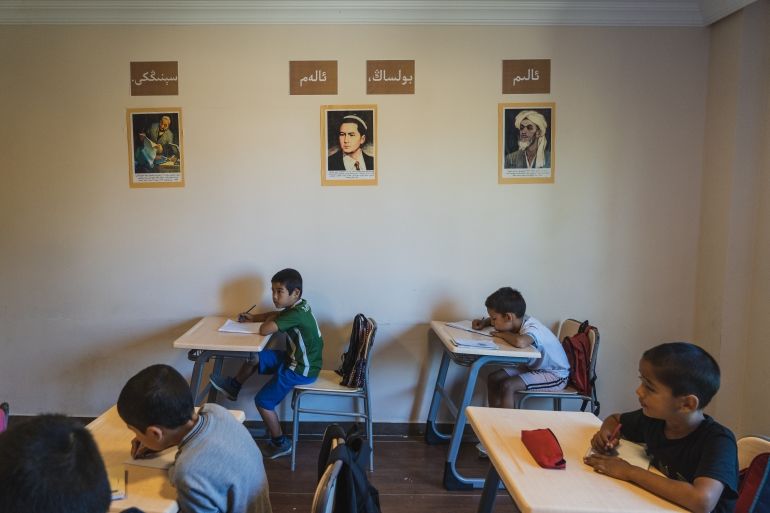 A classroom at the Uighur School in Istanbul displays images of famous Uighur poets and writers on the wall
‘Caught up in the camps’
While there is no official estimate, likely hundreds of Uighurs living in Turkey who made trips back home to Xinjiang were arrested upon their return. While some families in Turkey have received news of their loved ones’ fates, many have had no news for years.
Most Uighurs in Xinjiang have blocked their overseas relatives or are unresponsive on WeChat, a Chinese instant messaging app, fearful that communicating with loved ones abroad will result in arrest or internment.
“Many children came here with their parents,” explains Kuseni. “But the parents would go back and forth from Istanbul to East Turkestan for business and education. They didn’t realise the severity of what was happening and so they got caught up in the camps. None of us ever thought it would get as bad as it is now.”
“Now many children are growing up not knowing where their parents are – if they are in the camps or if they are already dead,” he adds.
As the situation worsened in Xinjiang, Uighurs in Turkey stepped up their efforts to preserve and develop the Uighur culture and identity and to care for children whose families have disappeared in Xinjiang.
None of the Uighur School’s students is untouched by the repression back in China. According to Kuseni, each child attending the programme, which provides after-school support to supplement their studies in public Turkish schools, has at least one relative who has disappeared in Xinjiang – usually their fathers.
At least 30 of the students have both of their parents in the camps and are staying with relatives or family friends in Istanbul, he says. The parents of another four children died in the internment camps.
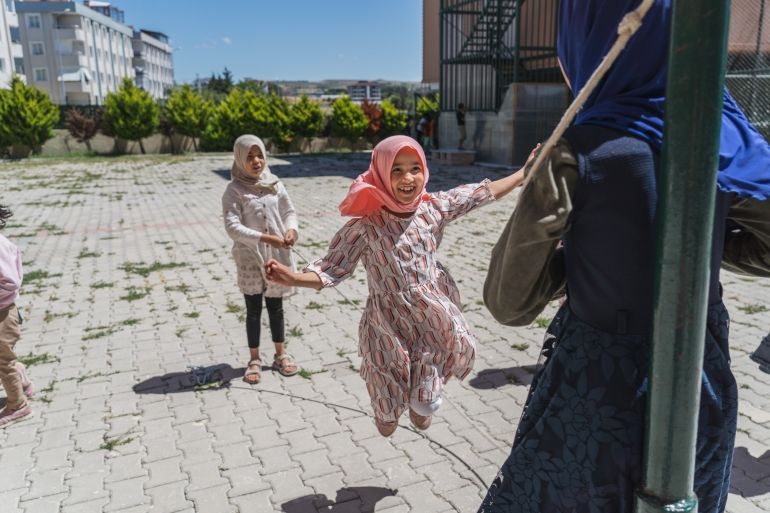 Some 35,000 Uighurs have sought refuge in Turkey, mostly around
Istanbul. Muyesser Tursun, a teacher at the school, says that many
children at the school have no idea if they will ever see their families
again
Some 35,000 Uighurs have sought refuge in Turkey, mostly around
Istanbul. Muyesser Tursun, a teacher at the school, says that many
children at the school have no idea if they will ever see their families
again‘Missing the love’
The children rush through the hallways of the school before recess, their footsteps quickening the closer they get to the exit. Finally reaching the door, they sprint excitedly to the playground, organising teams for jump rope and basketball.
The children’s beaming smiles belie a deep trauma.
“Many of the children have no idea when they will ever see their loved ones again, or if they are even still alive,” says 30-year-old Muyesser Tursun, who teaches mathematics and computer sciences at the school. Several of her own relatives have been imprisoned in China.
“The children from a very young age are forgetting what it’s like to have parents or a family,” she explains. “We are trying our best to provide that parental and familial support to them, but it’s not enough. They are missing the love of their parents and that has negative psychological effects.”
The school brings in psychiatrists to evaluate the students once every few months to help them grapple with the trauma of loss.
At the close of recess, the teachers appear outside as children run and kick a ball around in the yard, giggling loudly. The teachers call and wave at the students, signalling for them to return to their classrooms.
The small bodies move past posters on the schools’ walls displaying the faces of Uighur poets, writers, and scholars whose books are banned in China. Most of these writers were executed. The flag of the Uighur independence movement – baby blue emblazoned with a crescent moon and star – is displayed in the lobby, classrooms, and offices.
A poster outside a classroom reads: “the Uighurs are the true owners of East Turkestan. But now they are becoming slaves after the CCP’s occupation.” In one of the rooms, students recite the Quran.
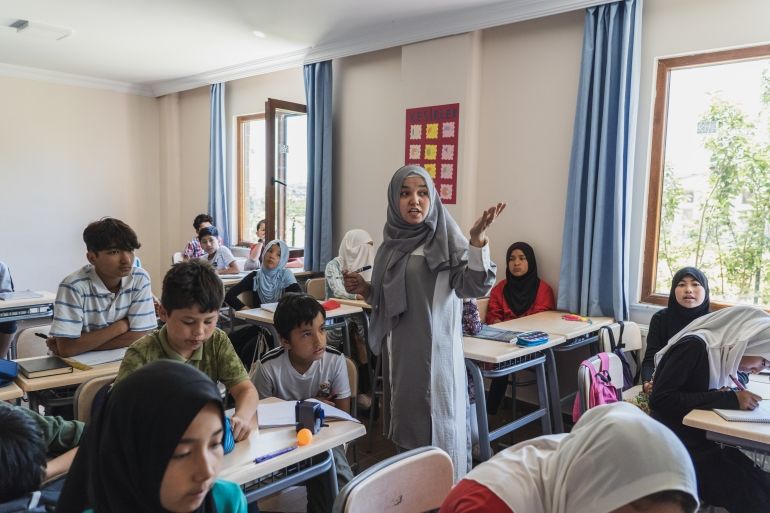 Subinur Omerjan teaches Uighur and Turkish language courses at the school
 ‘Wake up’
Subinur Omerjan, 29, teaches Uighur and Turkish language courses at the school and incorporates Uighur poets and writers into her curriculum.
As Omerjan discusses with her class the poem Trace, by Abdurehim Ötkür, who is considered the father of modern Uighur poetry, she breaks down the text’s literary allegories.
“He named his poem Trace because he suggests that we are continuing to follow in the footsteps of our ancestors, which means we are continuing to fight the Chinese who invaded us,” she tells the class.
“Do you understand?” The students excitedly nod their heads up and down.
Before assigning the students to memorise the poem, Omerjan says: “What he says in his poem is what your fathers have been fighting for since a very young age. For this reason, you all have to do the same.”
Learning Uighur poems and literature is not a mere class assignment for Omerjan, she considers it necessary for the Uighur community to preserve these works.
“If I was caught in China with the writings of any of these poets, they would call me a terrorist and I’d be thrown into the camps or imprisoned,” Omerjan tells Al Jazeera. In the back of her classroom is a map of China, with the borders of an independent East Turkestan carved into it.
“Through these poems and writings the students can understand the way forward – and what our ancestors were trying to tell us,” she adds. “They left behind these poems so that we can follow them like a map and see our future more clearly.”
Beside Omerjan’s whiteboard is an Arabic script scroll of a 1921 poem by the poet Abduhalik Uighur, who was executed by the Chinese strongman Sheng Shicai in 1933. A verse reads:
Hey, poor Uighur. Wake up. You have slept long enough.
You have nothing. What is now at stake is your very life.
If you don’t rescue yourself from this death,
Ah, your end will be looming. Your end will be looming.
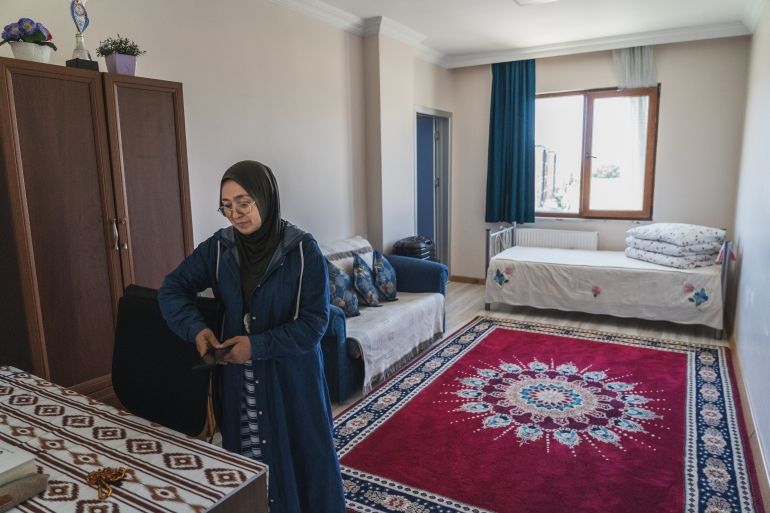 Minever Ablimit, 59, in her room where she lives beside the dormitories
Preparing to return
For the staff, too, the school is a balm to the soul.
Minever Ablimit, 59, lives in a small room beside the dormitories, where she works as a caretaker for the boarding students. Her brother in Xinjiang was sentenced to eight years in prison and she has had no contact with her relatives for five years. Her husband died after prolonged interrogations by Chinese authorities.
Ablimit can barely finish a sentence without tears blurring her eyes.
On the top floor of the school is a mosque, which students crowd into for their five daily prayers.
Ablimit has a daily routine each day after the third – Asr – prayer. “I take [the children] aside and try to joke with them,” she explains. She breaks down and cries, wiping her eyes with the ends of her hijab.
“I remind the children that one day East Turkestan will become independent and on that day we can return to our homeland,” she adds. “So now is the time to prepare for that day, and ensure that we are strong, educated, and determined enough to build when we finally go home.”