
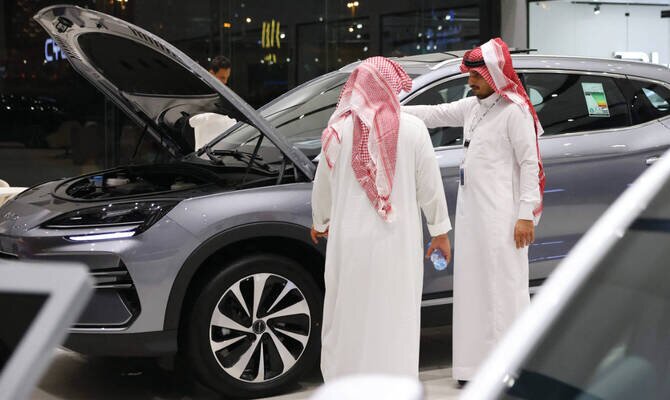
Saudi Arabia Powers Sustainability Race as EV Sales in ME Surge 40%
Riyadh: Saudi Arabia is emerging as the Middle East's leading force in electric vehicle adoption and manufacturing as governments across the region accelerate efforts to cut oil dependence, strengthen energy security, and build domestic clean-tech industries.
RIYADH: Saudi Arabia is emerging as the Middle East’s leading force in electric vehicle (EV) adoption and manufacturing as governments across the region accelerate efforts to cut oil dependence, strengthen energy security, and build domestic clean-tech industries.
According to a report released by the International Energy Agency (IEA), EV sales in the Middle East surged to around 75,000 units in 2025, marking a 40 percent year-on-year rise, underscoring the region’s accelerating pivot toward sustainable mobility, even as geopolitical tensions fuel a broader energy crisis.
The report revealed that EV sales grew significantly in the Kingdom and Qatar in 2025, with both nations together representing around 45 percent of regional demand.
In 2025, the UAE remained the region’s largest electric car market, accounting for almost 50 percent of sales.
However, its share of the regional market has declined from over 60 percent in 2023 as neighboring markets, including Saudi Arabia and Qatar, have gained momentum.
This comes as the Kingdom is promoting the adoption of EVs as part of its Vision 2030 strategy, which aims to achieve net-zero carbon emissions by 2060.
A critical target of the initiative is for 30 percent of all vehicles in Riyadh to be electric by 2030, contributing to a broader goal of reducing emissions in the capital by 50 percent.
"This structural shift is propelled by Saudi Arabia’s aggressive Vision 2030 local manufacturing investments, such as the Lucid and Ceer facilities in King Abdullah Economic City, alongside Qatar’s rapid electrification of its public transport infrastructure," said Joseph Salem, partner and head of travel, transportation, and hospitality practice at Arthur D.
Little Middle East.
He added: "Lucid Motors is significantly expanding its AMP-2 facility in KAEC to a targeted installed annual capacity of 150,000 fully assembled units.
Simultaneously, the homegrown EV brand Ceer, a joint venture between the Public Investment Fund and Foxconn, is constructing a 1 million sq.
meter facility designed to produce up to 240,000 vehicles annually by its targeted launch in late 2026".
Echoing similar views, Hashim Al-Fatayerji, CEO of Cararak, told Arab News that Saudi Arabia’s rapid EV growth reflects a major shift in adoption across the Gulf Cooperation Council (GCC) region, driven by Vision 2030, infrastructure investments, EV manufacturing projects, and increasing fleet electrification.
"The region’s young population is also more willing to adopt and experiment with new technologies," added Al-Fatayerji.
Safak Yucel, associate director of Georgetown McDonough's Business of Sustainability Initiative, said that the EV market in the UAE is dominated by premium vehicles, while the mass-market approach in countries like Saudi Arabia could further strengthen the growth of EVs in the region.
"What makes the adoption in Saudi Arabia and Qatar exciting is that they cater more toward a mass-market approach.
Although still small, this market expansion can be relevant for further adoption in the region," said Yucel.
NEW MODELS RESHAPE MARKET According to the IEA, EV adoption is rapidly progressing in the Middle East, with new players like BYD affirming their place in the market.
When electric car sales first began to scale in the Middle East in 2020, Tesla vehicles manufactured in the US accounted for about half of all sales.
However, the company’s share has fallen to around 15 percent, while BYD — which entered the regional market in 2022 — has rapidly expanded to around 60 percent of regional EV sales.
According to Salem, the attractiveness of EVs in Saudi Arabia is being fundamentally reshaped by a convergence of plunging global battery costs and the rapid influx of highly competitive Chinese models, which together offset the pressures of rising local fuel prices.
"While Chinese automakers, spearheaded by BYD, are capturing the lion's share of the Kingdom's early EV market by addressing mass-market and fleet affordability gaps, mainstream consumer adoption remains tempered by structural barriers," said Salem.
He added: "Fleet operators are currently the primary beneficiaries of these evolving economics, though broader market penetration will require resolving persistent concerns around charging density, extreme heat performance, and long-term resale values".
CHARGING NETWORKS EXPAND Salem said that the accelerated regional growth of EVs in the Middle East is being structurally driven by aggressive national decarbonization mandates, the rapid expansion of affordable Chinese EV imports, and shifting consumer economics exacerbated by volatile fuel prices.
According to him, the growth in charging infrastructure is also playing a crucial role in accelerating EV adoption in the region, as customers are now less concerned about range anxiety.
"As public charging infrastructure scales and fleet operators transition to electric alternatives, the Middle East is successfully transforming from a nascent market into a vital growth hub for global electric mobility," Salem said.
He added: "To combat range anxiety, national oil companies and joint ventures are rolling out ultra-fast charging networks.
ADNOC Distribution expanded its fast and super-fast EV charging network in the UAE by 1.4x year-on-year, reaching 400 points by early 2026.
In Saudi Arabia, the Eviq joint venture is targeting the installation of 5,000 fast chargers by 2030 to support inter-city mobility".
Al-Fatayerji agreed and said that electric vehicle growth in the Middle East is being driven by government investment, improved charging infrastructure, and more affordable EV models.
"The key lesson is that EV adoption depends on building the full ecosystem, not just selling vehicles," said Al-Fatayerji.
Bert Lijnen, automotive and financial services lead for Eastern Europe, the Middle East, and Africa at NielsenIQ, said EV adoption in the Middle East is expected to grow steadily as the market moves beyond premium early adopters.
He said progress will depend on three factors: expanding charging infrastructure, improving affordability, and building consumer confidence in EV technology.
"The challenge is no longer to generate interest; it is to resolve the structural and perceptual friction that stands between consideration and purchase," said Lijnen.
GLOBAL OUTLOOK According to the latest IEA report, global electric car sales are expected to rise again in 2026, reaching 23 million and accounting for close to 30 percent of all cars sold worldwide.
In 2025, global electric car sales increased by 20 percent, surpassing 20 million units.
This meant that EVs accounted for roughly one in every four new cars sold worldwide.
EVs also reached a 10 percent or higher market share in around 40 countries.
HIGHLIGHT The accelerated regional growth of EVs in the Middle East is being structurally driven by aggressive national decarbonization mandates, the rapid expansion of affordable Chinese EV imports, and shifting consumer economics exacerbated by volatile fuel prices.
In terms of production, Chinese automakers supplied 60 percent of electric cars sold worldwide, while European and North American automakers were each responsible for about 15 percent of global sales.
"Electric car sales set new records in close to 100 countries last year.
The growing popularity of EVs has marked a major shift for car markets and the energy system as a whole — and it is providing some relief now amid the largest oil supply shock in history," said Fatih Birol, executive director of the IEA, in the report.
He added: "Looking ahead, the falls we have seen in battery prices and the potential policy responses to the current global energy crisis are set to provide further momentum in EV markets".
The report highlights Southeast Asia as a region where the momentum behind EVs is particularly strong.
Annual electric car sales in the region more than doubled last year, giving them a market share of close to 20 percent.
China remains the world's largest manufacturing hub for EVs, making nearly three-quarters of the almost 22 million electric cars produced globally last year.
As production outstripped domestic demand, Chinese electric car exports doubled to a record high of more than 2.5 million.
According to a report released by the International Energy Agency (IEA), EV sales in the Middle East surged to around 75,000 units in 2025, marking a 40 percent year-on-year rise, underscoring the region’s accelerating pivot toward sustainable mobility, even as geopolitical tensions fuel a broader energy crisis.
The report revealed that EV sales grew significantly in the Kingdom and Qatar in 2025, with both nations together representing around 45 percent of regional demand.
In 2025, the UAE remained the region’s largest electric car market, accounting for almost 50 percent of sales.
However, its share of the regional market has declined from over 60 percent in 2023 as neighboring markets, including Saudi Arabia and Qatar, have gained momentum.
This comes as the Kingdom is promoting the adoption of EVs as part of its Vision 2030 strategy, which aims to achieve net-zero carbon emissions by 2060.
A critical target of the initiative is for 30 percent of all vehicles in Riyadh to be electric by 2030, contributing to a broader goal of reducing emissions in the capital by 50 percent.
"This structural shift is propelled by Saudi Arabia’s aggressive Vision 2030 local manufacturing investments, such as the Lucid and Ceer facilities in King Abdullah Economic City, alongside Qatar’s rapid electrification of its public transport infrastructure," said Joseph Salem, partner and head of travel, transportation, and hospitality practice at Arthur D.
Little Middle East.
He added: "Lucid Motors is significantly expanding its AMP-2 facility in KAEC to a targeted installed annual capacity of 150,000 fully assembled units.
Simultaneously, the homegrown EV brand Ceer, a joint venture between the Public Investment Fund and Foxconn, is constructing a 1 million sq.
meter facility designed to produce up to 240,000 vehicles annually by its targeted launch in late 2026".
Echoing similar views, Hashim Al-Fatayerji, CEO of Cararak, told Arab News that Saudi Arabia’s rapid EV growth reflects a major shift in adoption across the Gulf Cooperation Council (GCC) region, driven by Vision 2030, infrastructure investments, EV manufacturing projects, and increasing fleet electrification.
"The region’s young population is also more willing to adopt and experiment with new technologies," added Al-Fatayerji.
Safak Yucel, associate director of Georgetown McDonough's Business of Sustainability Initiative, said that the EV market in the UAE is dominated by premium vehicles, while the mass-market approach in countries like Saudi Arabia could further strengthen the growth of EVs in the region.
"What makes the adoption in Saudi Arabia and Qatar exciting is that they cater more toward a mass-market approach.
Although still small, this market expansion can be relevant for further adoption in the region," said Yucel.
NEW MODELS RESHAPE MARKET According to the IEA, EV adoption is rapidly progressing in the Middle East, with new players like BYD affirming their place in the market.
When electric car sales first began to scale in the Middle East in 2020, Tesla vehicles manufactured in the US accounted for about half of all sales.
However, the company’s share has fallen to around 15 percent, while BYD — which entered the regional market in 2022 — has rapidly expanded to around 60 percent of regional EV sales.
According to Salem, the attractiveness of EVs in Saudi Arabia is being fundamentally reshaped by a convergence of plunging global battery costs and the rapid influx of highly competitive Chinese models, which together offset the pressures of rising local fuel prices.
"While Chinese automakers, spearheaded by BYD, are capturing the lion's share of the Kingdom's early EV market by addressing mass-market and fleet affordability gaps, mainstream consumer adoption remains tempered by structural barriers," said Salem.
He added: "Fleet operators are currently the primary beneficiaries of these evolving economics, though broader market penetration will require resolving persistent concerns around charging density, extreme heat performance, and long-term resale values".
CHARGING NETWORKS EXPAND Salem said that the accelerated regional growth of EVs in the Middle East is being structurally driven by aggressive national decarbonization mandates, the rapid expansion of affordable Chinese EV imports, and shifting consumer economics exacerbated by volatile fuel prices.
According to him, the growth in charging infrastructure is also playing a crucial role in accelerating EV adoption in the region, as customers are now less concerned about range anxiety.
"As public charging infrastructure scales and fleet operators transition to electric alternatives, the Middle East is successfully transforming from a nascent market into a vital growth hub for global electric mobility," Salem said.
He added: "To combat range anxiety, national oil companies and joint ventures are rolling out ultra-fast charging networks.
ADNOC Distribution expanded its fast and super-fast EV charging network in the UAE by 1.4x year-on-year, reaching 400 points by early 2026.
In Saudi Arabia, the Eviq joint venture is targeting the installation of 5,000 fast chargers by 2030 to support inter-city mobility".
Al-Fatayerji agreed and said that electric vehicle growth in the Middle East is being driven by government investment, improved charging infrastructure, and more affordable EV models.
"The key lesson is that EV adoption depends on building the full ecosystem, not just selling vehicles," said Al-Fatayerji.
Bert Lijnen, automotive and financial services lead for Eastern Europe, the Middle East, and Africa at NielsenIQ, said EV adoption in the Middle East is expected to grow steadily as the market moves beyond premium early adopters.
He said progress will depend on three factors: expanding charging infrastructure, improving affordability, and building consumer confidence in EV technology.
"The challenge is no longer to generate interest; it is to resolve the structural and perceptual friction that stands between consideration and purchase," said Lijnen.
GLOBAL OUTLOOK According to the latest IEA report, global electric car sales are expected to rise again in 2026, reaching 23 million and accounting for close to 30 percent of all cars sold worldwide.
In 2025, global electric car sales increased by 20 percent, surpassing 20 million units.
This meant that EVs accounted for roughly one in every four new cars sold worldwide.
EVs also reached a 10 percent or higher market share in around 40 countries.
HIGHLIGHT The accelerated regional growth of EVs in the Middle East is being structurally driven by aggressive national decarbonization mandates, the rapid expansion of affordable Chinese EV imports, and shifting consumer economics exacerbated by volatile fuel prices.
In terms of production, Chinese automakers supplied 60 percent of electric cars sold worldwide, while European and North American automakers were each responsible for about 15 percent of global sales.
"Electric car sales set new records in close to 100 countries last year.
The growing popularity of EVs has marked a major shift for car markets and the energy system as a whole — and it is providing some relief now amid the largest oil supply shock in history," said Fatih Birol, executive director of the IEA, in the report.
He added: "Looking ahead, the falls we have seen in battery prices and the potential policy responses to the current global energy crisis are set to provide further momentum in EV markets".
The report highlights Southeast Asia as a region where the momentum behind EVs is particularly strong.
Annual electric car sales in the region more than doubled last year, giving them a market share of close to 20 percent.
China remains the world's largest manufacturing hub for EVs, making nearly three-quarters of the almost 22 million electric cars produced globally last year.
As production outstripped domestic demand, Chinese electric car exports doubled to a record high of more than 2.5 million.