
Saudi Arabia Deploys Solar Power at Break-Neck Pace, Claims United Nations
Kingdom vows to add 20 gigawatts of renewables annually as it accelerates energy transition with Chinese-backed projects
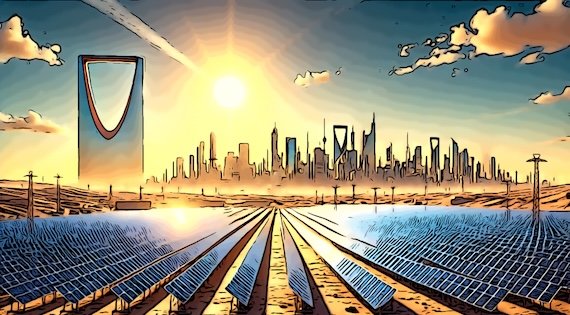
Saudi Arabia is racing to shift its electricity supply away from fossil fuels, declaring in a recent report from the United Nations Development Programme (UNDP) that it is “deploying solar energy at a faster rate than any country in history.” The kingdom has already connected more than ten gigawatts of renewable energy to its grid, with an additional 33 gigawatts currently in the pipeline, as part of its ambition to generate half its electricity from renewables by 2030.
According to the UNDP, Saudi Arabia plans to tender approximately 20 gigawatts of new renewable capacity each year until 2030. The strategy also extends into energy-storage, with around two gigawatts of battery capacity already operational and another 5.5 gigawatts under development.
The goal is to double that storage volume by 2030 to support variable solar and wind generation.
A major pillar in this transition is the kingdom’s partnership with Chinese clean-energy firms.
One flagship project is a three-gigawatt wind-farm near Riyadh, being built by China’s Goldwind in collaboration with ACWA Power, a Saudi utilities developer backed by the sovereign-wealth fund.
Saudi officials say Chinese technology has made it economically viable for the kingdom’s desert climate to support large-scale renewables without government subsidy.
Financial analysts note that while China has installed far more solar capacity overall, Saudi Arabia’s rapid acceleration—within a comparatively short timespan—is the novelty.
At end-2024 the kingdom had less than five gigawatts of solar; now it expects to scale to 130 gigawatts of combined solar and wind by the decade’s end.
The energy shift also supports the government’s broader economic plan under Saudi Vision 2030, aiming to free more oil and gas for export, reduce domestic fuel subsidies and foster growth in new industries.
By pivoting to renewables, Saudi Arabia hopes to repurpose its fossil-resource advantage into export-quality energy and industrial-base identity.
Challenges remain: experts point to climate-related hurdles such as dust and heat, which degrade solar-panel performance, as well as grid-integration issues in a system built around large thermal-power plants.
Local content in solar projects also remains below targeted thresholds, though officials are ramping up skill-development and manufacturing capacity.
Still, the kingdom’s commitment and pace are clear.
With major contracts, tender rounds and battery-storage plans underway, Saudi Arabia is making a bold bid to become a global leader in the energy-transition race—one built on the sun, the desert and a vision beyond oil.
According to the UNDP, Saudi Arabia plans to tender approximately 20 gigawatts of new renewable capacity each year until 2030. The strategy also extends into energy-storage, with around two gigawatts of battery capacity already operational and another 5.5 gigawatts under development.
The goal is to double that storage volume by 2030 to support variable solar and wind generation.
A major pillar in this transition is the kingdom’s partnership with Chinese clean-energy firms.
One flagship project is a three-gigawatt wind-farm near Riyadh, being built by China’s Goldwind in collaboration with ACWA Power, a Saudi utilities developer backed by the sovereign-wealth fund.
Saudi officials say Chinese technology has made it economically viable for the kingdom’s desert climate to support large-scale renewables without government subsidy.
Financial analysts note that while China has installed far more solar capacity overall, Saudi Arabia’s rapid acceleration—within a comparatively short timespan—is the novelty.
At end-2024 the kingdom had less than five gigawatts of solar; now it expects to scale to 130 gigawatts of combined solar and wind by the decade’s end.
The energy shift also supports the government’s broader economic plan under Saudi Vision 2030, aiming to free more oil and gas for export, reduce domestic fuel subsidies and foster growth in new industries.
By pivoting to renewables, Saudi Arabia hopes to repurpose its fossil-resource advantage into export-quality energy and industrial-base identity.
Challenges remain: experts point to climate-related hurdles such as dust and heat, which degrade solar-panel performance, as well as grid-integration issues in a system built around large thermal-power plants.
Local content in solar projects also remains below targeted thresholds, though officials are ramping up skill-development and manufacturing capacity.
Still, the kingdom’s commitment and pace are clear.
With major contracts, tender rounds and battery-storage plans underway, Saudi Arabia is making a bold bid to become a global leader in the energy-transition race—one built on the sun, the desert and a vision beyond oil.