

'It was theatre': Agnes Callamard on the Khashoggi murder trial
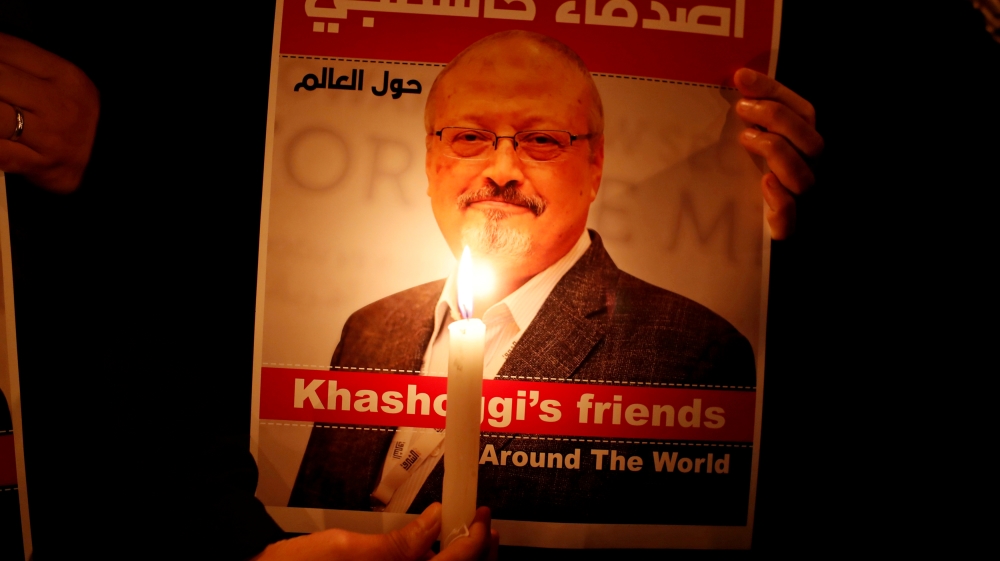
On Monday, a Saudi Arabian court overturned five death sentences over the killing of Saudi journalist Jamal Khashoggi in 2018. In a trial that has been widely condemned, the court handed 20-year sentences to five people and sentenced three others to between seven and 10 years.
Agnes Callamard, the United Nations special rapporteur on extrajudicial, summary or arbitrary executions, criticised the trial for being neither fair nor transparent and for failing to address "the responsibility of Crown Prince Mohammed bin Salman".
In June 2019, Callamard released a report in which she concluded that there was "credible evidence" that Khashoggi was "the victim of a premeditated extrajudicial execution for which the state of Saudi Arabia is responsible".
She spoke to Al Jazeera about the trial.
Al Jazeera: You have described the trial as making a "mockery of justice". Why do you believe this to be so?
Callamard: We know that the trial failed to meet the most basic international fair trial standards.
Most importantly, the high-level officials who were named by the prosecutor were never included in the trial and here I have in mind Saud al-Qahtani, the [former] adviser to the crown prince [Mohammed bin Salman]. The individuals who we know were part of the planning of the crime have not been indicted.
Another major problem is that the identity of those on trial has not been released. Under international law, there are very few cases where confidentiality can apply and this case did not qualify.
Also, there has been no explanation as to why these accused were picked and not others. The lowest-level officials were held guilty of the highest crimes.
Also, all the hearings were held behind closed doors.
Al Jazeera: Why do you think Saudi Arabia went ahead with the trial when it was largely considered to have lost credibility in the eyes of the international community?
Agnes Callamard: I always suspected the trial was undertaken because of pressure by the allies of Saudi Arabia.
The trial, which started in January 2019, always pretended to be conducted according to the best possible standards. It was accompanied by a narrative in the international sphere that insisted that the killing of Jamal Khashoggi was a domestic matter which required a domestic response. This was a way to manage the aftermath of the Khashoggi killing.
The five permanent members of the Security Council [China, France, Russia, the United Kingdom and the United States] were invited to attend the hearings. The trial was meant for those five powerful actors. It was not meant for the international audience generally because they were not present. And from that standpoint, Saudi Arabia has managed to make the Security Council complicit in this parody of justice.
The members of the Security Council have chosen to attend the trial and to remain silent. They have agreed to sign a non-disclosure agreement and this makes them complicit.
Watch: Will the truth about Khashoggi's murder ever be revealed?
Al Jazeera: In May, one of the journalist's sons, Salah Khashoggi, who lives in Saudi Arabia and has received financial compensation from the royal court for his father's killing, announced that the family had forgiven the killers. What role do you think this played in the sentencing?
Callamard: We expected a pardon and this is exactly what happened, even though the crime committed against Jamal Khashoggi was not of the kind that should be pardoned.
It was theatre. It was literally a play that was performed before our eyes with different acts.
There were Islamic scholars who debated whether this was a crime under Shariah (Islamic) law that could be pardoned. Because it was a premeditated crime, because it was so gruesome.
From my point of view, the crime had many more dimensions than a crime committed against the family of Jamal Khashoggi. There was an act of torture, an act of disappearance. The body has not been found. It was a crime against Turkey [as the murder took place in the Saudi consulate there], it was a crime under international law including the Vienna Convention. None of these dimensions was considered during the trial.
Al Jazeera: Do you believe the eight accused were guilty?
Callamard: The accused did not deny that they killed Jamal Khashoggi. The identity of the individuals has not been made public but they match the people identified by Turkey as those who were in the room when Khashoggi was killed.
So the hitmen were found guilty. But I do not believe that they should be the only ones paying. Those who have not been found guilty are the individuals who were part of the planning of the crime. The crime was a state crime and we need to make sure that the state is being held to account - not just the "little soldiers".
Al Jazeera: Mohammed bin Salman described the operation that led to the killing of Khashoggi as a "rogue operation". Did the trial serve to support that statement?
Callamard: Yes, this is why the trial was theatre. It is part of the narrative of Saudi Arabia from the beginning that it was a rogue operation.
As I repeatedly highlighted in my report, a rogue operation under international law is very narrowly identified. There is nothing that happened during this crime that meets the definition of a rogue operation under international law. Every single aspect of the crime brings in the responsibility of the state. The people on the team were all state officials. The team was dispatched on an official mission to Turkey. Those who executed the killing benefitted from state resources. They entered Turkey on a jet that had diplomatic clearance. Two members of the team had diplomatic passports. They operated inside a consulate. There was a follow-up team of 17 state officials who cleaned up the crime scene.
All the elements of the operation demonstrate the responsibility of the state of Saudi Arabia. There is nothing about this operation that can qualify as "rogue".
Al Jazeera: Saudi Arabia described the trial as a "final trial". Do you believe the world will ever hear the full truth about the killing of Jamal Khashoggi?
Callamard: It might be the final trial in Saudi Arabia. I've never believed that justice will be delivered through the Saudi Arabian justice system. They have just shown that they cannot administer justice.
It is doubtful that Mohammed bin Salman will ever appear before a court. But there are other ways to provide justice for Jamal. There is an ongoing trial in Turkey that may uncover more information. There are processes in the US Congress for the National Director of Intelligence to release their assessment of the responsibility of the crown prince. This document will eventually be made public. We just have to keep hammering and demanding the truth.
This interview has been edited for clarity and brevity.