
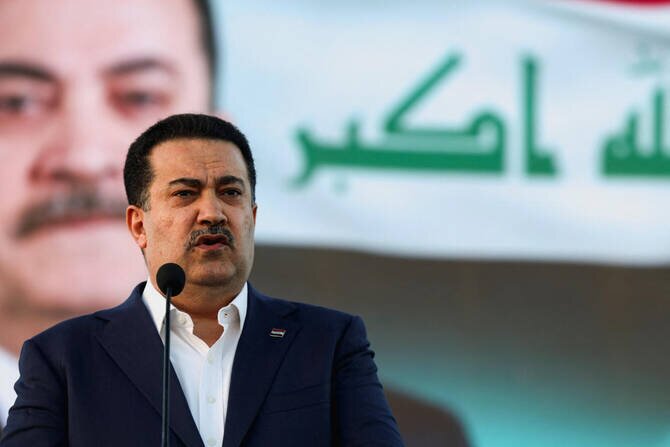
Iraq to Disarm Factions upon US Coalition Withdrawal, says Prime Minister
Prime Minister Mohammed Shia Al-Sudani announces plan for disarmament as coalition leaves by September 2026
BAGHDAD: Iraq has pledged to bring all weapons under the control of the state, but this endeavor will be challenging as long as there is a US-led coalition in the country that some Iraqi factions view as an occupying force.
Prime Minister Mohammed Shia Al-Sudani stated on Monday that the multinational anti-Daesh coalition's complete departure from Iraq by September 2026 is contingent upon the significant decrease in threats from Islamist militant groups.
The prime minister questioned the necessity of an 86-country coalition presence, given the current state of security and stability in Iraq.
He emphasized that once the coalition withdraws, there will be a clear program to disarm any factions outside of state institutions.
Sudani suggested that these factions can either join official security forces or engage in politics by laying down their arms.
The effort to disarm Iran-backed militias is a politically sensitive task, particularly amid pressure from the US.
The US has expressed its desire for Sudani to dismantle armed groups affiliated with the Popular Mobilization Forces (PMF), an umbrella organization of mostly Shiite factions.
Despite being formally integrated into Iraq's state forces, several PMF-aligned groups have ties to Iran.
The US and Iraq have agreed on a phased troop withdrawal, with full exit expected by the end of 2026.
The initial drawdown commenced in 2025.
Sudani acknowledged that there is time for international pressure on non-state armed groups like Lebanon's Hezbollah, part of Iran's so-called Axis of Resistance.
He emphasized that the situation in Iraq differs from Lebanon and reiterated his commitment to maintaining security and stability while ensuring that state institutions have control over war and peace.
Iran has gained significant influence in Iraq since the 2003 US-led invasion that toppled Saddam Hussein.
Pro-Iranian paramilitary groups hold considerable political and military power within Iraq.
Successive Iraqi governments have struggled to maintain alliances with both Iran and the US.
While the US imposes sanctions on Iran, Iraq continues to conduct business with it.
Securing major US investment remains a priority for Iraq, which has faced economic challenges and sectarian violence since 2003.
US companies are increasing their activity in Iraq, according to Sudani.
This includes a historic agreement with GE for power generation and an agreement with ExxonMobil that marks the first time Iraq is developing oilfields alongside an export system.
The Iraqi government aims to stop burning gas and import it from Iran by 2027 to achieve self-sufficiency.
Sudani, who campaigns as Iraq's builder-in-chief, expects a significant victory in the November elections.
He has implemented numerous infrastructure projects despite facing criticism over budgetary constraints and the addition of about one million employees to the state bureaucracy.