

‘I don’t intend to let my son down twice’: the bereaved father trying to end suicide
Not long before Christmas in 2014, Steve Mallen began to worry about the eldest of his three children. Edward, who had just turned 18, was good at everything. A gifted pianist, a talented sportsman and a nurturing big brother, he had secured a place at the University of Cambridge.
Then Edward stopped playing the piano. He became withdrawn and began to eat less and lose sleep. On 22 January 2015, he went to see the family’s GP, near their home in a village outside Cambridge. He revealed that he had suicidal feelings and had begun to self-harm, something he felt too ashamed to share at home. He had no known history of mental health problems.
The appointment triggered an urgent referral to NHS mental health services, but no swift action. Letters went missing, communication channels failed and the teenager’s parents were kept in the dark about his symptoms and treatment.
While they waited for help, the family booked an appointment with a private psychiatrist. Edward saw the psychiatrist on Friday 6 February and said it had gone well. He watched TV with the family that weekend and enjoyed his favourite dinner, spaghetti bolognese. On Sunday, he worked his usual shift at a bookshop in Cambridge. “I remember him coming home that evening and looking very tired,” Mallen says. “But we knew that we had got him some help. We were expecting letters from the NHS. His mum was making his favourite food …” His voice trails off.
The next day, Edward caught the train to Cambridge to hand in a maths assignment at his sixth-form college, then headed back to the village. Mallen was home alone that afternoon when there was a knock at the door. “Four big policemen in hi-vis jackets came in and informed me that my son had died horrifically, 500 yards from my front door,” he says. “And then they left. It was like someone had thrown a hand grenade into my house.”
I meet Mallen, 55, at the botanic garden in Cambridge, more than six years after Edward killed himself at his local train station. We sit on memorial benches outside the glasshouses and stroll among July blooms. “We used to spend whole days here with a picnic,” Mallen says. “Edward loved the natural world.”
Mallen has come dressed for business, in a suit over an open-necked shirt. He has an easy charm, but at times deep pain and anger inflect his voice. His face reveals the strain of grief and a personal mission that has cost him his privacy and his career.
In the weeks and months after that knock at the door, Mallen came to realise how badly Edward had been failed by the NHS, society – and his father. Almost immediately, Mallen, a commercial property consultant, began to direct his anger and guilt, as well as his astute business mind, into a new life.
In 2017, he co-founded the Zero Suicide Alliance, which has government funding and the backing of multiple NHS trusts. The alliance, which works with businesses, charities and bereaved families, has delivered online suicide-awareness training to more than 1.7 million people. It is part of a global “zero suicide” movement designed to shake up prevention strategies and attitudes at every level of society. Mallen does not believe we can eradicate suicide. “But if zero isn’t the right number to aim for, then what is?” he asks.
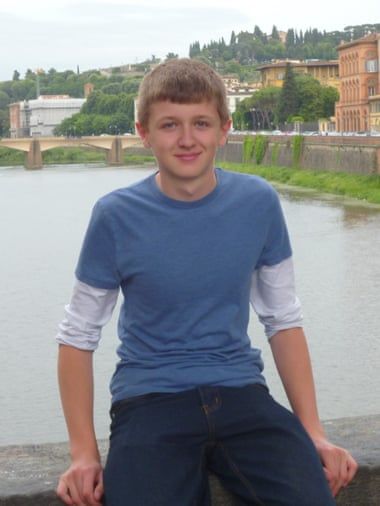 Edward Mallen, aged 17, on holiday in Florence.
Mallen regularly testifies to select committees in Westminster as part of overdue moves in parliament to improve mental health services. In an act he describes as “putting my head in the dragon’s mouth”, he became a governor at the NHS trust that he blames for his son’s death. Jeremy Hunt, the former health secretary who now chairs the health and social care select committee, has described Mallen as “the country’s most formidable campaigner on suicide prevention”.
“Tireless” does not do Mallen justice, nor is it correct. He is exhausted – and constantly aware of the potential impact of his work and profile on his wife and their surviving children, who are 22 and 19 (Edward would be 25). He prefers not to name the other family members or the village in which they live. Yet, with their support, Mallen is unbowed and driven by a promise.
“When Edward died, people would come up and say it was an accident, or like being struck by lightning,” Mallen says, his voice getting louder. “And they meant well, but what happened was a woeful indictment on our society. Edward should be alive. And I stood in front of his coffin and made him a public promise that I would investigate his death and seek reform. I don’t intend to let him down twice.”
Mallen is worried about the effects of the pandemic on young people, in particular the disruption and isolation they have endured. “This is going to scar a whole generation,” he says, sharing the concerns of mental health charities. There is no evidence yet of a related spike in suicides, but one study last year recorded a rise in suicidal feelings among young people. Suicides among people aged 10-24 (15-24 in Scotland) were already becoming more common in Great Britain, having increased in 2019 for the second year in a row, to 601 deaths in England and Wales (74% of them male) and 110 deaths in Scotland (70% of them male). There were slightly more than 6,500 suicides in Great Britain in 2019 – about 18 a day. (The Northern Ireland Statistics and Research Agency, which collates the figures for that country, has not published complete data for 2019.)
These deaths sometimes seem to defy explanation. A third of teenaged suicide victims have no known history of suicidal ideas or self-harm, plus low rates of risk factors such as substance misuse or adversity, according to a study last year by the Centre for Mental Health and Safety at the University of Manchester. “Suicidal ideas may develop rapidly in this age group and crisis services should therefore be widely available,” the researchers wrote. “Future prevention cannot rely on explicit expressions of risk.”
Edward’s inquest, in 2016, laid bare the failings that contributed to his death. After the urgent referral by the GP, 18 days before Edward’s death, a liaison practitioner decided the teenager did not need urgent help, despite conversations about suicide and daily train journeys. Instead, the clinician scrawled some support websites on a scrap of paper.
Edward was prescribed antidepressants, but he was not warned that initially they might make him feel worse. A letter, sent to Edward on 29 January 2015, about an appointment with a psychiatrist on 24 February, never arrived; it was incorrectly addressed. Meanwhile, Edward’s parents knew nothing; Edward was an adult, but he had given his consent for his parents to be told about his suicidal thoughts and treatment. “He felt ashamed and asked one of the clinicians to ‘tell my mum’ – and nobody even bothered to pick up the phone,” Mallen says.
The coroner was so concerned about the failings of Cambridge and Peterborough NHS foundation trust that she issued a “regulation 28” report – a requirement when action must be taken to prevent future deaths. The trust apologised. “While there are elements in what occurred that may well not have been foreseeable, there were also things we could have done better,” it said after the inquest, adding that it would act on the coroner’s direction and its own inquiry.
Under new leadership, the trust invited Mallen to become a governor in 2018. “Steve’s contribution is vital in helping us understand the needs of family members and patients,” says Tracy Dowling, the trust’s chief executive since 2017, in an email. “We have encouraged all our staff and indeed everyone we know to take the training offered by the Zero Suicide Alliance.”
Mallen, who was born near Tottenham in north London, started his mission by educating himself. He realised that he knew nothing about mental health or suicide prevention. “It’s really easy to throw rocks at stuff, but that’s not the same as doing the homework and getting inside the system,” he says.
Advertisement
An “Edward” folder on Mallen’s computer used to contain family photos and school documents. Mallen then added a subfolder and called it “RIP”. “It started off with his death certificate and letters from the coroner – that kind of thing,” Mallen says. “It now has over 60,000 files in it, from policy documents and letters to peer-reviewed academic journals from all over the world.”
Mallen blames decades of underinvestment in the NHS, as well as reforms introduced in 2013 by the Health and Social Care Act, for fragmenting health services, leading to a postcode lottery in funding and quality. He has also been struck by the varying levels of knowledge and commitment of the people he has met and challenged in government and beyond. “You quickly realise that, when you pull a lever in Westminster, there isn’t much on the end of it,” he says.
The Zero Suicide Alliance represents Mallen’s search for a functioning lever. The alliance, founded with Joe Rafferty, the head of Mersey Care NHS foundation trust and a zero-suicide pioneer in the UK, soon won government backing and funding, which has since hit £2m. Part of the zero approach involves providing education and information in all areas of life, from hairdressers’, schools and workplaces to late-night taxis, clifftops and bridges. “Intervening early is infinitely easier, and certainly a lot cheaper, than when somebody is in crisis,” Mallen says.
The alliance offers free interactive, online training, featuring case studies and “what would you do?” quizzes. A virtual coach offers advice, including on what to say to someone who seems withdrawn or has stopped doing the things they enjoyed (“they call that anhedonia,” Mallen says). Sleep or appetite loss is also a warning sign. The course cautions against using stigmatising language such as: “You’re not going to do something silly, are you?”
“It’s OK to have difficult conversations with your children,” Mallen says, wishing he had known six years ago a fraction of what he has learned. “It’s OK to say: ‘Are you OK?’ It’s OK to say: ‘Are you hurting yourself?’ or: ‘Have you thought about taking your own life?’”
Mallen was walking in the woods recently when he saw a woman sitting alone, clearly upset. He sat down with her and asked if she was OK. “I just got her to laugh and smile and made sure she had somewhere safe to go,” he says. “Does that make me a good samaritan? No, because it’s how we should all behave.”
Mallen is also big on “postvention”: what happens to a family bereaved by suicide, for whom rates of divorce, mental health struggles and suicide rise immediately. “Most families don’t survive this kind of trauma,” he says.
In 2018, Mallen was on his way home after a dinner when he was attacked by a drunk person. Mallen fell heavily against a shopfront. A huge cut to his face and head required 50 stitches and a blood transfusion. “Within 24 hours of being discharged, I was contacted by victim support and the police. I was given a case officer by the courts and was put in touch with a criminal compensation authority,” he says, running a finger along his scar. (His attacker received a two-year suspended sentence for grievous bodily harm.) “When my son got taken away from me in horrific circumstances, there was nothing.” Thanks in large part to his work, a commitment to suicide bereavement support services in all trusts by 2024 is part of the government’s NHS long-term plan.
Mallen is also working on prevention in prisons and schools. He is working with the government on guidelines for consent and confidentiality in families when there is an imminent risk to life. He is pleased that the levers of change are beginning to move – and celebrates a “social revolution” in discussions about mental health. After we met, NHS England announced plans for new waiting time standards for mental health patients, including one-hour responses in extreme cases. Charities welcomed the move while questioning the service’s ability to deliver, given growing demand and staff shortages.
Mallen is aware that he is privileged to be able to campaign full-time (even though most of his savings are gone). “I stand shoulder to shoulder with lots of other mums and dads who can’t do that,” he says. Their emails reach his inbox weekly; he has guided several families through grief and the trauma of inquests.
Yet campaigning has also been cathartic. Mallen can’t imagine doing anything else. He says he is often the only person in a room with dry eyes. But he often cracks, usually when he is alone and thinking about Edward’s death. “As much as I blame the system and the NHS for the loss of my boy, my son was dying in front of me and I couldn’t see it,” he says. “The feeling that one should have done better will never go away.”
As he heads off to get the same train home that Edward caught just before his death, Mallen says: “Grief is like glitter: no matter how hard you try, you never quite pick it all up. But you do rebalance.” He says he won’t stop campaigning until he can be confident that a boy like Edward, with the same symptoms today, would get the help he needed. “I will always stand next to my boy,” he says. “But we have a long way to go.”