

How China is creating new foods in space
At first glance they are identical to any other ears of wheat swaying in the wind all over the world. But the vast fields of crops in north-eastern China are no ordinary plants – they were created in outer space.
They are a variety known as Luyuan 502 and are China's second most widely grown type of wheat. The plants were bred from seeds that were flown into orbit 200 miles (340km) above the Earth's surface. Here, in the unique low gravity environment and outside the protective magnetic shield of our planet, they picked up subtle changes to DNA that gave them new qualities that made them more tolerant to drought and able to better resist certain diseases.
They are an example of a growing number of new varieties of important food crops that are being bred on spacecraft and space stations while orbiting our planet. Here they are subjected to microgravity and are bombarded by cosmic rays, which trigger the plants to mutate – a process known as space mutagenesis.
While some of the mutations leave the plants unable to grow, others can be advantageous. Some become hardier and able to withstand more extreme growing conditions while others produce more food from a single plant or grow faster or require less water. When brought back to Earth, seeds from these space-bred plants undergo careful screening and further breeding to create viable versions of popular crops.
In a world facing increasing pressure on agriculture due to climate change and vulnerable supply chains, which have underlined the need for crops to be grown closer to where they are eaten, some researchers now believe that space-breeding, also known as space mutagenesis, may help them to adapt crops to these new challenges.
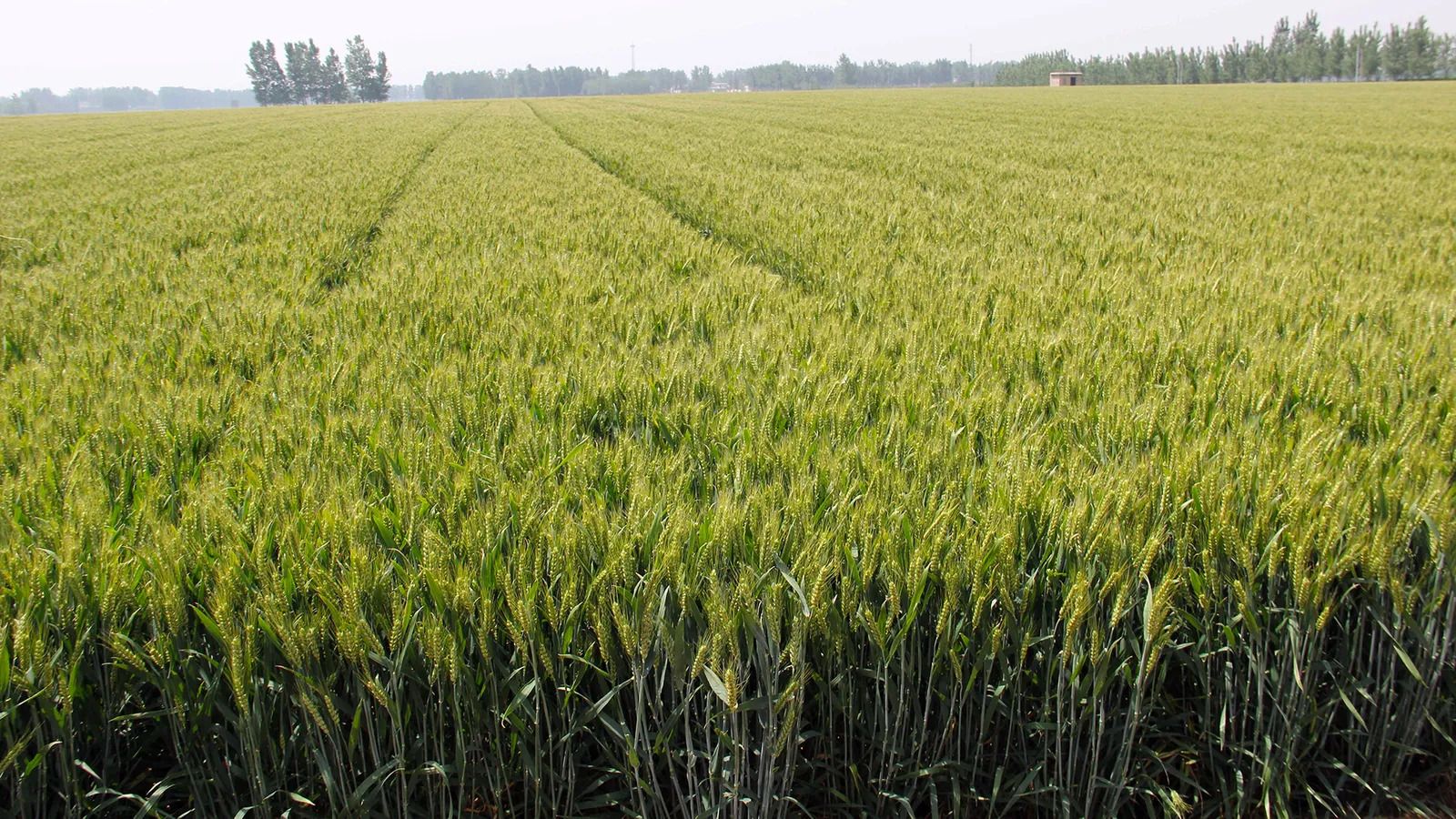 The second most planted wheat crop in China is the Luyuan 502 mutant variety that was created using space mutagenesis
"Space mutagenesis makes beautiful mutations," says Liu Luxiang, China's leading space mutagenesis expert and director of the National Center of Space Mutagenesis for Crop Improvement at the Institute of Crop Sciences of the Chinese Academy of Agricultural Sciences in Beijing.
Luyuan 502, for example, has an 11% higher yield than the standard wheat variety grown in China, a better tolerance to drought and stronger resilience against the most common wheat pests, according to the International Atomic Energy Agency, which coordinates international cooperation in the use of irradiation-based techniques for creation of new crop types.
"[Luyuan 502] is a real success story," says Liu. "It has a very high yield potential and adaptability. It can be cultivated in many different areas with different conditions."
This adaptability is what makes Luyuan 502 such a hit among farmers across China's vastly diverse agricultural landscapes and varied climate.
It is just one of more than 200 space-mutated crop varieties created in China over the past 30 years, according to Liu. In addition to wheat, Chinese scientists have produced space-bred rice, corn, soybeans, alfalfa, sesame, cotton, watermelons, tomatoes, sweet peppers and other types of vegetables.
China has been experimenting with space mutagenesis since 1987 and is the only country in the world consistently using the technique. Since then it has conducted dozens of missions to carry crop seeds into orbit. Chinese scientists released the first space-bred crop – a type of sweet pepper called Yujiao 1 – in 1990. Compared to conventional sweet pepper varieties grown in China, Yujiao 1 produces much bigger fruit and is more resistant to diseases, says Liu.
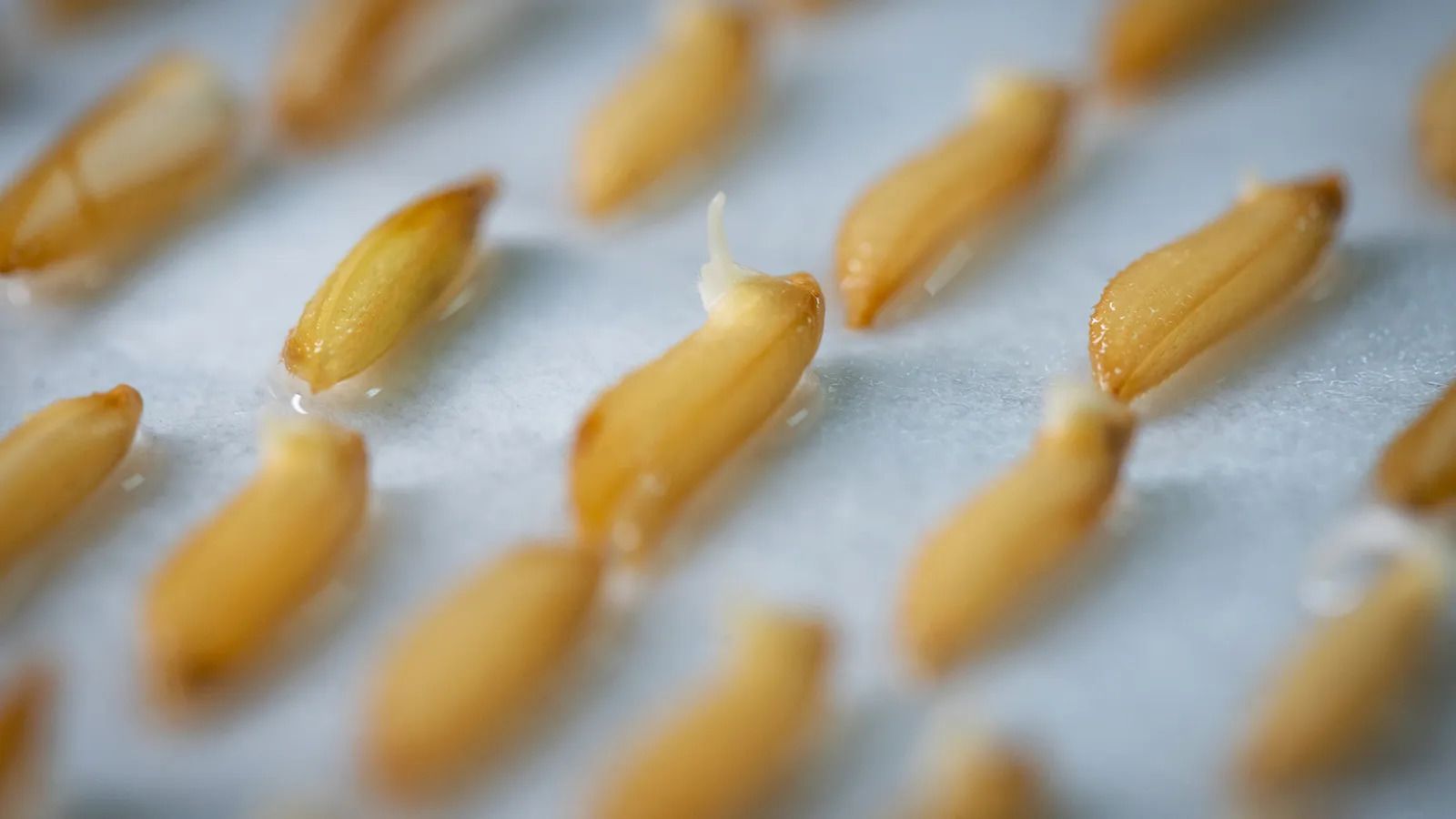 High-energy radiation in space can trigger mutations in seeds that can
lead to improved and desirable traits in important crops such as rice
High-energy radiation in space can trigger mutations in seeds that can
lead to improved and desirable traits in important crops such as rice
China's emergence as a global space power in recent decades has enabled it to send thousands of seeds into orbit. In 2006, the country shipped into orbit their largest batch ever – more than 250kg (551lbs) worth of seeds and microorganisms of 152 species – aboard the satellite Shijian 8. In May this year, 12,000 seeds including several types of grass, oats, alfalfa and fungi, returned from a six-month visit to China's Tianhe space station as part of the crewed Shenzhou 13 mission.
The Chinese even sent a batch of rice seeds for a lunar round-trip with the Chang'e-5 mission that put a lander on the surface of the Moon in November 2020. According to Chinese news reports, these lunar rice seeds successfully produced grain in laboratory after their return to Earth.
"We benefit from China's strong space programme," Liu says. "We can use recoverable satellites, high-altitude platforms but also manned spacecraft to send our seeds to space up to twice a year and use those space utilities for crop improvement."
The seeds are sent on trips lasting from just four days to several months. In this unusual environment, a number of changes can happen to seeds and plants. First, high energy solar and cosmic radiation can damage the genetic material in the seeds itself, leading to mutations or chromosomal aberrations that are passed onto future generations. The low gravity environment could also lead to other changes. Plants that germinate and are grown in microgravity show changes in cell shape and the organisation of structures within the cells themselves.
In most cases, Chinese scientists fly the seeds into space and then germinate them back on the ground once they are returned to Earth. The seedlings are then screened for useful traits that provide an advantage over more traditional crop varieties. The scientists are looking for changes that lead to bigger fruit, lower watering requirements, better nutrient profiles, resistance to high and low temperatures or resilience against disease. In some cases rare mutations can lead to breakthroughs in crop yield or resilience.
On Earth, we are protected from high-energy rays by the Earth's magnetic field and thick atmosphere, but in orbit, spacecraft and satellites are constantly exposed to this radiation
The most promising plants are bred further, until the researchers arrive at a substantially improved variant that can address the farmers’ needs.
China, however, although currently a leader in space mutagenesis, wasn't the first nation to experiment with space-breeding. The technique dates back to some early experiments conducted by US and Soviet scientists using carrot cells launched into orbit aboard the Soviet satellite Kosmos 782.
The approach relies on the same principles as nuclear mutagenesis, which has been around since the late 1920s. Nuclear mutagenesis speeds up the naturally occurring mutation processes in the DNA of living organisms by exposing them to radiation.
But while nuclear mutagenesis uses gamma rays, X-rays and ion beams from terrestrial sources, space mutagenesis relies upon the bombardment by cosmic rays that pepper space around our planet. On Earth, we are protected from those high-energy rays by the Earth's magnetic field and its thick atmosphere, but in orbit, spacecraft and satellites are constantly exposed to this radiation, which mostly comes from the Sun.
Both space and nuclear mutagenesis can help cut down the development times of new crop varieties by up to a half, according to Shoba Sivasankar, who leads the joint Plant Breeding and Genetics group of the International Atomic Energy Agency (IAEA) and the Food and Agriculture Organization of the United Nations (FAO).
The IAEA's nuclear laboratories in Seibersdorf, 21 miles (35km) south-east of Vienna, Austria, are the global hub and training centre for nuclear mutagenesis. Cooperating countries that don't possess their own nuclear facilities send their seeds, plant cuttings or seedlings to Sivasankar's team for irradiation.
"It only takes a couple of minutes to irradiate the seeds, but it requires sufficient knowledge and expertise," says Sivasankar. "Every variety has a different tolerance. Give the seeds a dose that is too high, keep them inside the irradiator too long, and you destroy them. They won't germinate. If you don't give them enough radiation, you won't generate enough mutations and end up with a generation that would look just like the predecessors."
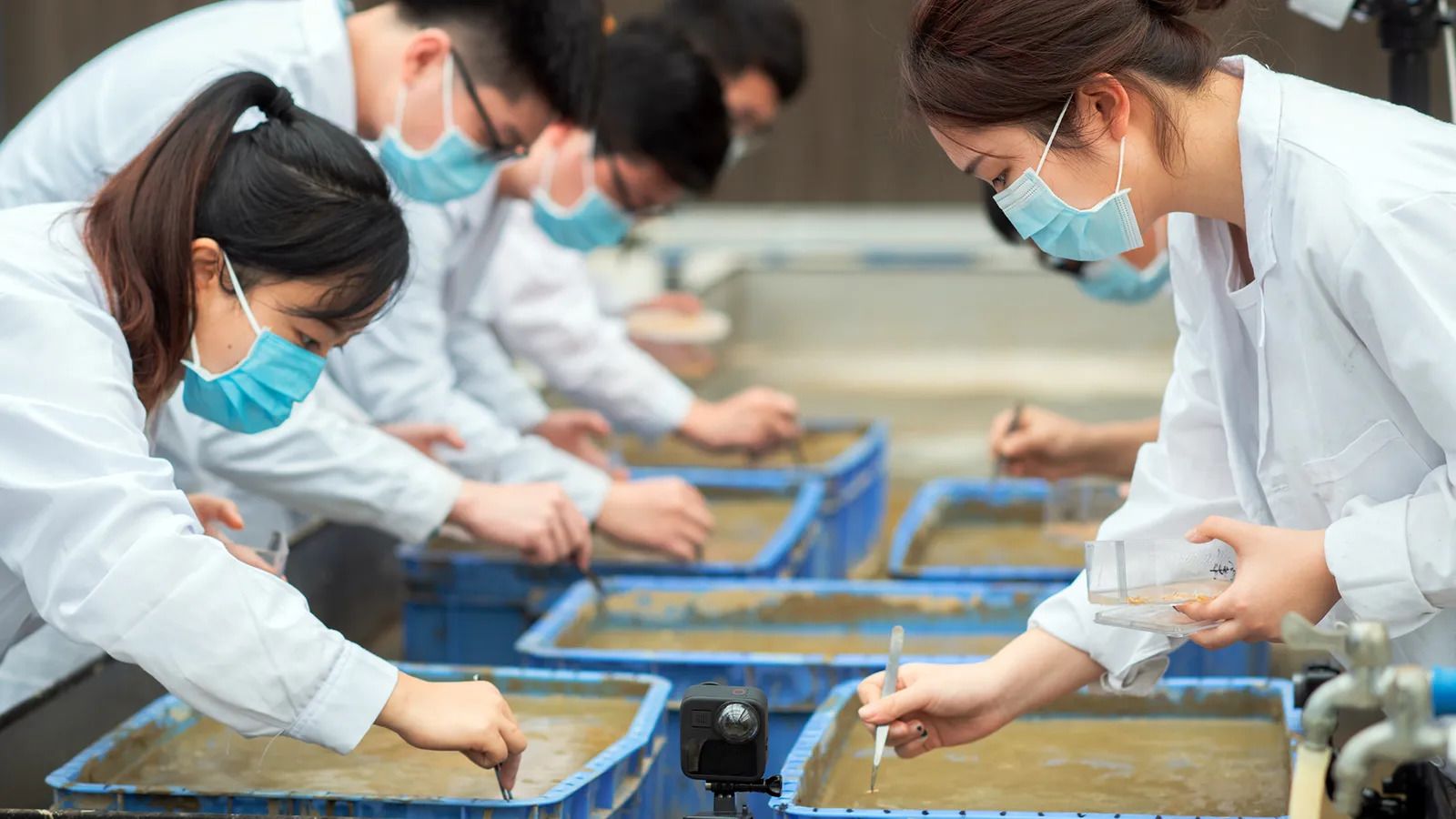 By sending seeds into space, Chinese scientists are trying to breed stronger crops that can produce better yields back on Earth
The Joint FAO/IAEA Division of Nuclear Applications in Food and Agriculture, of which the Plant Breeding and Genetics group is a part, was founded in 1964. In the late 1920s, experiments using X-rays to induce mutations in wheat, maze, rice, oats and barley, sparked the interest of botanists all over the world. By the 1950s most developed nations had their nuclear breeding programmes, experimenting not only with X-rays but also with UV rays and gamma rays.
"At that time, there was a lot of effort in Europe and North America," says Sivasankar. "Many new varieties created with the help of nuclear mutagenesis were released. But in the past two to three decades, many of these countries abandoned the technique. Especially the US has turned to transgenic technologies that enable the insertion of pieces of foreign DNA into the genome of plants in the lab."
Nuclear mutagenesis, however, didn't disappear. Countries in the Asia Pacific region maintained the momentum, headed by the increasingly confident China. They continue filling the IAEA's database of mutant crop varieties, which today encompasses 3,300 newly developed crop varieties.
Sivasankar says that while for some of the poorer Asian countries, the high cost of transgenic technologies may have been the primary motivation for sticking with nuclear mutagenesis, there are more practical reasons to continue using the technique mostly abandoned by the West.
"For example, the US industrial farming sector prioritises a handful of traits such as insect and herbicide resistance," says Sivasankar. "The transgenic technologies work quite well for that. But in Asian countries the situation is very different."
Asian breeders produce seeds for many small farmers who work in extremely diverse environments. Modifying just one or two traits would not be enough.
"They need more complex traits, many of them related to the climate situation such as heat and drought tolerance or the ability to grow in nutrient-poor or saline soil," says Sivasankar. "That, in my opinion, cannot be achieved with transgenic technologies."
According to Liu and his team the world has to increase its production of vital cereals by 70% if it wants to feed an additional two billion people that are expected to live on the planet by 2050
China sees the effort to improve the genetic pool of its agriculture crops as a necessity. According to Liu and his team the world has to increase its production of vital cereals by 70% if it wants to feed an additional two billion people that are expected to live on the planet by 2050. The growing population in the Asia Pacific region is at the highest risk of suffering from food shortages, they say.
Through nuclear and space mutagenesis, China alone has developed and introduced over 800 new varieties, improving on all key characteristics compared to the original crops, according to the IAEA.
But one questions remains: what is the advantage of sending seeds to space when the same can be done in labs on the ground?
Liu admits that sending seeds to space costs more than sticking them into ground-based irradiators. Still, the space trips seem to provide clear benefits and frequently produce more interesting results.
"We actually see a higher frequency of useful mutations from space mutagenesis than from gamma rays," says Liu. "In space, the radiation intensity is considerably lower, but the seeds are exposed to it over a much longer period of time. What we call the linear energy transmission of the particles and the overall biological effect are higher in space and there is a much lower rate of damage to the seeds compared to those irradiated in labs."
In an irradiator, the seeds receive large doses of ionising – from 50-400 grays – over a period of a few seconds, says Liu. On the other hand, seeds on a weeklong space trip are exposed to only two milligrays. As a result, up to 50% of seeds don't survive the harsh ground-based treatment while almost all of the seeds flown in space usually germinate, he adds.
"All these techniques are very useful and are helping us solve some very real problems," says Liu. "There are too few opportunities to fly seeds to space. We can't rely only on that."
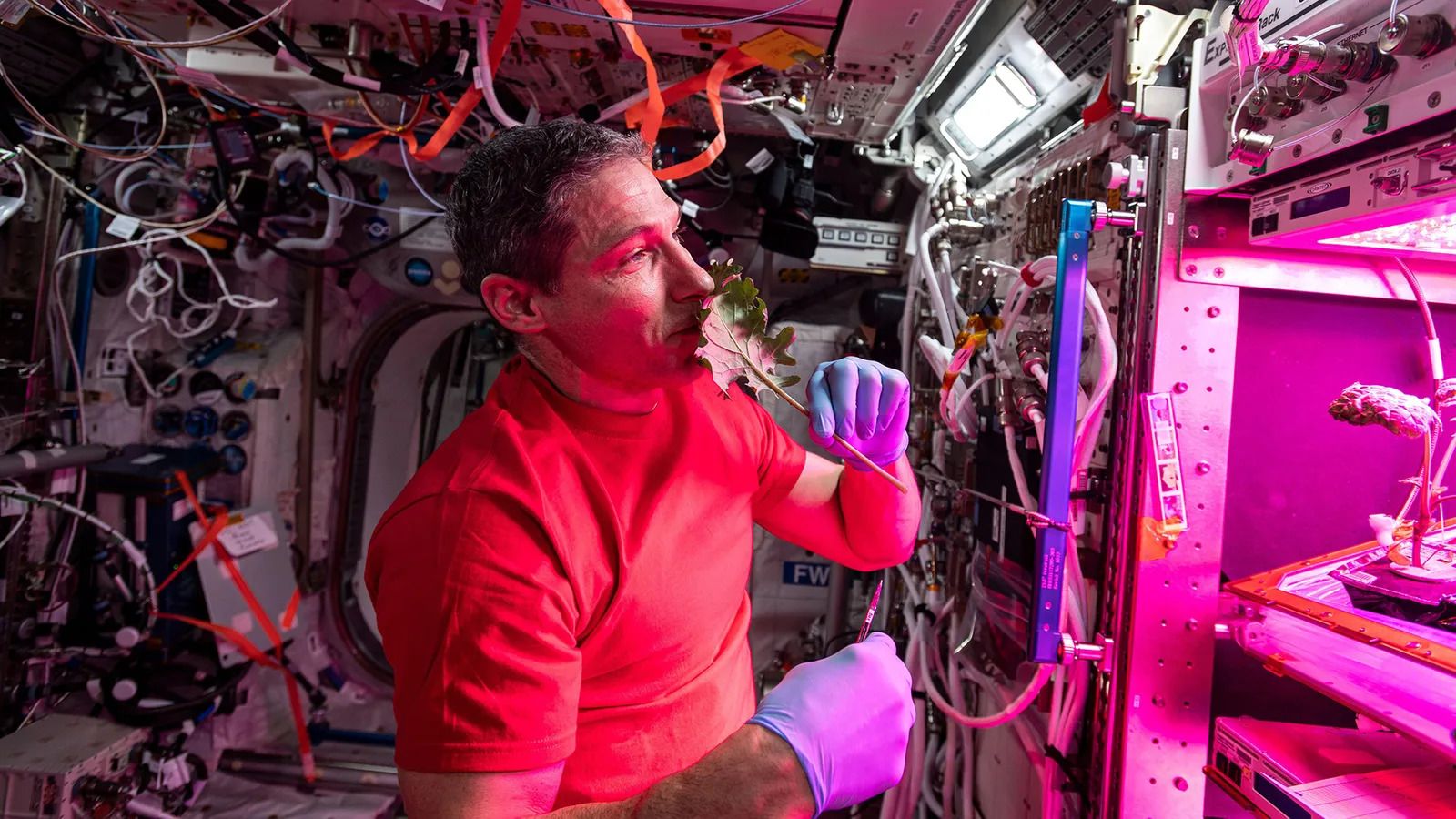 Nasa has been growing lettuce on the International Space Station in experiments it hopes will lead to fresh food for astronauts
Now it appears there is renewed interest from other parts of the world in growing food in space. In November 2020, American commercial space services company NanoRacks announced plans to operate orbiting greenhouses. Their goal? To develop new crop varieties that would be better suited to feed the world as it faces worsening climate change.
For the endeavour, the company, known for dispatching small satellites from the International Space Station, partnered with the United Arab Emirates, a country with little arable land of its own, meaning it has to import much of the food it requires.
However, not all seeds return from space as fledgling super plants. A batch of lettuce seeds sent to the International Space Station by European scientists in 2020 grew slower after their return to Earth when compared to plants that had stayed on the ground.
Much of the research now being conducted on growing food while in space is aimed at helping astronauts feed themselves while on missions. Astronauts on the ISS, for example, have been harvesting romaine lettuce since 2015 and eating it, and a study published in 2020 found it was safe to eat, and could provide a valuable source of nutrients on long missions.
But while growing food for astronauts could prove invaluable as space agencies around the world set their sights on returning humans to the Moon and visiting other planets such as Mars, space food will perhaps be of even greater use to those of us who remain here on Earth.