

Have we got Ancient Egypt's mummies all wrong?
Mummies, like werewolves, vampires and witches, are the stuff of legend in the popular imagination. The idea of bodies from an ancient civilisation, mysteriously preserved for thousands of years, discovered in glittering tombs, has always held an allure: from the Victorians holding mummy "unwrapping" parties through to "Tutmania" in the 1920s following the discovery of Tutankhamun's tomb, to a wealth of movies from Hammer Horror flicks to Indiana Jones.
Given all this, it's no wonder that myths and misconceptions about them abound. But a British exhibition aims to shed new light on this ancient practice – and maybe even shift our perspective.
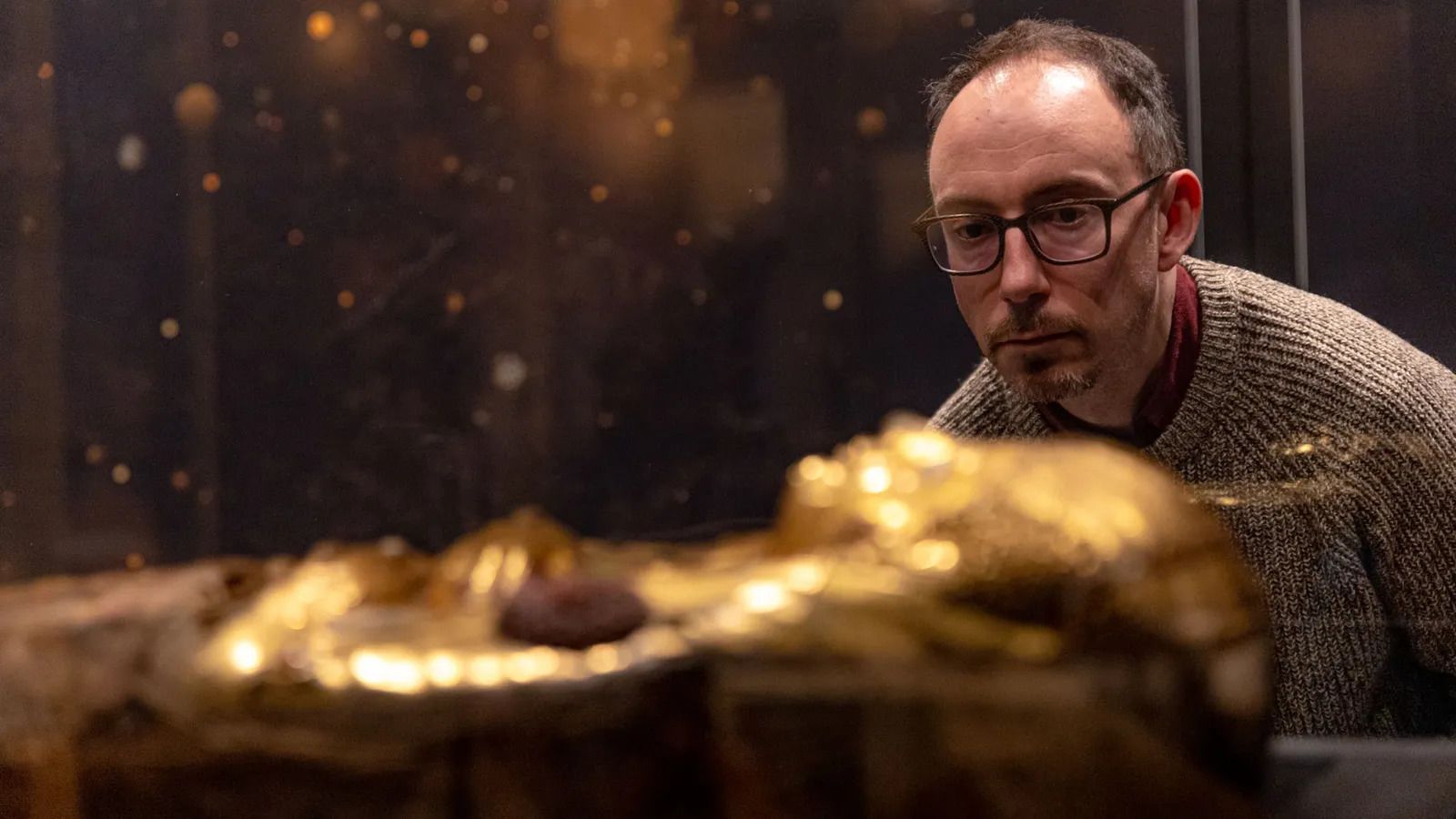 Curator Campbell Price says that the main intention of mummies was not to preserve the dead, but transform them into gods
Manchester Museum in the north of England reopened last month after a £15m redevelopment project – and their free opening exhibition, Golden Mummies of Egypt, showcases their incredible Egyptology collection. It includes eight mummies dating from the Graeco-Roman period (300BC to 300AD), brought to Britain by archaeologist Flinders Petrie, following his 1888–90 and 1911 excavations of a huge necropolis at Hawara, in the Faiyum region south of Cairo.
The show has arrived home in Manchester after touring North America and China while the museum was shut for refurbishment. And now Campbell Price, the curator, is on something of a mission: to change how we think and talk about mummies.
Flipping the mummy narrative
For starters, and rather unusually these days, they are not including any X-rays or CT scans of the human remains below the wrappings; there is no bio-medical speculation on how old these people were when they passed away or how they died. Scans of the mummies were included while the show was on tour – but have now been removed (which involved reworking information displays at some cost), to reflect Manchester Museum's new thinking about how to present such sensitive artefacts. "We're stepping back from this desire to unwrap," says Price, adding that they hope to "flip the narrative" by refocusing the attention "from the inside – what we expect we have the right to see – on to the outside – what the Ancient Egyptians expected people to see."
Rather than including arguably voyeuristic speculation over human remains, Golden Mummies focuses more on the astonishing casings that the Egyptians crafted for their dead to spend eternity in.
And this is the main myth that Price hopes to bust: mummies were not actually about preserving the dead – they were about transforming the dead into gods. The ostentatiously decorated coffins and casings don't reflect the person inside, but use divine, idealised imagery to help the spirit to live on in greater glory. By using iconography associated with funerary gods – the male god Osiris and the female god Hathor – it's as if the embalmers were offering reassurance that, yes, this person is ready for the afterlife.
I have been in hospitals where mummies have gone into the CT scanner and there are Egyptologists, biomedical Egyptologists, and clinicians, and no one can agree what CT scans show – Campbell Price
"There are texts that say 'the dead person is going to become a god' – that is what the mummification process is about," insists Price. "When we find mummies that are judged by modern people 'well-preserved', that may be a symptom, rather than an intention."
Some evidence for this can be found in the fact that the late-period mummies, like the ones in Manchester's show, often won't even have had their organs removed. The fact that ensuring the entire physical body was neatly preserved clearly wasn't always the aim arguably suggests that it may in fact never have been the sole or main intention – but rather just one aspect of a wider ritual around death.
"A myth has developed in Egyptology itself, that in Ancient Egypt there's lots of experimentation [in embalming], they get it right for a few generations, and then 'forget' how to do it," Price says, sounding deeply unconvinced. "And it just declines, till you get to the Graeco-Roman period, where they so don't care about the inside that they're not removing the internal organs, they're just sloshing on resin, and they make it look pretty on the outside."
He considers this a condescending and colonial interpretation, thinking it is more likely that the long-term physical preservation of the body was always simply less significant than the performed, ritual act of preparing the body for the afterlife – essentially, giving the dead a fabulous send-off.
Looking around the exhibition, at the gilded masks and jewellery, the intricately painted hieroglyphs, patterns and scenes, it's impossible not to be struck by how vivid the mummies still are. Although now displayed horizontally, it is thought these later period mummies were likely stood upright to be publicly displayed and admired for years, possibly even generations, following their death – as a kind of "divine statue". With low lighting catching all that gold, the atmosphere in the exhibition does indeed feel reverential.
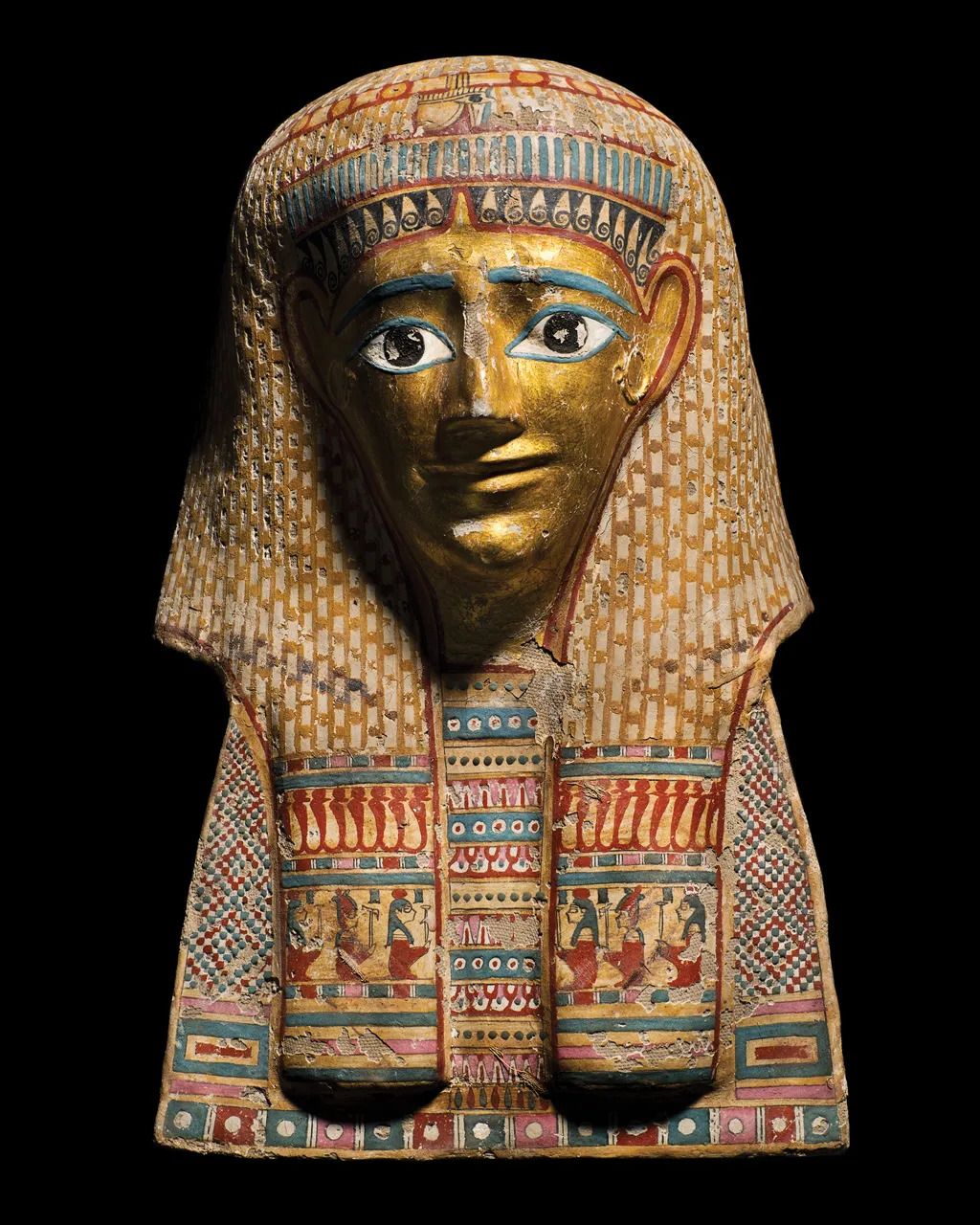 Several of the exhibition's mummies fit the classic image that most
people have – with their gold and blue, heavy-eyed 'death masks'
Several of the exhibition's mummies fit the classic image that most
people have – with their gold and blue, heavy-eyed 'death masks'
And it is this external deification that the show centres – rather than scanning coffins to see if the people inside were well-preserved, or if they had gammy knees or died of cancer.
"I want to get away from that biomedical interpretation, and focus on the becoming-a-god bit," says Price. "I'm not saying all those scientific inquiries are 'bad' and shouldn't be done. I'm just saying, it's a chance to look at the material in a different way."
This is partly about respect; Manchester Museum's new director Esme Ward's stated mission for the institution is "to build understanding between cultures and a more sustainable world", with their core values being "inclusion, imagination and care". And when talking about showing care, in the case of this particular exhibition, it felt important for the team behind it to acknowledge that we were never meant to see under the mummies' wrappings.
Some in the sector even suggest that mummies shouldn't be on display at all; in 2020, the Pitt Rivers Museum in Oxford removed a mummy, alongside other human remains such as shrunken heads, from its displays. The decision was made following audience research that showed visitors often understood the Museum's displays of human remains as "a testament to other cultures being 'savage', 'primitive"' or 'gruesome'… [reinforcing] racist stereotypes". The Museum said that the decision to remove human remains was an attempt to "show our respect for the communities around the world with whom we work".
"It's fairly clear that the Ancient Egyptians involved in making works like this didn’t want them to be unwrapped," confirms Price. But it's not just sensitivity to this that has informed Manchester Museum's decision-making: he also isn't terribly convinced by the science available to us. "I have been in hospitals where mummies have gone into the CT scanner and there are Egyptologists, biomedical Egyptologists and clinicians, and no one can agree what CT scans show," he laughs. After all, CT scans were designed for living bodies, not dried-out corpses. "You can say 'this is evidence of a health condition', and someone else will say 'no it's an effect of mummification'. Something may appear like a calcified whatnot or a fossilised ding-dong – but actually you've got to own up to the public and say 'we do not know'."
The legacy of Western archaeologists unwrapping mummies (often destroying them in the process) also has the tang of colonial entitlement to it – from Victorians making macabre entertainment out of 'unrollings' through to the fact that some institutions continued to unwrap in the name of research right up until the 1980s. Since then, digital unwrapping has taken over – and of course, does not damage the mummies. And CT scans can offer astounding detail: from revealing amulets buried with the body right down to how hardened an artery was.
The argument for 'unwrapping'
Speaking out against 'unwrapping' is somewhat controversial: there will be many who think pursuit of knowledge trumps all other considerations, or that after thousands of years, it is overly reverential to worry about the feelings of the dead. "Some biomedical [Egyptologists] maybe have had their noses put out of joint; more hard scientists may be disappointed [by our exhibition]," acknowledges Price. And Manchester Museum is also placing itself in opposition to other notable institutions, such as the British Museum, whose Exploring Ancient Lives exhibition is literally about using scans to humanise the individuals inside their mummies.
First seen at the museum itself in 2014, that exhibition has since been on a whopping international tour; it heads to Japan and Spain this year. No one from the British Museum was willing to discuss it for this piece, although in an article for BBC Culture in 2014, original curator John H Taylor said their intention was "to get back to the idea that these were once real, living people".
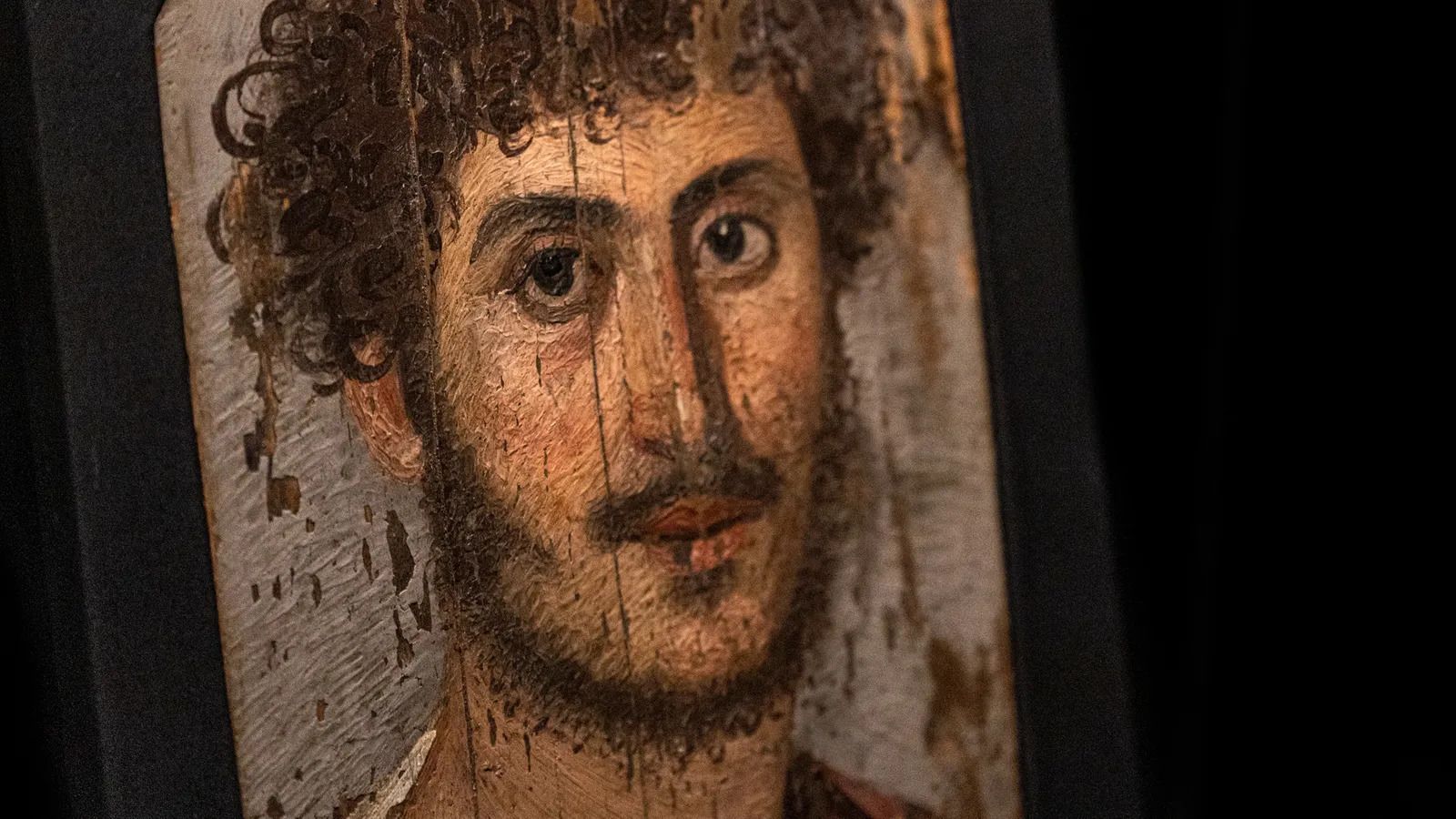 Faiyum portraits were flat painted images attached to the casings of mummies in the later Roman period
The show, seen by more than 2m visitors, offers undoubtedly compelling insights and speculation into the sex, age, health and even diet of six mummified people. "It is only through the study of the individuals' carefully preserved remains that we are able to further our understanding of the people who lived thousands of years ago," the curators, Marie Vandenbeusch and Daniel Antoine, have written.
One thing that their research does reveal is that there's often a gap between what the physical body was like in death, and the outward depiction on coverings, which feature idealised figures. This is most clearly seen in the case of mummified children, who were represented as adults – to allow them to live their best (after)life. For Price, this only supports the idea that mummies were less about celebrating the individual in death, and more about allowing them to transcend human frailty.
Lifelike mummy portraits – or are they?
While several of Manchester Museum's mummies perfectly fit the classic image we all have – with their gold and blue, heavy-eyed visages – the exhibition also features late-style ones that look very different. These feature remarkably lifelike painted portraits; you'd assume they were from Renaissance Italy, perhaps, not Ancient Egypt. They are astonishing – and likely to jolt many viewers with their surprisingly direct gaze. These are the Faiyum portraits: they were flat, 2D painted images on thin wood, that were attached or bound to the outer casings of some mummies in the Roman period (100-300AD), and also intended for display.
And they reflect another myth-busting fact – Ancient Egypt was not some high, mysterious, isolated culture, but a multicultural country. The mummies of the Graeco-Roman era often feature a "mish-mash of images", says Price. So, the show features a mummy labelled with a Greek name – Artemidorus – but featuring a Faiyum portrait, suggesting he may have been "a Roman elite person". And the casing is decorated with images of Egyptian gods, including Osiris, while stars decorating the shoulder of his casing reference Serapis – "a newly-minted god who seems to have been created to promote Egyptian-Greek cohesion," says Price. Why go for this Egyptian-Greek-Roman mash-up? "I suspect you are hedging your bets when you get to the pearly gates: let's appease all the gods!"
Imagine you go to the chapel, and there are 20 mummified people there, you want your mummified relative to attract the attention and prayers of passers-by – so maybe you use that painted technique – Christopher Price
When Flinders Petrie first found the mummies at Hawara he was dismissive of this incongruous multicultural style. But Victorian England soon went mad for the portrait mummies, in particular. Artists such as Holman Hunt and Laurence Alma-Tadema were influenced by an exhibition of them in 1888, and it's thought they even inspired Oscar Wilde to write The Picture Of Dorian Grey: his famous novel featuring a beautiful young man who, after his portrait is painted, never ages.
Of course, it's even more tempting to wonder about the real person beneath a Faiyum portrait – one can't help but assume they're a literal depiction of the deceased. But Price isn't having that either: he thinks these are also idealised depictions – the image of how the person might like to look for all eternity. It's true that the faces of the Faiyum portraits tend to be young, healthy, handsome – perhaps flatteringly so. "I think they are, at best, an idealised approximation of what the person looked like," says Price. "People would debate this I'm sure, but I think that they look like gods: images of divine-like beings."
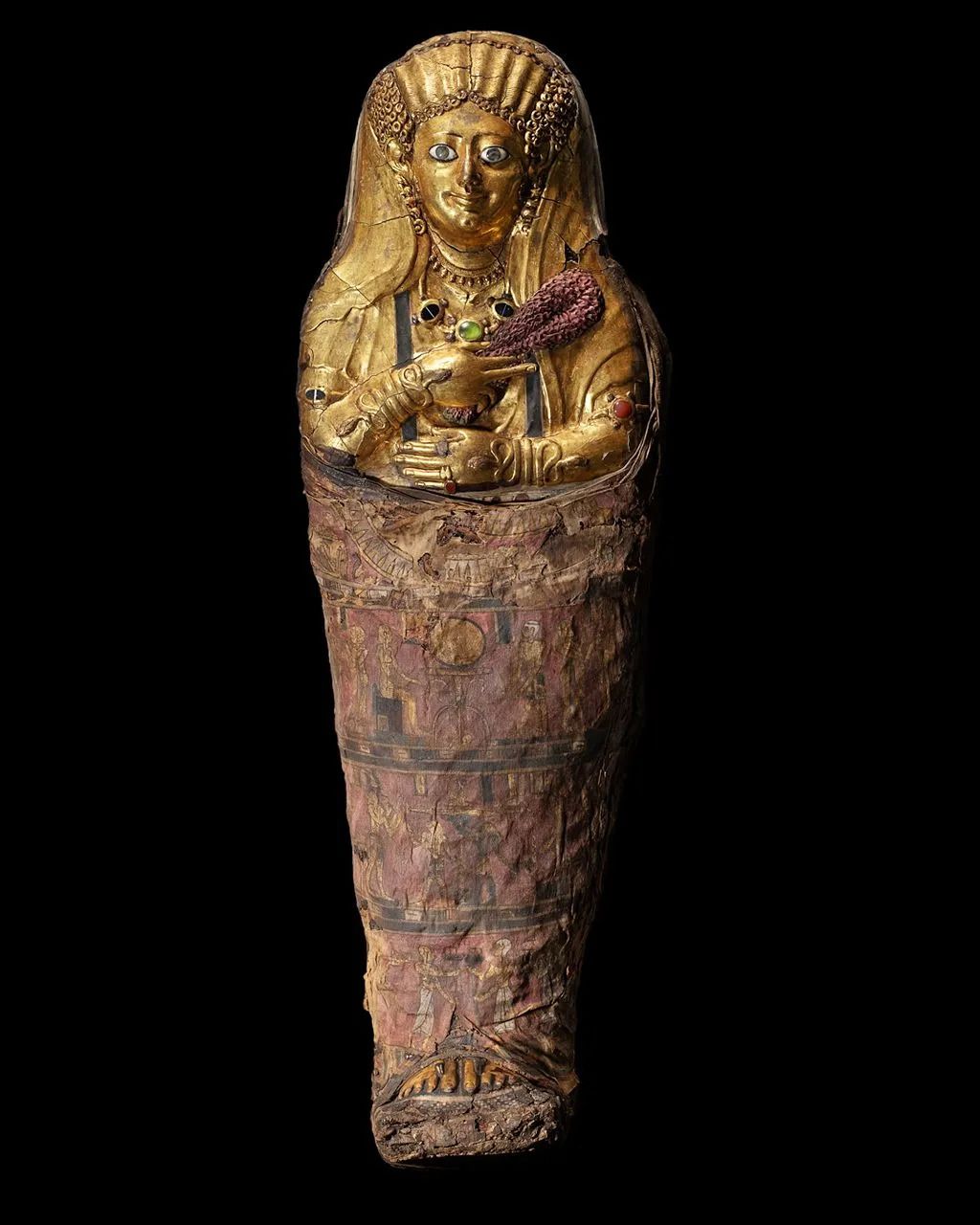 Mummified children were represented as adults, which Price believes
supports the idea that the mummies were intended to transcend their
human origins
Mummified children were represented as adults, which Price believes
supports the idea that the mummies were intended to transcend their
human origins
He points to a Faiyum portrait in their collection that shows a man with laurel leaves in his hair and a line of gold leaf between his lips. The hairstyles in the portraits seem to follow changing fashions set by the Roman Emperor and Empress – also considered divine figures. Maybe it's fashion; maybe it's a bid for eternal life.
Why does the style mutate so wildly, then, in the Graeco-Roman era – when both golden mummies and portrait mummies would have potentially been on display, side-by-side, at the same time? "I wonder if it's to get people's attention; in crude terms, clickbait," says Price. "Imagine you go to the chapel and there are 20 mummified people there, you want your mummified relative to attract the attention and prayers of passers-by – so maybe you use that painted technique, with its glint in the eyes…"
One thing, however, is surely true: the Ancient Egyptians probably weren't banking on us still paying attention to their mummified relatives, thousands of years later. But their mission to make them look remarkable – whether that's via a gold and lapis mask or a sharp-eyed portrait eyeballing you down the millennia – certainly continues to work. Whether we find ourselves more interested in their god-like images, or drawn to what we might discover about the bodies beneath, mummies continue to hold an incredible, glittering fascination.