Discovering Saudi Arabia's Hidden Treasures: Over 300 Caves and Geological Wonders
Over 300 caves have been discovered in Saudi Arabia's deserts, formed over millions of years due to the dissolution of limestone rocks from rain and floods.
These unique earth treasures come in various sizes, lengths, and types, including deep and superficial caves and those lying below the surface.
Mahmoud Al-Shanti, a senior geologist specializing in caves and "duhool" at the Saudi Geological Survey, is working to locate, explore, and study these natural wonders.
Considered a valuable national treasure, these caves attract explorers, researchers, and those interested in the field.
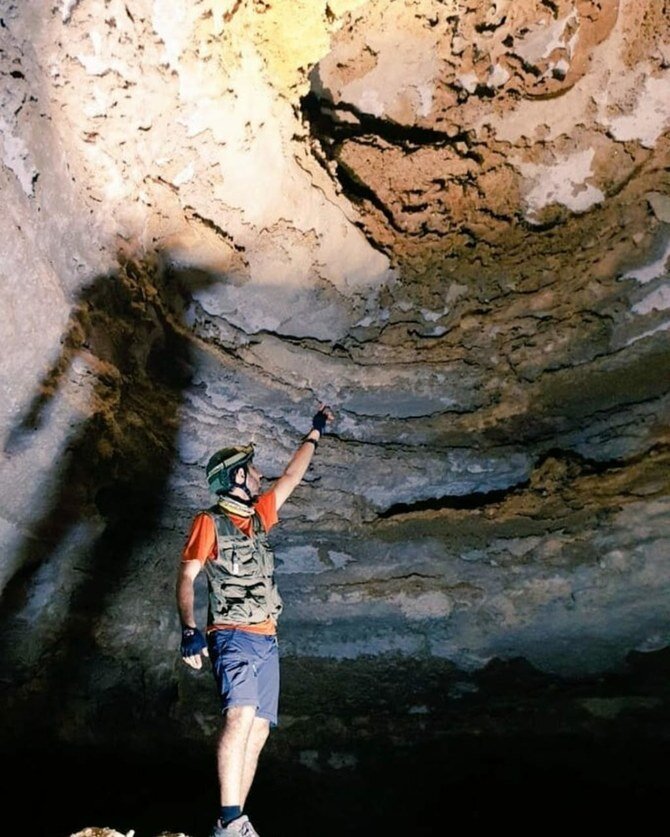
A volcanologist explained that when a volcano's lava stops flowing in the subsoil, the last remaining lava rushes forward, leaving behind a longitudinal vacuum.
This vacuum eventually hardens and creates a cave or volcanic tubular tunnel beneath the earth's surface.
Two examples of such cavities are the Ghar Al-Habashi cave in Harrat Al-Buqum and the Umm Jirsan cave in Harrat Khaybar, which is about 1,500 meters long.
He also mentioned "duhool" and limestone caves in various regions of Saudi Arabia.
Limestone caves are formed from hardened sedimentary rock composed of shells, remnants, and dead marine organisms.
Limestone rocks are formed from the accumulation of components, such as shells and other organic matter, underwater over millions of years.
The constant pressure and cohesion result in rigid and coherent rock layers.
Animals like weasels, wildcats, foxes, hyenas, wolves, and some mammals live in caves for shelter.
Tareq Mohammed, a young Saudi man specializing in cave tourism, emphasizes that geotourism includes not only beaches, forests, deserts, mountains, and hot springs but also caves.
Mohammed discussed the various types of caves found in Saudi Arabia, which include ice caves, marine caves, basaltic caves, limestone caves, and sand caves.
He explained that basaltic caves, also known as volcanic caves, are formed when lava freezes on the surface but remains liquid below ground.
An example of such a cave is Maker Al-Shaiheen, the longest basaltic cave in the Middle East, with a length of approximately 3,700 meters.
This cave is a long tunnel formed by volcanic lava that continues to flow until it reaches the end of the tube.
The Maker Al-Shaiheen cave in the west of Saudi Arabia's Madinah region has dimensions ranging from 4-12 meters in width and 1.5-12 meters in length.
Al-Qarah Mountain in the eastern region is an example of sandy mountains.
Limestone caves, found in the central region of the Kingdom, are formed by the dissolution of biodegradable rocks through rainwater and carbon dioxide.
Notable examples include the Al-Murabba (square) cave and the Tahaleb (algae) cave, which is characterized by moisture and algae at its entrance.
These caves are known for their unique limestone formations, such as stalactites and stalagmites.
The constant temperatures of 24-26 C make cave tourism a year-round activity in the Kingdom.
Firas Al-Hazabi, a cave tourism enthusiast, recommends that anyone visiting caves should be accompanied by a specialized guide.
He describes the experience as unique, filled with suspense and excitement, but notes that tourism to these caves is not common enough.
Mahmoud Al-Shanti, a senior geologist specializing in caves and "duhool" at the Saudi Geological Survey, is working to locate, explore, and study these natural wonders.
Considered a valuable national treasure, these caves attract explorers, researchers, and those interested in the field.
A volcanologist explained that when a volcano's lava stops flowing in the subsoil, the last remaining lava rushes forward, leaving behind a longitudinal vacuum.
This vacuum eventually hardens and creates a cave or volcanic tubular tunnel beneath the earth's surface.
Two examples of such cavities are the Ghar Al-Habashi cave in Harrat Al-Buqum and the Umm Jirsan cave in Harrat Khaybar, which is about 1,500 meters long.
He also mentioned "duhool" and limestone caves in various regions of Saudi Arabia.
Limestone caves are formed from hardened sedimentary rock composed of shells, remnants, and dead marine organisms.
Limestone rocks are formed from the accumulation of components, such as shells and other organic matter, underwater over millions of years.
The constant pressure and cohesion result in rigid and coherent rock layers.
Animals like weasels, wildcats, foxes, hyenas, wolves, and some mammals live in caves for shelter.
Tareq Mohammed, a young Saudi man specializing in cave tourism, emphasizes that geotourism includes not only beaches, forests, deserts, mountains, and hot springs but also caves.
Mohammed discussed the various types of caves found in Saudi Arabia, which include ice caves, marine caves, basaltic caves, limestone caves, and sand caves.
He explained that basaltic caves, also known as volcanic caves, are formed when lava freezes on the surface but remains liquid below ground.
An example of such a cave is Maker Al-Shaiheen, the longest basaltic cave in the Middle East, with a length of approximately 3,700 meters.
This cave is a long tunnel formed by volcanic lava that continues to flow until it reaches the end of the tube.
The Maker Al-Shaiheen cave in the west of Saudi Arabia's Madinah region has dimensions ranging from 4-12 meters in width and 1.5-12 meters in length.
Al-Qarah Mountain in the eastern region is an example of sandy mountains.
Limestone caves, found in the central region of the Kingdom, are formed by the dissolution of biodegradable rocks through rainwater and carbon dioxide.
Notable examples include the Al-Murabba (square) cave and the Tahaleb (algae) cave, which is characterized by moisture and algae at its entrance.
These caves are known for their unique limestone formations, such as stalactites and stalagmites.
The constant temperatures of 24-26 C make cave tourism a year-round activity in the Kingdom.
Firas Al-Hazabi, a cave tourism enthusiast, recommends that anyone visiting caves should be accompanied by a specialized guide.
He describes the experience as unique, filled with suspense and excitement, but notes that tourism to these caves is not common enough.
Translation:
Translated by AI