
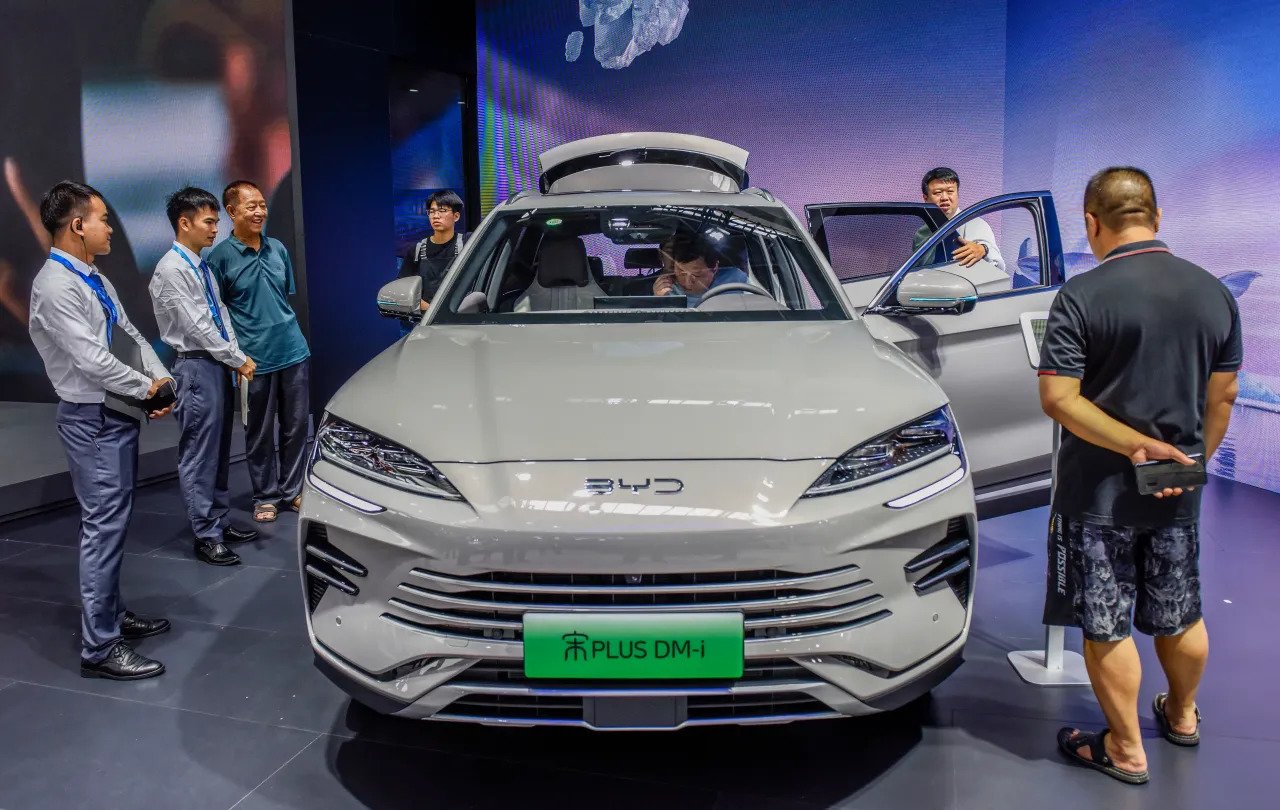
BYD Accelerates Saudi Expansion as China–U.S. EV Rivalry Moves Into the Gulf
Chinese automaker BYD is expanding its presence in Saudi Arabia, intensifying competition in a market recently entered by Tesla and reshaping the Gulf’s electric vehicle strategy
The expansion of electric vehicle manufacturing and sales in Saudi Arabia is being driven by SYSTEM-DRIVEN industrial policy shifts under the country’s broader economic diversification strategy, as global automakers compete for influence in a market that is rapidly becoming a strategic hub for mobility, energy transition, and foreign investment.
Chinese electric vehicle manufacturer BYD is increasing its push into Saudi Arabia through expanded sales, distribution planning, and potential local partnerships, positioning itself to capture early market share in a country that has only recently opened more aggressively to large-scale electric vehicle deployment.
This comes months after Tesla officially entered the Saudi market, marking a new phase of competition between the world’s two leading EV manufacturers in a region historically dominated by internal combustion engine vehicles.
What is confirmed is that Saudi Arabia is actively seeking to expand electric vehicle adoption as part of its long-term economic transformation agenda, which includes infrastructure development, urban mobility projects, and reduced dependence on oil-linked transportation systems.
The government’s investment strategy has included commitments to charging infrastructure and support for domestic manufacturing partnerships, aiming to make the kingdom a regional EV production and logistics hub.
BYD’s strategy in the kingdom reflects a broader global pattern in which Chinese EV manufacturers are expanding into emerging and strategically significant markets as competition intensifies in Europe and North America.
The company has grown rapidly into one of the world’s largest EV producers, leveraging vertical integration in battery production and cost-competitive models that appeal to price-sensitive and infrastructure-developing markets.
Tesla’s entry into Saudi Arabia introduced a premium Western EV brand into a market still in the early stages of electrification.
Its presence has helped normalize EV adoption among higher-income consumers and corporate fleets, while also increasing pressure on rival manufacturers to establish local partnerships, service networks, and pricing strategies adapted to regional conditions.
Saudi Arabia’s appeal as an EV market is tied not only to domestic demand but also to its geographic and logistical position.
The kingdom’s infrastructure investments and strategic location between Europe, Asia, and Africa make it a potential export and assembly hub for future electric vehicle supply chains, especially as global manufacturers seek to diversify production away from concentrated East Asian manufacturing centers.
The competitive dynamic between BYD and Tesla in Saudi Arabia is therefore not limited to retail sales.
It reflects a broader geopolitical and industrial competition over supply chains, battery technology influence, and regional industrial partnerships.
Chinese firms often emphasize rapid deployment and cost efficiency, while U.S.-based Tesla focuses on brand positioning and vertically integrated technology ecosystems.
The expansion also aligns with Saudi Arabia’s broader Vision 2030 framework, which prioritizes non-oil industries, advanced manufacturing, and technology-driven sectors.
Electric vehicles are a key component of this strategy, linking energy transition policy with industrial development goals and foreign investment attraction.
As both Chinese and American firms deepen their presence in the kingdom, Saudi Arabia is emerging as a neutral but highly competitive battleground for global EV leadership, where market access, infrastructure control, and long-term industrial partnerships will determine which companies shape the region’s transport future.
Chinese electric vehicle manufacturer BYD is increasing its push into Saudi Arabia through expanded sales, distribution planning, and potential local partnerships, positioning itself to capture early market share in a country that has only recently opened more aggressively to large-scale electric vehicle deployment.
This comes months after Tesla officially entered the Saudi market, marking a new phase of competition between the world’s two leading EV manufacturers in a region historically dominated by internal combustion engine vehicles.
What is confirmed is that Saudi Arabia is actively seeking to expand electric vehicle adoption as part of its long-term economic transformation agenda, which includes infrastructure development, urban mobility projects, and reduced dependence on oil-linked transportation systems.
The government’s investment strategy has included commitments to charging infrastructure and support for domestic manufacturing partnerships, aiming to make the kingdom a regional EV production and logistics hub.
BYD’s strategy in the kingdom reflects a broader global pattern in which Chinese EV manufacturers are expanding into emerging and strategically significant markets as competition intensifies in Europe and North America.
The company has grown rapidly into one of the world’s largest EV producers, leveraging vertical integration in battery production and cost-competitive models that appeal to price-sensitive and infrastructure-developing markets.
Tesla’s entry into Saudi Arabia introduced a premium Western EV brand into a market still in the early stages of electrification.
Its presence has helped normalize EV adoption among higher-income consumers and corporate fleets, while also increasing pressure on rival manufacturers to establish local partnerships, service networks, and pricing strategies adapted to regional conditions.
Saudi Arabia’s appeal as an EV market is tied not only to domestic demand but also to its geographic and logistical position.
The kingdom’s infrastructure investments and strategic location between Europe, Asia, and Africa make it a potential export and assembly hub for future electric vehicle supply chains, especially as global manufacturers seek to diversify production away from concentrated East Asian manufacturing centers.
The competitive dynamic between BYD and Tesla in Saudi Arabia is therefore not limited to retail sales.
It reflects a broader geopolitical and industrial competition over supply chains, battery technology influence, and regional industrial partnerships.
Chinese firms often emphasize rapid deployment and cost efficiency, while U.S.-based Tesla focuses on brand positioning and vertically integrated technology ecosystems.
The expansion also aligns with Saudi Arabia’s broader Vision 2030 framework, which prioritizes non-oil industries, advanced manufacturing, and technology-driven sectors.
Electric vehicles are a key component of this strategy, linking energy transition policy with industrial development goals and foreign investment attraction.
As both Chinese and American firms deepen their presence in the kingdom, Saudi Arabia is emerging as a neutral but highly competitive battleground for global EV leadership, where market access, infrastructure control, and long-term industrial partnerships will determine which companies shape the region’s transport future.