

What to know about Axiom Space, the company behind the first all-private mission to the ISS
They'll be riding on a SpaceX Falcon 9 rocket, and docking at the station via a SpaceX Dragon capsule, but don't get Axiom confused with Elon Musk's private spaceflight company. It serves a different purpose entirely. Axiom is less focused on building rockets than re-thinking the future of space stations.
The four crew members -- three paying passengers and a former NASA astronaut there to serve as commander -- taking part in the mission, dubbed Ax-1, will taxi to the ISS via SpaceX vehicles as part of the 10-day trip. Axiom has arranged with NASA for them to spend eight days aboard the orbiting laboratory managed by a team of international government-backed agencies. While on the ISS, the civilians are slated to assist with more than two dozen scientific experiments, as well as help pave the way for the development of Axiom's plans to build the first commercial space station.
Axiom, SpaceX and NASA announced Sunday evening that they are now targeting no earlier than Friday at 11:17 a.m. ET for the launch, which is set to lift off from NASA's Kennedy Space Center in Florida. If the launch goes as planned on Friday, docking of the SpaceX Dragon capsule to the station is scheduled for early Saturday morning. Those interested in watching the launch can tune in via NASA and Axiom Space's live coverage of the event on Friday morning.
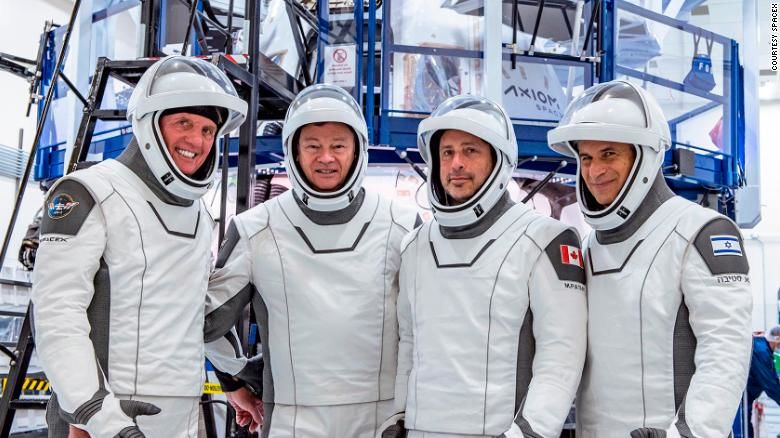 The Ax-1 Crew (left to right): Larry Connor, Michael López-Alegría, Mark Pathy, Michael López-Alegría and Eytan Stibbe.
The commander of the first-ever private astronaut mission to the ISS is Axiom's Michael López-Alegría, a veteran Spanish-American NASA astronaut with four previous spaceflights under his belt, and who now has the professional title of Vice President of Business Development for Axiom. He will be joined by three fee-paying crewmates -- Larry Connor of the United States, Eytan Stibbe of Israel and Mark Pathy of Canada -- who each dished out an estimated $55 million to Axiom in order to take the journey into orbit. (Axiom did not publicly disclose the specific financial details of the trip.)
Here is what you should know about the upcoming Axiom spaceflight, which comes as a handful of private companies are seeking to commercialize the space beyond our planet's surface.
What is Axiom Space?
Axiom Space, the Houston-based company overseeing the entire mission, does not build launch vehicles or rockets like some of the other players in the emerging private spaceflight industry such as Blue Origin, SpaceX and Virgin Galactic.
The company arranges so-called "private astronaut" missions to the ISS, which includes seventeen weeks of training and custom itineraries based on the individual goals of those wealthy enough to afford the trip. Ax-1 is the company's first of these planned trips to the ISS, and late last year NASA and Axiom announced Ax-2 is targeting to launch between fall 2022 and spring 2023. In addition to its human spaceflight services, Axiom also offers on its website opportunities for companies and individuals seeking to access space for research purposes.
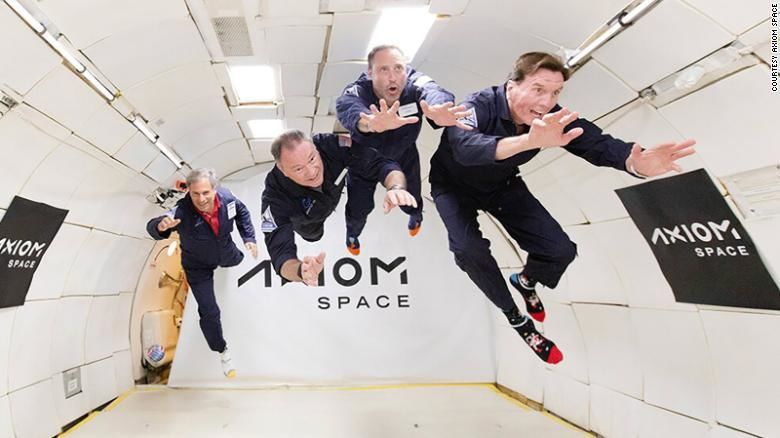 The Ax-1 Crew during Zero-G flight training.
NASA uses the term "private astronaut missions" to refer to "missions that are privately funded, fully commercial spaceflights on a commercial launch vehicle for the purpose of enabling tourism, outreach, commercial research, and approved commercial and marketing activities on the space station." Referring to ultra-wealthy thrill seekers with the title of "astronaut," however, has spurred heated debates over its definition online in recent years.
In January 2020, NASA selected Axiom to provide at least one habitable commercial module to be added to the ISS's Harmony node in 2024. Axiom said it has plans to have its module be ready to detach from the station by late 2028, and operate as the first building block of a private commercial space station.
Axiom's lofty plans to build the first private space station and pioneer the commercialization of low-Earth orbit are what it sees as setting itself apart from others in the budding private space industry. The company even touts the Ax-1 mission as "an important step toward Axiom's goal of constructing a private space station in low-Earth orbit that can serve as a global academic and commercial hub."
Building a commercial destination in low-Earth orbit
Axiom CEO Michael Suffredini, a 30-year veteran of NASA who served as the ISS program manager from 2005 to 2015, described Ax-1 during a pre-launch news conference last week as a "precursor mission" to the company's plans of eventually assembling and launching its fully commercial space station in orbit.
While Axiom is partnering with SpaceX to launch its private astronauts, "SpaceX is just a taxi," John Logsdon, a professor emeritus at George Washington University's Elliott School of International Affairs, told CNN Business of the role of Musk's company in this Axiom mission.
Logsdon, who was the founder and longtime director of GW's Space Policy Institute, added that he sees Axiom's inaugural private astronaut mission as "the first step in a process that could result in one or more private space stations doing a variety of things in low Earth orbit."
"We've had the International Space Station in orbit, with people aboard, since the year 2000," Logsdon added. "NASA says it will de-orbit it in 2030 or so and turn over the use of low-Earth orbit to the private sector."
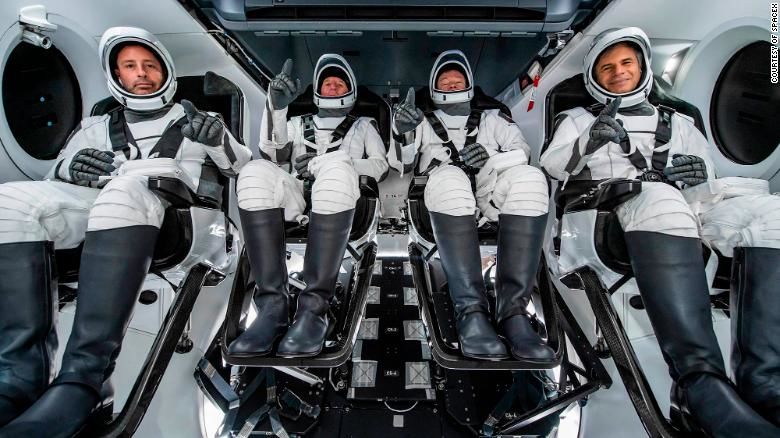 Ax-1 Crew (left to right) Mark Pathy, Larry Connor, Michael
López-Alegría and Eytan Stibbe in SpaceX Crew Dragon during training.
Ax-1 Crew (left to right) Mark Pathy, Larry Connor, Michael
López-Alegría and Eytan Stibbe in SpaceX Crew Dragon during training.
Axiom Space "is the first of the private sector ventures getting ready for that transition," according to Logsdon. He noted that construction of the first Axiom space station modules are already underway abroad, and it is slated to be shipped to Houston for final assembly next year ahead of their tentative launch in 2024.
"Like all entrepreneurial investments, there's a high risk of failure, but a possibility, a very real possibility, of success -- success in terms of economic payoffs from doing things in space," Logsdon said. In February 2021, Axiom said it raised some $130 million from investors, adding that the "new financing will accelerate the growth of Axiom's workforce and construction of its privately developed space station."
While private astronauts seeking to venture beyond Earth's surface can potentially strike a launch deal directly with SpaceX -- as billionaire Jared Isaacman did last year for his self-funded Inspiration4 mission -- Logsdon says the purpose of Axiom's mission is "fundamentally different than Inspiration4."
Logsdon said these trips are the first step in the process toward Axiom's primary goal of constructing a commercial space station to replace the ISS. The Inspiration4 mission was "basically a tourist ride," he added.
While it will likely be years before opportunities to visit a commercial space station become available to more than just the wealthy, Logsdon notes that a private space station could provide benefits beyond vacations for the rich -- especially if the ISS is retired as planned and scientists, engineers and other researchers look for alternatives.
The privatization of human spaceflight is becoming an increasingly crowded sector amid the rise of a handful of space tourism ventures. However, Axiom CEO Suffredini said during last Friday's news conference that he thinks the company's plan of creating the first commercial space station -- and launching the first commercial module to be added onto the ISS in 2024 -- gives the company a novel "business plan."
"We think it does put us in a good place relative to the competition, but we're happy that there are others that are going to help us grow the LEO [low-earth orbit] economy along the way," Suffredini said.
Logsdon said he has been watching human spaceflight launches for decades and was at the Kennedy Space Center for the Apollo 11 launch that put the first humans on the moon back in 1969. While the private sector's foray into spaceflight has muddled some of the initial intrigue, he said he's still planning on tuning in for the launch.