
UN Watchdog Finds Uranium Traces at Suspected Syrian Former Nuclear Site
The International Atomic Energy Agency's inspectors have discovered traces of uranium at a site in Syria believed to be part of a clandestine nuclear program by the former government.
The United Nations' nuclear watchdog announced on Tuesday that its inspectors had detected traces of uranium at a location in Syria, which is suspected to have been involved in an undeclared nuclear program operated by the previous administration.
Under the rule of former President Bashar Assad, Syria allegedly engaged in an extensive covert nuclear initiative, encompassing an undisclosed nuclear reactor built with North Korean assistance in eastern Deir Ezzor province.
The International Atomic Energy Agency's (IAEA) director-general, Rafael Mariano Grossi, had previously indicated to The Associated Press that some of Syria's activities 'were, in the judgment of the agency, probably related to nuclear weapons.' In an effort to investigate these allegations, IAEA inspectors visited and collected environmental samples from three sites purportedly linked to the Deir Ezzor facility last year.
Analysis of these samples revealed a significant presence of human-made uranium particles at one of the locations.
According to Fredrik Dahl, an IAEA spokesman, some of the identified uranium particles are consistent with the process of converting uranium ore concentrate into uranium oxide — a typical step in nuclear power reactor operations.
Grossi presented these findings to the IAEA's board of directors on Monday, detailing the latest developments concerning Syria's nuclear activities.
The Deir Ezzor site remained unknown to the public until 2007 when Israel, believed to be the only nuclear-armed state in the Middle East (though it has not officially acknowledged its program), launched airstrikes targeting and destroying the facility.
Subsequently, Syria demolished the site and failed to provide a comprehensive response to the IAEA's inquiries.
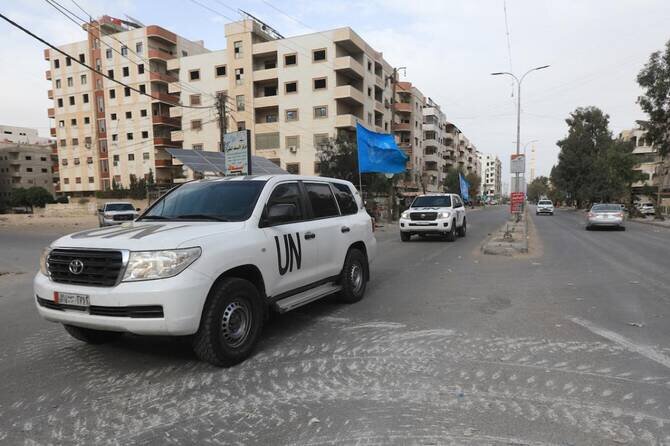
After visiting some sites of interest during Bashar Assad's tenure last year, an IAEA team was granted access once again by the new government led by interim President Ahmad Al-Sharaa following Assad's fall from power.
The inspectors collected further samples at the location where uranium traces were initially identified and will assess the results, as well as consider any necessary follow-up actions.
In a June interview with The Associated Press during a visit to Damascus, Grossi mentioned that Al-Sharaa had expressed an interest in pursuing nuclear energy for Syria's future.
Several other countries within the region are currently exploring nuclear energy options.
Grossi suggested that Syria may be considering small modular reactors, which are more cost-effective and easier to deploy compared to traditional large-scale reactors.
Furthermore, the IAEA has offered assistance to rebuild Syria's radiotherapy, nuclear medicine, and oncology infrastructure.
The country’s healthcare system has been significantly weakened by nearly 14 years of civil war.
Under the rule of former President Bashar Assad, Syria allegedly engaged in an extensive covert nuclear initiative, encompassing an undisclosed nuclear reactor built with North Korean assistance in eastern Deir Ezzor province.
The International Atomic Energy Agency's (IAEA) director-general, Rafael Mariano Grossi, had previously indicated to The Associated Press that some of Syria's activities 'were, in the judgment of the agency, probably related to nuclear weapons.' In an effort to investigate these allegations, IAEA inspectors visited and collected environmental samples from three sites purportedly linked to the Deir Ezzor facility last year.
Analysis of these samples revealed a significant presence of human-made uranium particles at one of the locations.
According to Fredrik Dahl, an IAEA spokesman, some of the identified uranium particles are consistent with the process of converting uranium ore concentrate into uranium oxide — a typical step in nuclear power reactor operations.
Grossi presented these findings to the IAEA's board of directors on Monday, detailing the latest developments concerning Syria's nuclear activities.
The Deir Ezzor site remained unknown to the public until 2007 when Israel, believed to be the only nuclear-armed state in the Middle East (though it has not officially acknowledged its program), launched airstrikes targeting and destroying the facility.
Subsequently, Syria demolished the site and failed to provide a comprehensive response to the IAEA's inquiries.
After visiting some sites of interest during Bashar Assad's tenure last year, an IAEA team was granted access once again by the new government led by interim President Ahmad Al-Sharaa following Assad's fall from power.
The inspectors collected further samples at the location where uranium traces were initially identified and will assess the results, as well as consider any necessary follow-up actions.
In a June interview with The Associated Press during a visit to Damascus, Grossi mentioned that Al-Sharaa had expressed an interest in pursuing nuclear energy for Syria's future.
Several other countries within the region are currently exploring nuclear energy options.
Grossi suggested that Syria may be considering small modular reactors, which are more cost-effective and easier to deploy compared to traditional large-scale reactors.
Furthermore, the IAEA has offered assistance to rebuild Syria's radiotherapy, nuclear medicine, and oncology infrastructure.
The country’s healthcare system has been significantly weakened by nearly 14 years of civil war.