
Saudi Aramco Launches Direct Air Capture Technology to Combat Emissions
The Kingdom’s first direct air capture test unit aims to enhance carbon capture and support national sustainability goals.
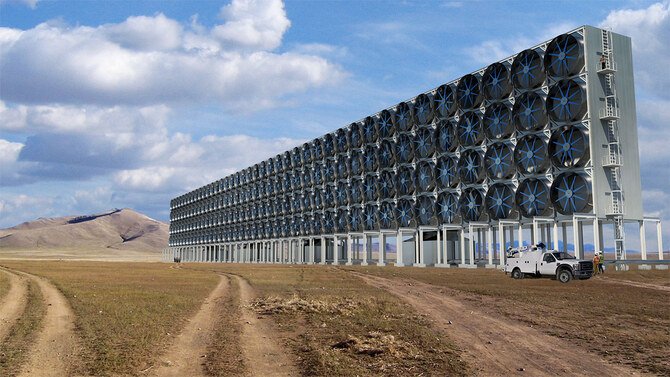
Saudi Aramco has introduced the Kingdom’s inaugural direct air capture (DAC) test unit, a significant advancement in its efforts to mitigate carbon emissions and promote carbon capture technology.
The new unit is designed to remove approximately 12 tonnes of carbon dioxide from the atmosphere annually, as stated by the company.
As the leading integrated energy and chemicals firm globally, Aramco noted that the pilot facility, developed in collaboration with Siemens Energy, is a critical milestone in boosting DAC capabilities.
Ali A. Al-Meshari, Aramco’s Senior Vice President of Technology Oversight and Coordination, remarked on the importance of direct carbon capture technologies in addressing greenhouse gas emissions, emphasizing their potential in sectors that are particularly challenging to decarbonize.
"The test facility launched by Aramco is a key step in our efforts to scale up viable DAC systems, for deployment in the Kingdom of Saudi Arabia and beyond.
In addition to helping address emissions, the CO2 extracted through this process can in turn be used to produce more sustainable chemicals and fuels,” Al-Meshari stated.
This initiative aligns with Saudi Arabia’s goal of reaching net-zero emissions by 2060, as part of a broader circular carbon economy strategy.
This approach emphasizes the principles of reducing, reusing, recycling, and removing carbon emissions.
The Saudi Green Initiative further supports this ambition, with a target to reduce carbon emissions by 278 million tonnes annually by 2030 and transition 50 percent of the country’s energy sources to renewables.
The project illustrates Aramco’s commitment to carbon capture as an essential element of its objective to achieve net-zero Scope 1 and Scope 2 greenhouse gas emissions across its wholly-owned and operated assets by 2050.
The new facility is positioned to serve as a testing ground for innovative CO2 capture materials tailored to Saudi Arabia’s environmental conditions, with plans to reduce costs and facilitate the faster adoption of DAC technologies in the region.
Part of a comprehensive circular carbon economy strategy, Aramco is exploring both emission source capture and atmospheric CO2 removal methods, integrating advanced technological solutions.
Additionally, Aramco’s DAC test facility launch follows a recent announcement of a shareholders' agreement with partners Linde and SLB to establish a carbon capture and storage hub in Jubail, which aims to capture 9 million tonnes of CO2 from three Aramco gas plants and other industrial emissions in its first phase.
In October 2023, Saudi Aramco also disclosed its partnerships with major international corporations to innovate emissions reduction strategies, focusing on lower-carbon hydrogen, direct air capture of CO2, and novel approaches to CO2 storage.
The new unit is designed to remove approximately 12 tonnes of carbon dioxide from the atmosphere annually, as stated by the company.
As the leading integrated energy and chemicals firm globally, Aramco noted that the pilot facility, developed in collaboration with Siemens Energy, is a critical milestone in boosting DAC capabilities.
Ali A. Al-Meshari, Aramco’s Senior Vice President of Technology Oversight and Coordination, remarked on the importance of direct carbon capture technologies in addressing greenhouse gas emissions, emphasizing their potential in sectors that are particularly challenging to decarbonize.
"The test facility launched by Aramco is a key step in our efforts to scale up viable DAC systems, for deployment in the Kingdom of Saudi Arabia and beyond.
In addition to helping address emissions, the CO2 extracted through this process can in turn be used to produce more sustainable chemicals and fuels,” Al-Meshari stated.
This initiative aligns with Saudi Arabia’s goal of reaching net-zero emissions by 2060, as part of a broader circular carbon economy strategy.
This approach emphasizes the principles of reducing, reusing, recycling, and removing carbon emissions.
The Saudi Green Initiative further supports this ambition, with a target to reduce carbon emissions by 278 million tonnes annually by 2030 and transition 50 percent of the country’s energy sources to renewables.
The project illustrates Aramco’s commitment to carbon capture as an essential element of its objective to achieve net-zero Scope 1 and Scope 2 greenhouse gas emissions across its wholly-owned and operated assets by 2050.
The new facility is positioned to serve as a testing ground for innovative CO2 capture materials tailored to Saudi Arabia’s environmental conditions, with plans to reduce costs and facilitate the faster adoption of DAC technologies in the region.
Part of a comprehensive circular carbon economy strategy, Aramco is exploring both emission source capture and atmospheric CO2 removal methods, integrating advanced technological solutions.
Additionally, Aramco’s DAC test facility launch follows a recent announcement of a shareholders' agreement with partners Linde and SLB to establish a carbon capture and storage hub in Jubail, which aims to capture 9 million tonnes of CO2 from three Aramco gas plants and other industrial emissions in its first phase.
In October 2023, Saudi Aramco also disclosed its partnerships with major international corporations to innovate emissions reduction strategies, focusing on lower-carbon hydrogen, direct air capture of CO2, and novel approaches to CO2 storage.