

‘My roof was stolen’: Syrian homes looted after gov’t recapture
Ghassan Hammoud, aged 46, fled Kafr Nabel in southern Idlib province in 2019, as government forces captured opposition-held areas in Syria’s northwest.
He left behind a house he had built a few years earlier, and now lives in a displacement camp near the Turkish border, where he works as a day labourer to look after his seven children and his niece.
Hammoud’s life is hard; he relies on loans for almost half of his monthly expenses and is struggling to cope with abysmal living conditions and cuts to humanitarian aid. But it is what he has recently discovered about his old home, left behind in Kafr Nabel, that upsets him the most.
“I discovered my roof was stolen,” he told Al Jazeera, still in disbelief. After hearing from friends and residents that Syrian government forces had looted abandoned homes, Hammoud had been looking at Google Maps on his phone to view his old neighbourhood.
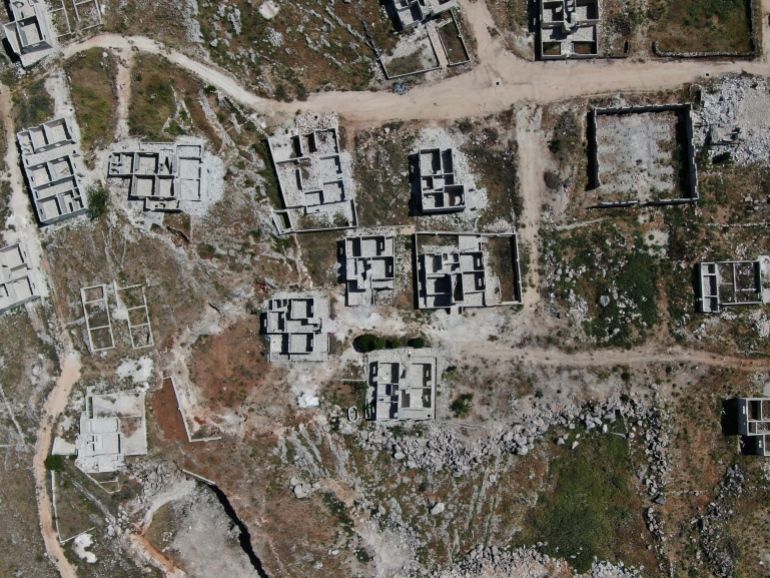 Photos taken from the air reveal countless homes in Kafr Nabel, including Ghassan Hammoud’s, with missing rooftops
“Then a friend of mine who passed by the area sent me a picture which confirmed everything,” Hammoud said, his voice trembling. “It makes my blood boil.”
And Hammoud said, he was not the only one with a missing roof.
“I don’t think I was personally targeted; they looted the entire neighbourhood!”
Displaced Syrians who fled southern Idlib and Hama province over the past four years, along with human rights monitors, have accused Syrian government forces of ransacking the ruins of their neighbourhoods and auctioning off agricultural land.
The Syrian government has not commented publicly on the accusations. Al Jazeera has reached out to the Syrian authorities for comment.
Drone pictures obtained by Al Jazeera show hundreds of houses and buildings in southern Idlib province stripped down to their concrete foundations. The glass windows, roofs, aluminium frames, and everything in between are all gone.
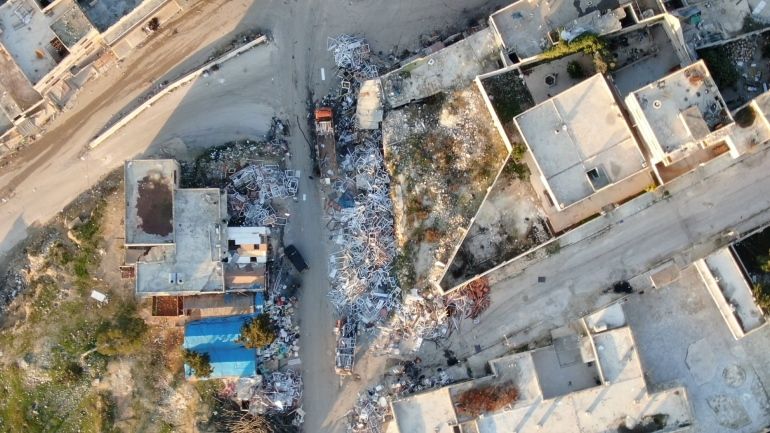 Drone picture shows what appear to be looted window frames and other materials taken from homes in Maarat Al Numan, in Idlib
Some of the drone pictures show pickup trucks near scrapheaps of metal and bricks. Watchdog groups and monitors have shared photos on the ground of government forces looting not just the foundations of the houses, but washing machines, refrigerators, furniture, and even steel pots and pans. Photos that surfaced on activist pages and on social media show construction workers drilling through homes and mosques to remove their roofs.
Groups such as the Syrian Observatory for Human Rights and the Syria Network for Human Rights say Syrian troops and state-backed militias have looted some three dozen towns and villages in southern Idlib over the past three years, after their residents fled northwards. Stolen goods are then sold online or in flea markets, according to the organisations.
Syria’s mass uprising in 2011 turned into a devastating war after Bashar al-Assad’s government in Damascus carried out a brutal crackdown on peaceful protesters. The armed rebellion spread, bringing in foreign proxies, complicating the conflict, which is now in its 12th year.
At least 350,000 people have been killed in the war according to the United Nations, with the true number thought to be much higher. Approximately half of Syria’s pre-war population is displaced, with millions forced to flee to neighbouring countries and other parts of the country. The UN estimates that 90 percent of Syria’s population lives in poverty.
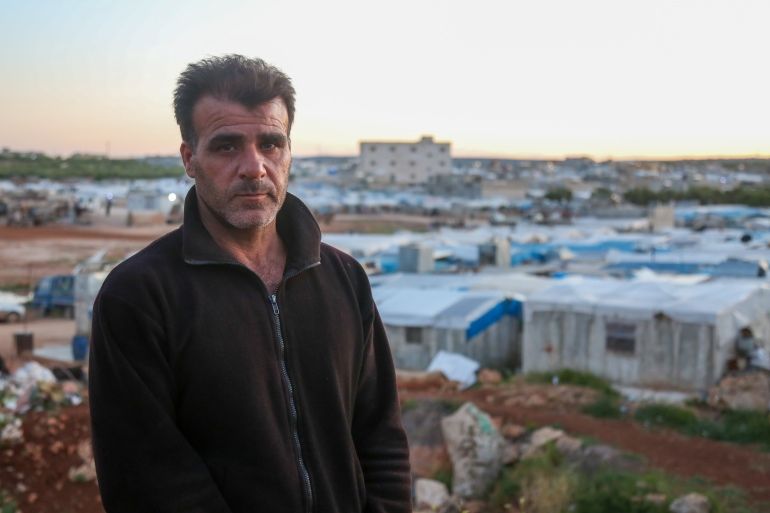 Ghassan Hammoud now lives in a camp for those internally displaced near
the Syrian border, while his home in Kafr Nabel has been looted
Ghassan Hammoud now lives in a camp for those internally displaced near
the Syrian border, while his home in Kafr Nabel has been looted
Confiscated loot
“We call them the army of looters,” 32 year-old journalist Ibrahim Al-Soueid told Al Jazeera, as he scrolled through footage he had collected from years of covering the conflict in northwest Syria with pro-opposition television station Syria TV.
Al-Soueid was born and raised in Kafr Nabel, and had to flee further north in 2019, when government forces reclaimed the area.
“It’s so overwhelming seeing your own home defiled,” he said. “I didn’t think we would never return when we left, so we kept most things, even the children’s toys.”
The house al-Soueid inherited from his grandfather and shared with other members of his family was partially damaged in an artillery strike, but he says the doors, windows, kitchen appliances, and aluminium framES he put in were all looted.
But it was the messages on Facebook that most upset him.
“People who say they live in Kafr Nabel and appear to be pro-regime in their profile would send me defamatory messages,” al-Soueid explained. “And they would send photos of my looted home with threatening messages written on the walls.”
Looters in military garb sprayed the word “confiscated” and al-Soueid’s name on his living room wall.
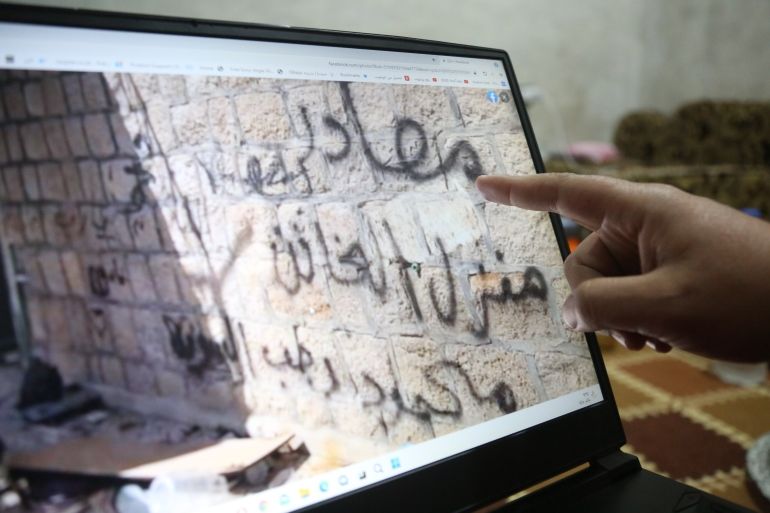 Al-Souied points to a picture of the wall of his old home with graffiti
daubed on it. In Arabic, the graffiti calls al-Souied a ‘traitor’, and
says that the home has been confiscated
Al-Souied points to a picture of the wall of his old home with graffiti
daubed on it. In Arabic, the graffiti calls al-Souied a ‘traitor’, and
says that the home has been confiscated
In another photo, they had tagged “the home of the traitor has been confiscated”. Another picture they sent the reporter was a truck loaded with his furniture.
The NGO Syrians for Truth and Justice has documented the widespread looting of homes by Syrian forces, and the auctioning off of farmland abandoned by owners who fled the area to the opposition-held enclave further north.
“This is especially happening across areas the regime reclaimed areas in Idlib and Hama provinces,” a researcher at the Syrians for Truth and Justice, who did not wish to be named, told Al Jazeera. “They’re taking advantage of the fact that nobody is in those areas.”
Local governments and security committees are publicly auctioning off land they claim to be vacant, but which the NGO says is in fact the property of residents who fled into opposition territory or out of the country.
Even people with their land deeds, other documents, and house keys have no way of claiming their property or land back.
“Sometimes the authorities will also argue that they took loans that they could not pay back, but many say they never took loans,” the organisation explained.
Experts and activists say that Syria’s government, struggling economically, has resorted to auctioning off property to generate revenue, while pro-government militias have sold valuable looted raw material from homes for profit.
Now, as the conflict in most of Syria subsides, President Bashar al-Assad has publicly stated that he wants refugees to return home, and the governments of neighbouring countries, hosting millions of Syrians, want the same.
But most displaced Syrians do not have much to return to, having lost not just their homes, but their livelihoods. Meanwhile, human rights organisations have documented returnees being arbitrarily detained, forcefully conscripted into the army, and a host of human rights abuses.
Even with no political solution on the horizon, and the leader he detests entrenched in power, al-Soueid hopes to be able to return to Kafr Nabel.
“We hope to go back to our towns and homes, and rebuild this home that they took from me,” a dejected al-Soueid said. “My home is just one of thousands of homes that was looted.”
But as he stared at a photo of his old living room now covered in graffiti, the reality is that may not happen any time soon.