

Houthis continue to recruit child soldiers, despite Yemen truce
In the video, a man stands in front of a blackboard in a full classroom, teaching the parts of an AK-47 rifle. He then hands it over to a boy, showing him how to cock it.
Other children crowd around, many of whom appear to be no older than 10, asking for their turn. The video, leaked online this month, provides a rare window into child soldier indoctrination by Yemen’s Iran-allied Houthi rebels. Residents confirmed to The Associated Press that it was filmed in recent weeks in Yemen’s rebel-held province of Amran, northwest of the capital, Sanaa.
Despite an agreement with the United Nations in April to halt the practice, the Houthis continue to recruit children into their military ranks to fight in the country’s grinding civil war, Houthi officials, aid workers and residents told the AP.
Two Houthi officials said the rebels recruited several hundred children including those as young as 10 over the past two months. Those children have been deployed to front lines, as part of a buildup of forces taking place during a UN-brokered truce, which has held for more than two months, one official said.
The officials, both hardliners within the Houthi movement, said they see nothing wrong with the practice, arguing that boys from 10 or 12 are considered men.
“Those are not children. They are true men who should defend their nation against the Saudi-American aggression, and defend the Islamic nation,” one of them said. The two spoke on the condition of anonymity to avoid friction with others among the Houthis.
The Houthis have used what they call “summer camps” to disseminate their religious ideology and to recruit boys to fight. Such camps take place in schools and mosques around the Houthi-held part of Yemen, which encompasses the north and centre of the country, including Sanaa.
2,000 child soldiers killed
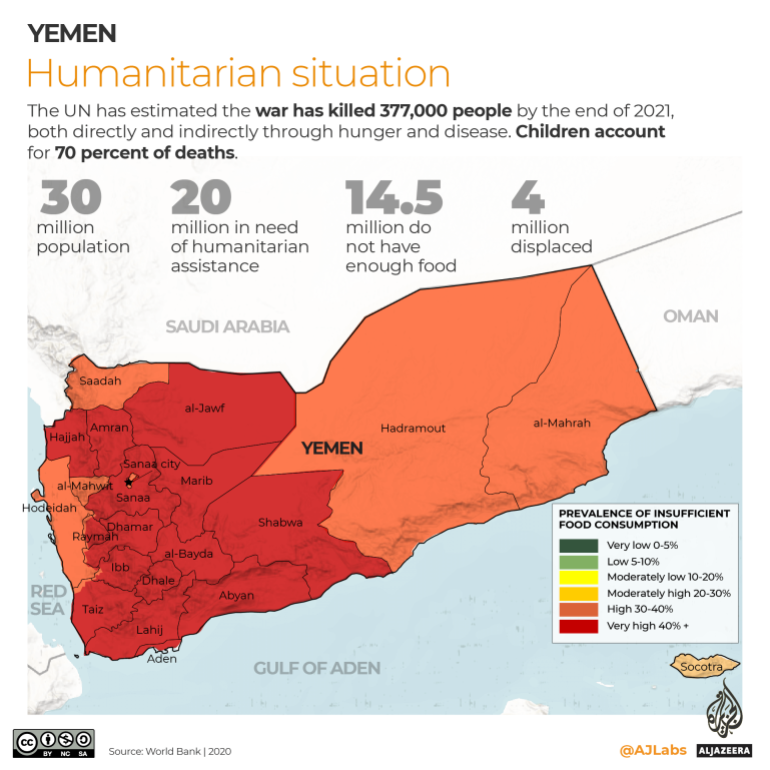
Yemen’s conflict erupted in 2014 when the Houthis descended from their northern enclave and took over Sanaa, forcing the internationally recognised government to flee to the south. A Saudi-led coalition entered the war in early 2015 to try to restore the government to power, waging a destructive air campaign and arming anti-Houthi forces.
The war has killed more than 150,000 people, including more than 14,500 civilians, and has plunged the country into near famine, creating one of the world’s worst humanitarian crises.
Child soldiers have been involved for years. Nearly 2,000 Houthi-recruited children were killed on the battlefield between January 2020 and May 2021, according to UN experts. Pro-government forces have also used child fighters but to a much lesser degree and have taken greater measures to halt the practice, according to UN and aid officials.
Overall, the UN says more than 10,200 children have been killed or maimed in the war, though it is unclear how many may have been combatants.
In April, the rebels signed what the UN children’s agency described as an “action plan” to end and prevent the practice. UN spokesman Stephane Dujarric said the rebels committed to identifying children in their ranks and releasing them within six months.
UNICEF and the Houthis did not respond to requests for comment on the continued recruitment since.
Four aid workers with three international organisations operating in rebel-held areas said they observed intensified Houthi efforts to recruit children in recent weeks. The Houthis’ ranks have been thinned because of battlefield losses, especially during a nearly two-year battle for the crucial city of Marib.
The aid workers spoke on condition of anonymity for fear of their safety and that their groups could be barred from working in Houthi-held territory.
They said the rebels have pressured families to send their children to camps where they learn how to handle weapons and plant mines, in return for services including food rations from international organisations.
One aid worker who operates in remote northern areas described watching children as young as 10 manning checkpoints along the road, with AK-47s hanging on their shoulders. Others are sent to the front line. He said children have returned wounded from fighting in Marib.
Thousands of fighters were killed in the battle for government-held Marib. The Houthi momentum towards the city was only stopped in late 2021 when government forces were bolstered by better-equipped fighters backed by the United Arab Emirates.
Poor families pressured
Abdel-Bari Taher, a Yemeni commentator and former head of the country’s Journalists’ Union, said that the Houthis are exploiting local customs, to the children’s and society’s detriment. Having or carrying a weapon is a tradition deeply rooted in Yemen, especially in rural and mountainous communities, he said.
“It is a source of pride and kind of manhood for the boys,” he said.
The Houthis also condition crucial food aid on children attending the training camps, some say.
Two residents in Amran province said Houthi representatives came to their homes in May and told them to prepare their children for camps at the end of the school year. The residents, who are farmers, spoke on condition of anonymity for fear of reprisals.
They said their five children, aged between 11 and 16, were taken in late May to the school where the video was taken. One father said he was told that if he did not send his children, his family would no longer receive food rations.
The UN panel of experts said earlier this year that the Houthis, a Zaidi Shia religious movement-turned-rebel militia, have a system to indoctrinate child soldiers, including using humanitarian aid to pressure families.
Children are taken first to centres for a month or more of religious courses. There, they are told they are joining a holy war against Jews and Christians and Arab countries that have succumbed to Western influence. Seven-year-olds are taught weapons cleaning and how to dodge rockets, the experts found.
The Houthis have in the past officially denied enlisting children to fight.
But they have also provided evidence to the contrary. A high-ranking Houthi, Mohammed al-Bukhaiti, posted a video in early June from a visit he paid to one of the camps in Dhamar province. It shows dozens of children in uniforms standing in a military-like formation and declaring allegiance to rebel movement’s top leader, Abdul-Malek al-Houthi.
“Soldiers of God,” they shout. “We are coming.”