

Ferdinand Marcos Jr set to triumph in Philippines presidential election
Ferdinand Marcos Jr, the son and namesake of the late dictator, has won a landslide presidential election victory, signalling an extraordinary rehabilitation for one of the country’s most notorious political families.
With more than 90% of an initial count concluded, Marcos Jr had almost 30 million votes, more than double the tally of his closest rival, the current vice-president, Leni Robredo, a former human rights lawyer.
Supporters dressed in red shirts, his campaign colour, gathered outside his camp’s headquarters in Mandaluyong City on Monday night, waving the flag of the Philippines as passing cars sounded their horns.
Marcos thanked volunteers and political leaders “that have cast their lot with us” in a late-night video message, but he stopped short of claiming victory. “Let’s wait until it’s very clear, until the count reaches 100%, then we can celebrate,” he said.
Marcos Jr, 64, ran with the slogan “Together we shall rise again”, invoking nostalgia for his father’s authoritarian regime, which the family and its supporters have portrayed as a golden era in a campaign fuelled by online disinformation as social media has been flooded with false stories that have swept aside the atrocities and corruption widespread during the period.
Such portrayals have horrified survivors of Marcos Sr’s brutal regime. Thousands of political opponents were tortured, arrested and disappeared under his rule, while as much as $10bn (£8bn) was plundered.
Marcos Sr was ousted in the People Power revolution in 1986, when the family was humiliatingly airlifted from the presidential palace by helicopter, and fled into exile.
Ever since, say analysts, the Marcoses have sought to rebrand themselves and regain their place in politics. “The disinformation infrastructure has been there for a long time. It’s not as if it just sprouted during this campaign. The Marcoses’ plan to reach the presidency has been in action for decades,” said Aries Arugay, a visiting fellow at the ISEAS-Yusof Ishak Institute, who is based in Manila.
Marcos Jr had maintained a clear lead over his opponents in surveys conducted in the run-up to the vote, with Robredo second. A former human rights lawyer who has advocated for marginalised groups, she campaigned on a promise of good governance and an end to corruption.
People began lining up to vote before polling centres opened at 6am local time (2300 BST) on Monday morning, and some waited more than four hours in the heat as malfunctioning voting machines caused delays. The vote followed three months of fierce campaigning, in which 2 million Robredo volunteers launched an unprecedented door-to-door campaign to try to win over voters and counter the onslaught of online disinformation.
Although Marcos Jr has denied the existence of any organised online campaign, he was the overwhelming beneficiary of false claims circulating on social media. The majority of disinformation was either designed to undermine Robredo’s reputation or enhance the images of the Marcoses, according to analysis by the fact-checking coalition Tsek.ph, which monitored disinformation in the run-up to the election.
Marcos Jr has avoided TV debates and challenging media interviews ahead of the election, and his campaign has been thin on policy detail.
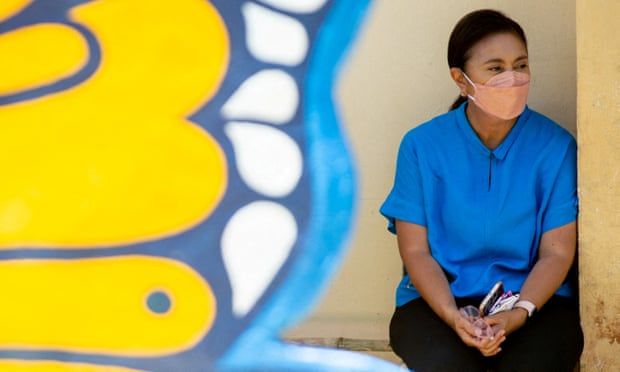 Leni Robredo queues as she waits to vote in Magarao, Camarines Sur.
Marcos Jr’s candidacy has polarised opinion, and some do not believe that the family has plundered state wealth, despite court rulings at home and abroad.
At Santa Ana elementary school, in a residential area of Manila, which opened as a polling station, Raquel Deguzaman, 59, said she supported Marcos Jr and did not believe the family was corrupt. “[Marcos Sr] was able to help the Philippines. He’s really good,” she said, adding that he had built infrastructure, including hospitals.
Jack Drescher, 58, who was on his way to vote, also cited the building of infrastructure under Marcos Sr as a reason for backing his son. He was not concerned about corruption within the family, he said. “He has a lot of gold so he won’t steal any money,” he said, adding that he had heard this from YouTube.
A myth claiming that the Marcoses own large stashes of gold has circulated online in various forms for years, including the claim that it will be given back to the people if the family is returned to power.
The idea that Marcos Sr’s rule was a prosperous and peaceful era appeals to a generation of voters who did not live through Marcos Sr’s martial law regime, including those who “may harbour deep dissatisfaction with the non-inclusive development of the past 30 or so years,” said Ronald Mendoza, dean of Manila’s Ateneo school of government.
Cleo Anne A Calimbahin, an associate professor of political science at De La Salle University Manila, said the results should not come as a surprise but that they were sobering. They reflected in part a growing frustration among the public with previous administrations.
“I think this is a response of a public that saw the lack of progress made since 1986,” said Calimbahin, referencing the People Power revolution that put the Philippines on the road to democracy, a process that has not been linear.
“Unfortunately, the reforms agenda and its inability to deliver since 1986 has made people even wary of reformist candidates,” said Calimbahin.
The election winner will take office on 30 June for a single six-year term.