
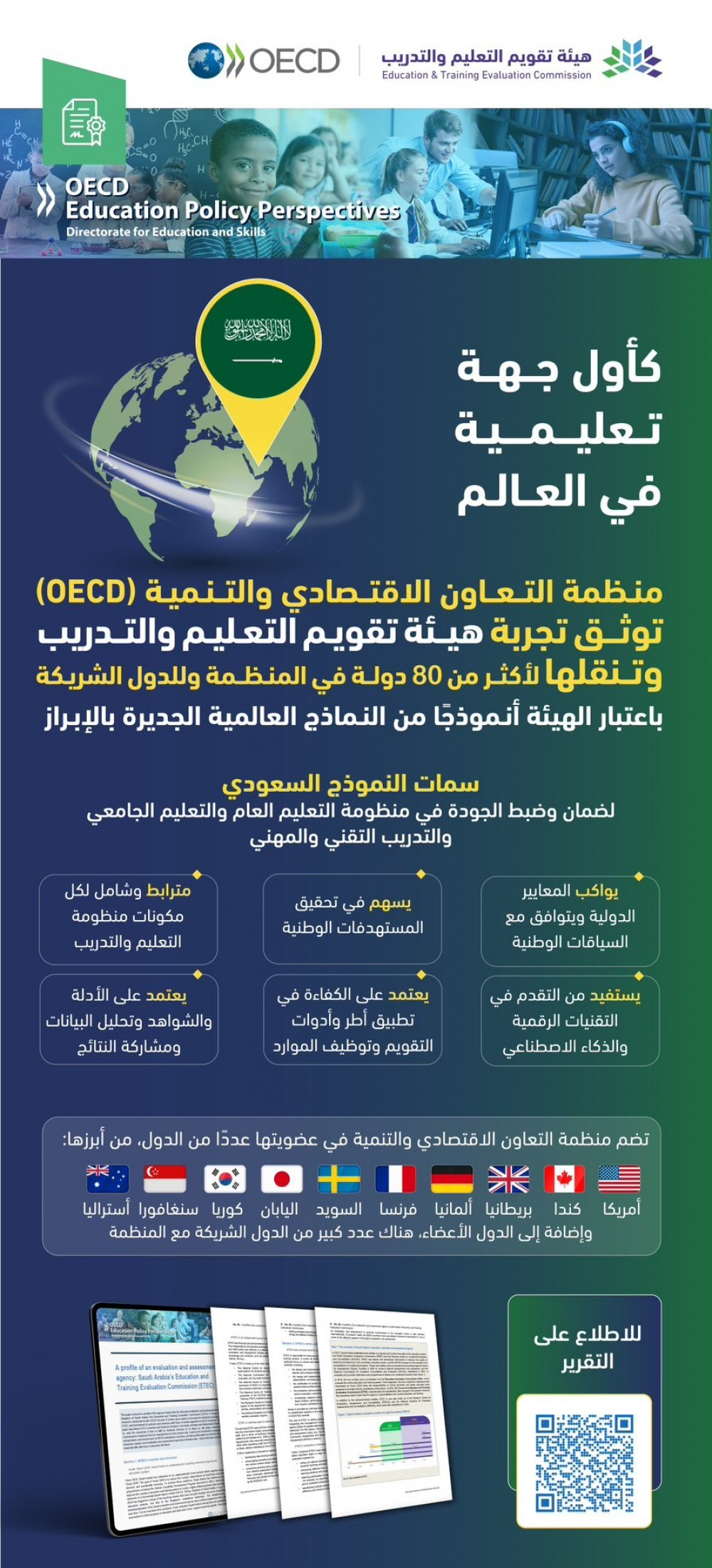

Saudi Arabia's Education and Training Evaluation Commission Becomes First Global Educational Entity Documented by OECD
In a groundbreaking move, the Organization for Economic Cooperation and Development (OECD) has officially documented the operational model of the Saudi Education and Training Evaluation Commission (ETEC), as revealed in a published report.
The ETEC is recognized for its role in overseeing the evaluation and quality assurance of general education, higher education, and technical and vocational training in the Kingdom of Saudi Arabia.
The objective of the report is to share the experiences and frameworks employed by ETEC with OECD member countries and partner states. OECD membership extends to 38 countries, including major nations from North America (the United States and Canada), Western and Northern Europe (the United Kingdom, Germany, France, and Sweden), and East Asia (Japan, Korea, Singapore, and Australia). More than 40 partner countries also participate in the organization’s educational assessment studies and issued reports.
The report entitled "An Overview of Entities Responsible for Evaluation: The Education and Training Evaluation Commission of Saudi Arabia," highlights the critical reforms initiated under Saudi Vision 2030. These reforms, which resulted in significant institutional changes within the education system, emphasized the establishment of a dedicated authority for education assessment as a pivotal element, showcasing Saudi Arabia's focus on evaluation as a means to improve education quality and consequently enhance the country's economic growth.
The OECD analyzes the development of ETEC from its inception and its evolution into a cohesive organization, where specialized centers collaborate in carrying out evaluation, measurement, and accreditation tasks efficiently. For example, the ETEC conducts the national NAFIS tests, designed by three of its centers Qiyas, Tamayaz, and the Research Center and implemented by Qiyas on the ground. Tamayaz uses the results for school evaluations, while the Research Center leverages the data in producing reports that support decision-making within the education and training system.
The report further explains that the Saudi evaluation model adopted by the ETEC aligns with international standards and practices, yet remains tailored to the Saudi context and priorities. The ETEC's approach to school evaluation, which mandates self-assessment to promote school-led improvements, aligns with international trends. Furthermore, the ETEC has adopted external evaluations considering the Saudi context and the necessity for schools to have external stimuli to advance performance.
The OECD report notes that ETEC provides a comprehensive picture of performance across the education and training system by sharing outcomes, indicators, and evaluation data. The ETEC has plans to make more information and reports available to stakeholders.
In pursuit of this, ETEC has developed data platforms, classifications, indicators, and performance scorecards to evaluate general, higher, and vocational education institutions. The ETEC issues a Performance Indicator for Schools (Tarateeb), and the 'Mostaqbalehom' smartphone app allows parents to access their children's test results and school evaluation outcomes, promoting attention to the quality of education and training institutions and encouraging ongoing improvement and development.
ETEC boasts financial and administrative independence and reports directly to the Saudi Council of Ministers. The report emphasizes the importance of separation between evaluation institutions and the education policy and execution bodies, a common practice among OECD countries. This ensures that evaluations are made primarily on specialized technical knowledge, evidence-based findings, and are not influenced by conflicts of interest.
The report concludes with the assertion that ETEC represents a valuable asset to the Saudi education and training system, shaping reform plans, and providing data to support improvement policies. ETEC monitors progress indicators towards outlined educational goals, addresses potential challenges, and advocates for the efficient use of resources.
ETEC operates based on a vision of cooperation and integration with national entities and institutions to establish a globally leading Saudi model for ensuring and controlling the quality of education and training in the Kingdom, contributing to the objectives of Saudi Vision 2030 and the Human Capacity Development Program's targets.
The objective of the report is to share the experiences and frameworks employed by ETEC with OECD member countries and partner states. OECD membership extends to 38 countries, including major nations from North America (the United States and Canada), Western and Northern Europe (the United Kingdom, Germany, France, and Sweden), and East Asia (Japan, Korea, Singapore, and Australia). More than 40 partner countries also participate in the organization’s educational assessment studies and issued reports.
The report entitled "An Overview of Entities Responsible for Evaluation: The Education and Training Evaluation Commission of Saudi Arabia," highlights the critical reforms initiated under Saudi Vision 2030. These reforms, which resulted in significant institutional changes within the education system, emphasized the establishment of a dedicated authority for education assessment as a pivotal element, showcasing Saudi Arabia's focus on evaluation as a means to improve education quality and consequently enhance the country's economic growth.
The OECD analyzes the development of ETEC from its inception and its evolution into a cohesive organization, where specialized centers collaborate in carrying out evaluation, measurement, and accreditation tasks efficiently. For example, the ETEC conducts the national NAFIS tests, designed by three of its centers Qiyas, Tamayaz, and the Research Center and implemented by Qiyas on the ground. Tamayaz uses the results for school evaluations, while the Research Center leverages the data in producing reports that support decision-making within the education and training system.
The report further explains that the Saudi evaluation model adopted by the ETEC aligns with international standards and practices, yet remains tailored to the Saudi context and priorities. The ETEC's approach to school evaluation, which mandates self-assessment to promote school-led improvements, aligns with international trends. Furthermore, the ETEC has adopted external evaluations considering the Saudi context and the necessity for schools to have external stimuli to advance performance.
The OECD report notes that ETEC provides a comprehensive picture of performance across the education and training system by sharing outcomes, indicators, and evaluation data. The ETEC has plans to make more information and reports available to stakeholders.
In pursuit of this, ETEC has developed data platforms, classifications, indicators, and performance scorecards to evaluate general, higher, and vocational education institutions. The ETEC issues a Performance Indicator for Schools (Tarateeb), and the 'Mostaqbalehom' smartphone app allows parents to access their children's test results and school evaluation outcomes, promoting attention to the quality of education and training institutions and encouraging ongoing improvement and development.
ETEC boasts financial and administrative independence and reports directly to the Saudi Council of Ministers. The report emphasizes the importance of separation between evaluation institutions and the education policy and execution bodies, a common practice among OECD countries. This ensures that evaluations are made primarily on specialized technical knowledge, evidence-based findings, and are not influenced by conflicts of interest.
The report concludes with the assertion that ETEC represents a valuable asset to the Saudi education and training system, shaping reform plans, and providing data to support improvement policies. ETEC monitors progress indicators towards outlined educational goals, addresses potential challenges, and advocates for the efficient use of resources.
ETEC operates based on a vision of cooperation and integration with national entities and institutions to establish a globally leading Saudi model for ensuring and controlling the quality of education and training in the Kingdom, contributing to the objectives of Saudi Vision 2030 and the Human Capacity Development Program's targets.