
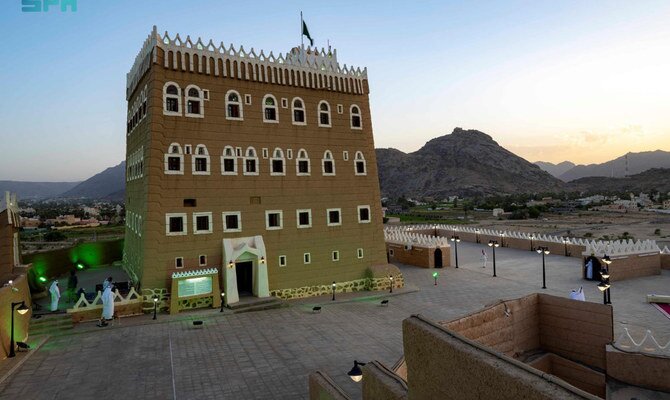
Al-Aan Palace: A 17th-Century Najran Landmark Showcasing Mudbrick Architecture and Strategic Defenses
Najran's Al-Aan Palace, a 1600s citadel in Najran, Saudi Arabia, is a significant architectural and cultural landmark.
Located on Al-Aan Mountain, it offers stunning views of the region's landscape.
Built during the 1600s, this mudbrick palace, also known as Saadan Palace, is a popular tourist attraction in Najran, known for its vibrant culture and rich history.
Saudi architect Khalid Al-Ojyan explained that the palace was constructed on top of the mountain for its inhabitants to enjoy the breathtaking view.
The unique design of Al-Aan Palace showcases Najrani architecture.
Al-Aan Palace is a historic landmark in Saudi Arabia, built in 1688 by Shaikh Mohammad Ismail and HibatuAllah Al-Makrami.
The palace is an example of Najani architecture, which utilizes natural materials such as mud and rocks to create mudbricks.
The palace's construction primarily used mudbricks, but also included other natural materials like wood from palm tree trunks, tamarisk and sidr trees, and palm fronds for the ceilings.
The circular and rectangular towers surrounding the palace were likely added for defensive purposes.
The text discusses the Al-Aan Palace, which features increasing window size on each of its four stories for both aesthetic and protective purposes.
The lower levels have smaller windows for security reasons.
The palace underwent renovation by the Saudi Heritage Commission five years ago, preserving its mudbrick construction, natural materials, and defensive features.
These elements offer visitors an authentic cultural experience and showcase Najran's ingenious building practices.
Built during the 1600s, this mudbrick palace, also known as Saadan Palace, is a popular tourist attraction in Najran, known for its vibrant culture and rich history.
Saudi architect Khalid Al-Ojyan explained that the palace was constructed on top of the mountain for its inhabitants to enjoy the breathtaking view.
The unique design of Al-Aan Palace showcases Najrani architecture.
Al-Aan Palace is a historic landmark in Saudi Arabia, built in 1688 by Shaikh Mohammad Ismail and HibatuAllah Al-Makrami.
The palace is an example of Najani architecture, which utilizes natural materials such as mud and rocks to create mudbricks.
The palace's construction primarily used mudbricks, but also included other natural materials like wood from palm tree trunks, tamarisk and sidr trees, and palm fronds for the ceilings.
The circular and rectangular towers surrounding the palace were likely added for defensive purposes.
The text discusses the Al-Aan Palace, which features increasing window size on each of its four stories for both aesthetic and protective purposes.
The lower levels have smaller windows for security reasons.
The palace underwent renovation by the Saudi Heritage Commission five years ago, preserving its mudbrick construction, natural materials, and defensive features.
These elements offer visitors an authentic cultural experience and showcase Najran's ingenious building practices.
Translation:
Translated by AI