‘Bizarre’ Hanbok Costumes at Saudi Korea Village Ignite Criticism Over Cultural Misuse
Videos of women in distorted traditional outfits at Riyadh’s Korea theme park spark backlash from social media and cultural observers
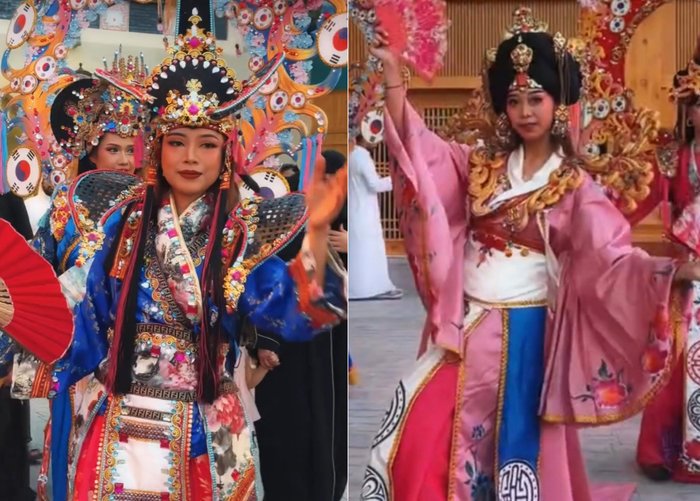
Shortly after the opening of a new Korea-themed village in Saudi Arabia, social media has erupted in criticism after videos emerged of women donning modified hanbok outfits described by many as “bizarre” and detached from traditional Korean dress codes.
The footage has stirred concern among Korean cultural observers and online communities over the distortion of a national symbol abroad.
The installation — designed to showcase Korean culture in Riyadh — was intended to celebrate Korean heritage.
But the viral clips show skirts and jackets styled in ways that deviate sharply from the conventional hanbok structure, prompting claims that the outfits misrepresent Korea’s traditional garments.
Some of the attire combine hanbok elements with unrelated costume features, leading critics to question whether the display honours or trivialises Korea’s cultural legacy.
The criticism is especially sharp among hanbok purists and heritage advocates who stress that the traditional garment embodies centuries-old aesthetic and social values.
They argue that distorting the silhouette — including altered proportions, unconventional accessories or mismatched layers — undermines the integrity of the hanbok and blurs the line between cultural celebration and caricature.
Supporters of the Saudi installation counter that the village is a commercial entertainment project rather than a museum-quality curation.
They say the versions of hanbok were chosen to appeal to a diverse, international audience, many of whom are unfamiliar with the subtleties of Korean cultural dress.
For them, the adaptation represents a form of “fusion” costume designed for spectacle rather than authenticity.
The debate reflects broader tensions experienced in South Korea itself, where the popularity of modernised or “fusion” hanbok — especially among tourists renting hanbok for palace visits — has frequently sparked discussion over cultural preservation vs.
commercial adaptation.
While some welcome evolving styles as a way to keep tradition alive, others warn that excessive alteration undermines the garment’s heritage value and risks erasing historical authenticity.
As the controversy unfolds, calls are growing for clearer guidelines and greater cultural sensitivity when traditional garments are displayed abroad.
For many observers, the episode serves as a reminder that cultural exchange requires respect as much as curiosity — and that symbols such as the hanbok deserve more careful stewardship than mere costume experimentation.
The footage has stirred concern among Korean cultural observers and online communities over the distortion of a national symbol abroad.
The installation — designed to showcase Korean culture in Riyadh — was intended to celebrate Korean heritage.
But the viral clips show skirts and jackets styled in ways that deviate sharply from the conventional hanbok structure, prompting claims that the outfits misrepresent Korea’s traditional garments.
Some of the attire combine hanbok elements with unrelated costume features, leading critics to question whether the display honours or trivialises Korea’s cultural legacy.
The criticism is especially sharp among hanbok purists and heritage advocates who stress that the traditional garment embodies centuries-old aesthetic and social values.
They argue that distorting the silhouette — including altered proportions, unconventional accessories or mismatched layers — undermines the integrity of the hanbok and blurs the line between cultural celebration and caricature.
Supporters of the Saudi installation counter that the village is a commercial entertainment project rather than a museum-quality curation.
They say the versions of hanbok were chosen to appeal to a diverse, international audience, many of whom are unfamiliar with the subtleties of Korean cultural dress.
For them, the adaptation represents a form of “fusion” costume designed for spectacle rather than authenticity.
The debate reflects broader tensions experienced in South Korea itself, where the popularity of modernised or “fusion” hanbok — especially among tourists renting hanbok for palace visits — has frequently sparked discussion over cultural preservation vs.
commercial adaptation.
While some welcome evolving styles as a way to keep tradition alive, others warn that excessive alteration undermines the garment’s heritage value and risks erasing historical authenticity.
As the controversy unfolds, calls are growing for clearer guidelines and greater cultural sensitivity when traditional garments are displayed abroad.
For many observers, the episode serves as a reminder that cultural exchange requires respect as much as curiosity — and that symbols such as the hanbok deserve more careful stewardship than mere costume experimentation.